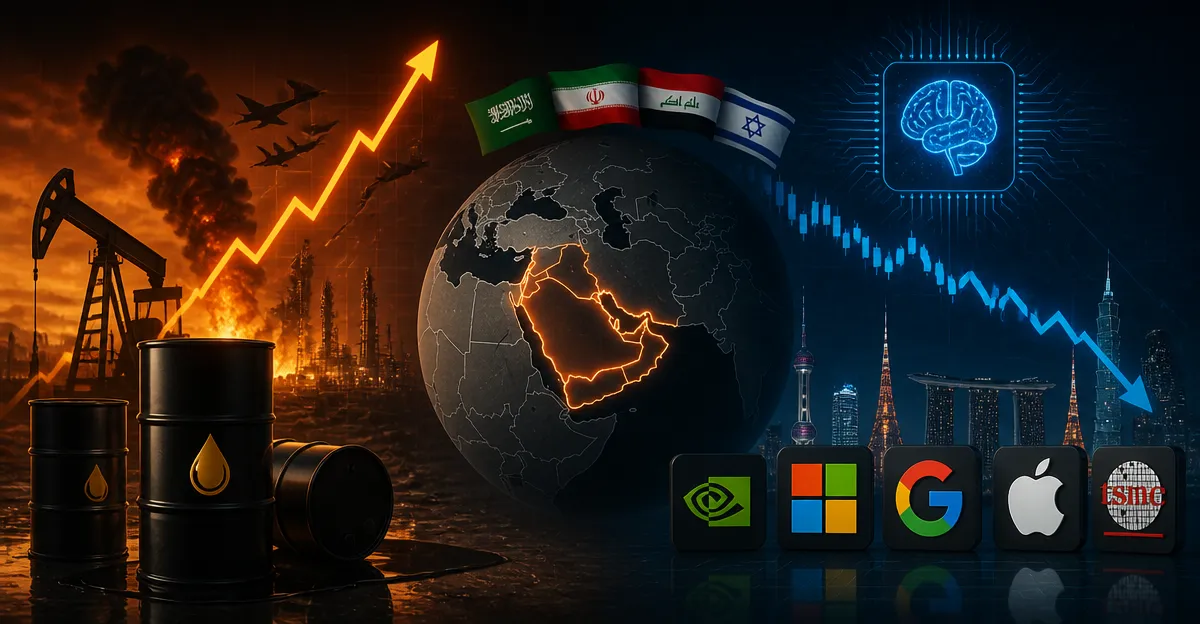
July 14, 2026, (Inside AI) — Oil prices surged on Tuesday as military clashes escalated in the Middle East, while Asian stock markets retreated, dragged down by a sharp sell-off in artificial intelligence shares.
Brent crude rose to just over $84 a barrel after a nearly 10% leap on Monday. U.S. benchmark West Texas Intermediate gained 1.4% to $79.20 a barrel. The spike follows reports of intensified fighting and competing claims by the U.S. and Iran over control of the Strait of Hormuz, a critical chokepoint for global oil shipments.
The disruption has kept tankers from transiting the waterway, choking off crude deliveries from the Persian Gulf. President Donald Trump said Washington was “reinstating” a blockade on Iran in the strait, and the U.S. launched fresh strikes. The standoff injects deep uncertainty into supply forecasts, though prices remain far below the wartime peak of nearly $120 a barrel.
In Asia, the Nikkei 225 fell 1% to 66,574.96, and South Korea’s Kospi dropped 3.2% to 6,589.37. The Shanghai Composite lost 0.8% to 3,884.32, even as China reported a 27% jump in June exports year-on-year, fueled by AI-driven demand for chips and tech. Hong Kong’s Hang Seng edged up 0.1% to 24,230.46, while Australia’s S&P/ASX 200 shed 0.5% to 8,767.00.
On Monday, Wall Street’s S&P 500 fell 0.8%, the Dow slipped 0.3%, and the Nasdaq sank 1.6%. AI chip stocks led the retreat. Micron Technology tumbled 4.4%, trimming its year-to-date gain to 243.1%. Nvidia, the most valuable stock on Wall Street, dropped 3.5%, exerting the heaviest drag on the S&P 500.
Investor anxiety is mounting that AI stock valuations have become detached from reality. The sell-off reflects fears that demand may not sustain if AI fails to deliver the expected profit and productivity surge. This week’s parade of bank earnings—including Bank of America, Citigroup, JPMorgan Chase, Goldman Sachs, and Wells Fargo—will test whether corporate profits can justify lofty market levels.
Analysts forecast S&P 500 companies will report 23.6% earnings growth from a year earlier, according to FactSet. That would mark the second straight quarter above 20%. But with indexes near records, any disappointment could deepen the rout.
Higher oil prices add another layer of risk. Costlier energy feeds inflation, potentially forcing the Federal Reserve to raise interest rates. That would cool the economy and pressure investment prices across the board. In currency markets, the dollar slipped to 162.34 yen, and the euro rose to $1.1391.
The Strait of Hormuz standoff is not merely a geopolitical flashpoint; it is a direct threat to the global energy supply chain. About 20% of the world’s oil passes through the strait. Any prolonged blockage could send prices spiraling and reignite inflation just as central banks were gaining confidence. For AI stocks, the timing is brutal. The sector was already under scrutiny after a historic rally, and now faces a double blow from rising input costs and tighter monetary policy expectations.
This convergence of oil shocks and AI skepticism marks a pivotal moment. If earnings fail to impress, the AI trade could unwind further, dragging broader markets with it. For now, all eyes are on the strait and the boardrooms.