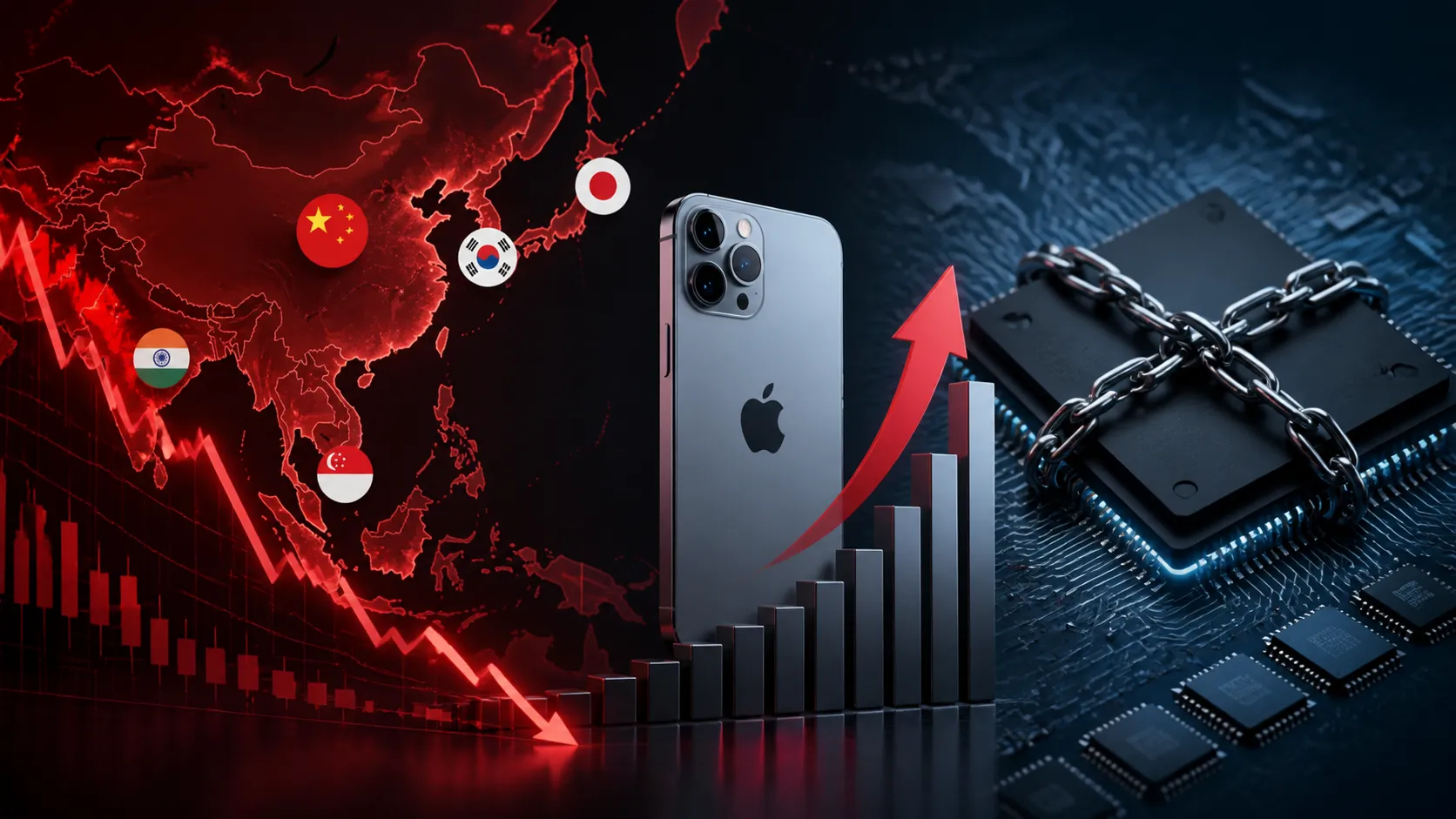
June 26, 2026, (Inside AI) — Asian stock markets plunged up to 6% on Friday, driven by Apple’s 20% price hike on iPads and MacBooks and South Korea’s proposal to tax unrealized equity gains. The sell-off hammered AI and chip-related stocks, with South Korea’s Kospi index tumbling 5.8% and briefly triggering an 8% circuit breaker for the second time this week.
Japan’s Nikkei 225 fell 4.2%, led by a 12.5% plunge in Softbank. Taiwan’s Taiex dropped 3.6%. Both markets are dominated by semiconductor firms: TSMC makes up 40% of the Taiex, while Samsung and SK Hynix account for over 50% of the Kospi. The rout followed a 0.5% overnight dip in the Nasdaq Composite, where Apple shares sank over 6% and Dell lost 5.5%.
Apple’s Thursday announcement cited surging chip costs from the global AI boom. The company said it had absorbed increases but could no longer avoid passing them on. Hours later, Xbox announced its second price hike within a year, raising costs up to 25%. The moves confirm a deepening “RAMageddon” shortage as manufacturers prioritize high-bandwidth memory for AI data centers, slashing output of consumer device chips.
The AI Chip Crunch Hits Consumers
Apple’s statement was unusually blunt: “We have never seen a component price increase this much, this quickly. We have shielded our customers from these increases so far, but we have now reached a point where we need to begin raising prices on a number of products, including today’s increases for iPad and Mac.”
The shortage stems from a strategic pivot by memory giants SK Hynix, Samsung, and Micron. They have shifted production to high-margin HBM chips for AI servers, starving the consumer electronics supply chain. This has forced HP, Dell, and ASUS to hike prices in recent months. One research head told Inside AI: “Apple’s price hikes likely confirmed that the chip shortage is not likely to go away anytime soon. If a company like Apple with big balance sheets cannot absorb the high costs, the entire industry will be forced to keep increasing prices. And that will eventually lead to lower margins and subdued volumes with some part of their customer bases being priced out of new products.”
In Asia, SK Hynix shares plunged over 8%, while TSMC and Samsung fell 2-5%. The sell-off reflects fears that even dominant chipmakers face demand destruction if end-user prices climb too high. The Kospi had already lost 10% on Tuesday—dubbed “Bloody Tuesday”—after South Korea proposed taxing unrealized gains on stocks and real estate.
Tax Fears Compound the Sell-Off
The tax proposal, introduced Tuesday, would treat paper profits as taxable income, forcing investors to sell assets to cover liabilities. Foreign institutional investors pulled between $4 billion and $6 billion from South Korean equities amid the uncertainty. Sumit Pokharna, vice president at Kotak Securities, warned: “People will start dumping (South Korean equities) the moment they realise they have to pay taxes on unrealised gains. It is not practically possible.”
Pokharna added that leveraged investors would be forced to liquidate holdings, accelerating a downward spiral. The proposal adds a policy risk layer to an already fragile AI rally. Japanese and Taiwanese markets, while spared the tax shock, remain vulnerable to global chip supply dynamics and Apple’s demand signal.
Indian markets were closed Friday for Muharram, avoiding the immediate fallout. But the global ripple effects of Apple’s move and South Korea’s fiscal experiment are far from over. As AI infrastructure consumes an ever-larger share of chip output, consumer electronics may face a prolonged era of scarcity and rising prices—testing the limits of tech demand worldwide.