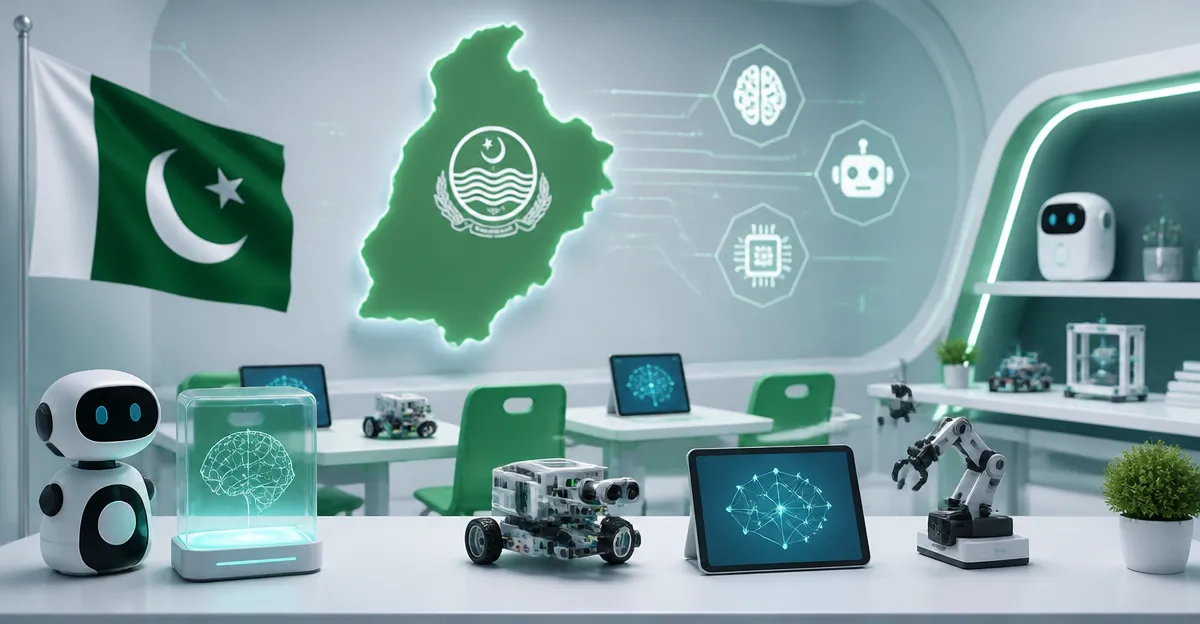
July 10, 2026, (Inside AI) — The Punjab Curriculum and Textbook Board has granted final approval to introduce artificial intelligence as a subject for students up to class five. Dedicated AI labs will be established in all primary schools across the province.
The curriculum will be implemented starting in the 2027-28 academic year. This decision marks a significant departure from traditional primary education in Pakistan, embedding computational thinking at the earliest stages of formal schooling.
The board confirmed that the AI curriculum has cleared all regulatory hurdles. Officials stated that the rollout will begin with the next academic session, making AI a regular part of the syllabus for young learners. This move positions Punjab as one of the first regions globally to mandate AI education at the primary level.
Inside the Classroom: What Punjab’s Youngest Learners Will Study
While full details of the syllabus remain under wraps, early indications suggest a focus on foundational concepts. Students will likely explore pattern recognition, simple algorithms, and the ethical use of technology. The approach mirrors global trends where AI literacy is treated like basic mathematics or science.
The dedicated AI labs will be central to this effort. Each primary school will receive equipment and resources to support hands-on learning. This infrastructure investment signals a long-term commitment beyond textbook theory.
A spokesperson for the board noted that the curriculum is designed to be age-appropriate. Young children will not be coding complex neural networks. Instead, they will learn how machines perceive the world and make decisions. This aligns with research from the MIT Media Lab, which advocates for teaching AI concepts through play and experimentation.
However, the plan faces practical hurdles. Many primary schools in rural Punjab lack basic electricity and internet connectivity. Deploying AI labs in such settings will require massive infrastructure upgrades. The government has not yet disclosed the budget or timeline for this logistical challenge.
A Global Race with Local Realities
Punjab’s initiative echoes similar programs in China and Singapore, where AI education starts early. But those nations have robust digital ecosystems. Pakistan’s educational landscape is marked by resource disparities and teacher shortages. Training thousands of primary school teachers in AI will be a monumental task.
Critics argue that without proper execution, the program could widen the digital divide. Urban schools may thrive with new labs, while rural counterparts struggle. The board has not yet outlined a teacher training framework, raising questions about readiness.
Despite these concerns, the move has garnered support from education reformers. They see it as a necessary step to prepare children for a future dominated by automation. A recent World Economic Forum report predicts that 65% of today’s primary school children will work in jobs that don’t yet exist.
The curriculum’s approval comes after years of pilot projects in select private schools. Those trials showed that children as young as six could grasp basic AI concepts. The board used this data to shape the final syllabus, ensuring it meets cognitive development milestones.
Implementation will be phased. The first batch of AI labs will likely appear in district headquarters, then expand to tehsil and village levels. The government aims to complete the rollout by 2029, though delays are common in large-scale educational reforms.
This initiative also intersects with Pakistan’s broader digital transformation agenda. The Ministry of Information Technology has been pushing for AI integration across sectors. Primary education is now a key pillar of that strategy, aiming to build a future workforce fluent in AI.
As the 2027-28 academic year approaches, all eyes will be on Punjab’s ability to turn policy into practice. Success could set a precedent for other provinces. Failure might reinforce skepticism about top-down educational reforms in developing nations.