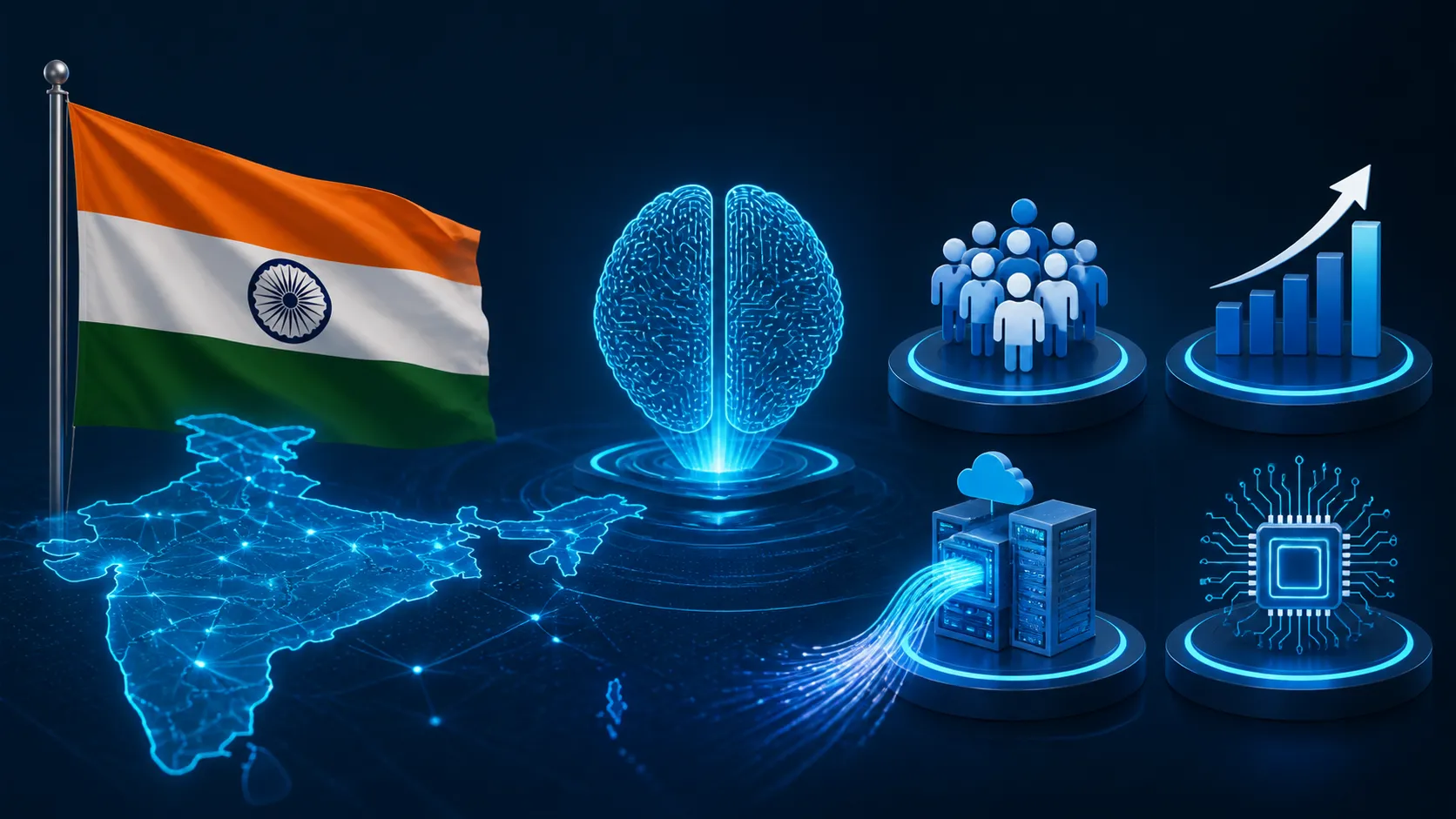
June 30, 2026, (Inside AI) — India is positioned to become a defining force in the artificial intelligence era, leveraging four strategic advantages that few nations can match: a deep pool of technical talent, a forward-leaning regulatory stance, massive infrastructure investments, and a fast-expanding renewable energy base. These assets, combined with the country’s scale and digital public infrastructure experience, could shift India from a supplier of data and talent to a core node in the global AI value chain.
The global AI landscape is transforming at a pace without precedent. According to the Stanford AI Index, the cost of querying a model at GPT-3.5 level performance plummeted from $20 per million tokens in November 2022 to just $0.07 by October 2024—a 280-fold collapse in 18 months. On the SWE-bench, which measures real-world software engineering ability, AI systems improved from solving 4.4% of problems in 2023 to 71.7% in 2024. By 2025, 88% of surveyed organizations reported using AI in at least one business function, up from 55% two years prior (McKinsey). Generative AI reached 53% population adoption in three years, outpacing the personal computer and internet at similar stages.
This structural fall in the cost of intelligence forces every government and institution to rethink assumptions. For India, the critical question is whether it can capture value from this transformation or merely supply inputs for others’ success. Nearly 90% of notable frontier models in 2024 originated from the US, per Stanford, while India contributes vast digital exhaust, linguistic diversity, and human context. Without sovereign compute, data architecture, and model capacity, much of that value accrues abroad.
The Four Pillars of India’s AI Advantage
India’s first advantage is talent. The country ranks first in AI skill penetration at 2.8 times the global average, ahead of the US and Germany. Talent concentration has risen sharply as global capability centers, startups, and major firms build AI teams domestically. India is moving from a back office to a principal operating theater for AI.
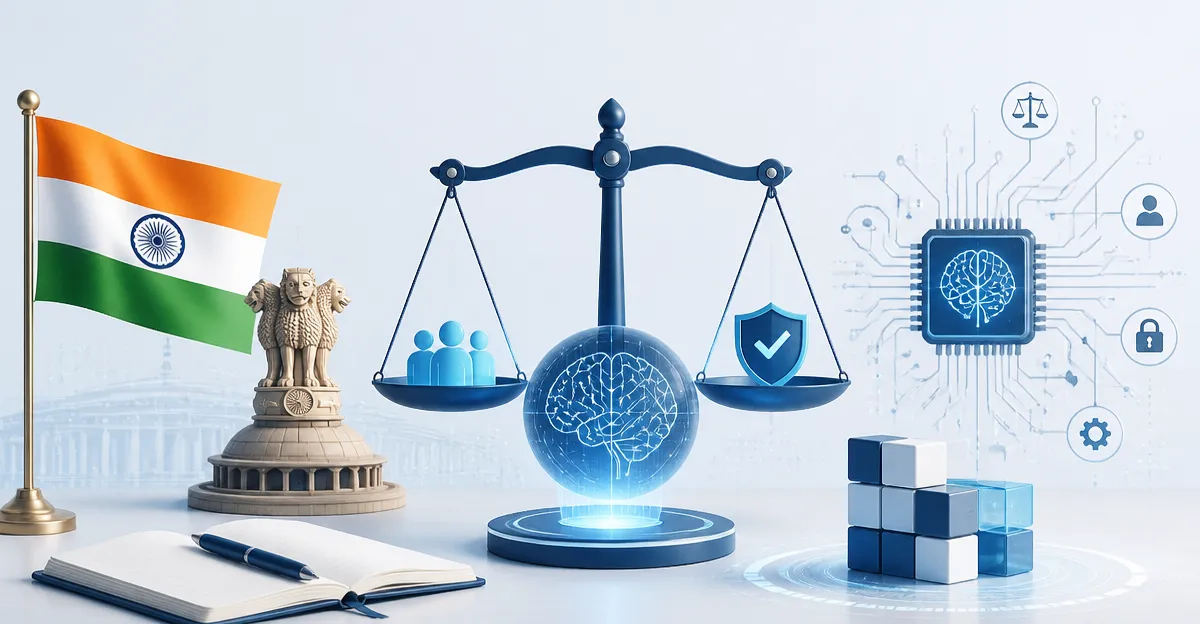
Second, regulatory openness. India has chosen a feather-touch approach, with frameworks like the RBI Regulatory Sandbox, IFSCA innovation frameworks, and the IndiaAI Mission’s principles-based guidelines. This build-first, govern-later philosophy avoids rigid ex ante controls that can delay deployment and raise costs, potentially giving India a competitive edge in fast-moving sectors.
Third, infrastructure. A massive build-out of data centers, semiconductors, and cloud capacity is underway. Private investment in data centers alone has crossed $160 billion, with $70 billion already underway and $90 billion in announced projects. Google’s $15 billion AI hub in Visakhapatnam, Microsoft’s $17.5 billion cloud and AI commitment, and Reliance’s multi-gigawatt plans in Jamnagar illustrate the scale. On semiconductors, Tata’s Dholera facility, Micron’s Sanand investment, and SiCSem’s Odisha fab are laying a domestic chip ecosystem. The IndiaAI Mission is making compute accessible to startups and researchers.
Fourth, energy. Data centers need reliable, round-the-clock power, making energy policy central to AI competitiveness. India added a record 55.3 gigawatts of non-fossil capacity in FY 2025-26, taking total non-fossil installed capacity to 283.46 gigawatts by March 31, 2026. Solar tariffs have fallen dramatically, strengthening India’s case as a location for clean-powered AI infrastructure. Data centers can become anchor demand for renewable energy, storage, and grid modernization, creating a symbiotic cycle.
From Interdependence to Indispensability
No single country controls the entire AI value chain. Advanced lithography comes from the Netherlands, chip fabrication is concentrated in Taiwan and South Korea, energy is local, and talent is globally distributed. India is indispensable due to its scale, linguistic diversity, and lived complexity. The idea of one nation monopolizing AI is strategically false; what matters is becoming an indispensable node in an interdependent system.
India has a credible claim to that role. It combines affordable clean energy, world-class talent, a massive data universe, a multilingual user base, and proven Digital Public Infrastructure like Aadhaar, UPI, and ONDC. The next step is applying that philosophy to AI through shared sovereign compute, high-quality public datasets, multilingual models, and open infrastructure. This is crucial for inclusion across 1.4 billion people. An AI system that works only in English and metros is not Indian. The real prize is population-scale intelligence—models that work in Tamil, Marathi, Bengali, and Bhojpuri, for farmers and primary health centers as much as for global corporations.
Enterprise must shift from endless pilots to scaled deployment. The next phase belongs to institutions that combine AI adoption with governance, accountability, and execution discipline. History shows first movers don’t always win: ARPANET laid the internet’s foundations, but the World Wide Web made it accessible; Clive Sinclair built the first mass-market home computer, but IBM, Apple, and Microsoft defined the era. Winners build durable ecosystems when technology becomes broadly usable. India still has that window, but it won’t stay open forever. To capitalize, India must build sovereign compute, widen access to intelligence, align AI with clean energy, design for the bottom of the pyramid, and integrate AI into credit, agriculture, health, and public services at population scale. If it does, India will not be a peripheral player—it can be one of the countries that defines the AI age.