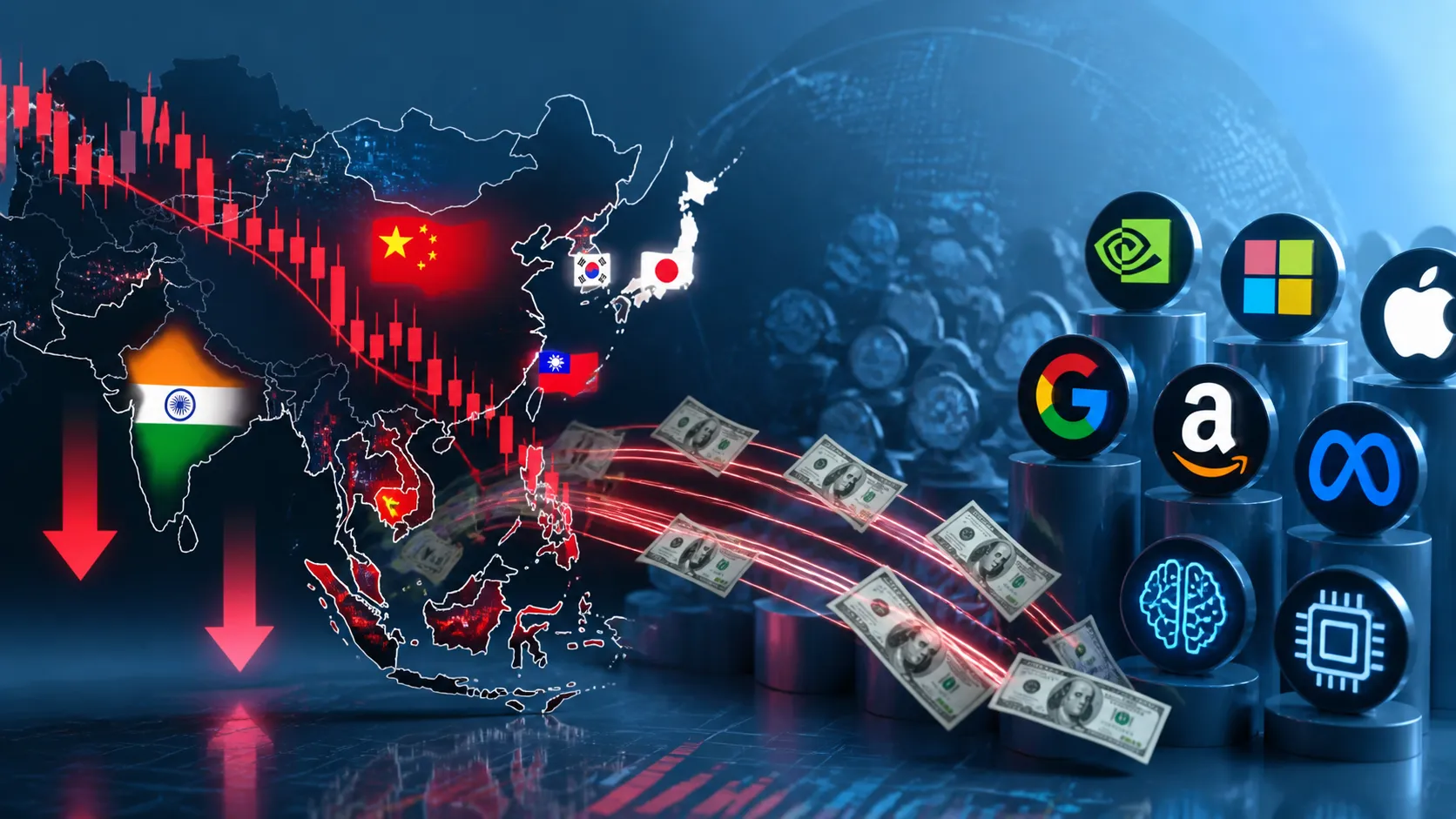
July 1, 2026, (Inside AI) — Foreign investors dumped Asian equities at a record pace in the first half of 2026, pulling a net $137.36 billion from seven key markets, according to LSEG data. South Korea and Taiwan, epicenters of the AI-driven chip boom, suffered the steepest outflows at $70.8 billion and $29.6 billion respectively.
The exodus marks the fastest six-month withdrawal since records began in 2010. It underscores how the blistering rally in AI-linked stocks forced fund managers to trim winners and rebalance portfolios. The KOSPI nearly doubled, while Taiwan’s benchmark surged 62%.
Yet the gains concentrated in three chipmakers: TSMC, Samsung, and SK Hynix. Their growing index weight pushed investors to cut exposure and hunt for cheaper alternatives. The selling was not a broad flight from risk but a strategic pivot.
“Markets in Asia, there’s only two markets and one sector that’s outperforming, so at the end of the day, you have to get your balance right,” said Joshua Crabb, head of Asia-Pacific equities at Robeco.
Read: South Korea Kospi Plunges 10% as Global AI Stock Exuberance Falters
In June alone, foreigners offloaded $27.08 billion in regional equities. South Korea saw $12.63 billion in outflows, Taiwan $8 billion, and India $5.91 billion. Data from Bank of New York Mellon revealed mutual funds sold $7.50 billion of Korean shares, pension funds $4.35 billion, and hedge funds $1.87 billion.
BNY analysis pointed to rebalancing and profit-taking by long-only funds, not a rejection of South Korea’s market. The moves align with currency hedging and benchmark adjustments to limit concentration risk.
The selling raises questions about whether the AI rally’s strongest phase has ended. Demand for AI infrastructure persists, but caution grew after steep gains in semiconductor and memory stocks. Investors now probe deeper into the supply chain for value.
Crabb noted Southeast Asia remains “very, very cheap” with structural tailwinds, though near-term conviction is mixed. Kerry Craig, global market strategist at J.P. Morgan Asset Management, said investors are reassessing tech exposure while eyeing defense, renewables, and diversification.
Record outflows do not guarantee a swift return to regional laggards. Much capital may be hedged, repatriated, or redeployed outside Asia. Still, a valuation reset could lure foreigners back if AI fundamentals hold.
The data covers South Korea, Taiwan, India, Indonesia, Thailand, Vietnam, and the Philippines. It excludes China, where regulatory and economic headwinds complicate the picture. The concentration in AI winners mirrors global trends, where a handful of tech giants dominate indexes.
Read: South Korean Chip Stocks Plunge as AI Boom Fears Rattle Markets
Historical parallels exist: the dot-com bubble saw similar crowding before a sharp correction. However, today’s AI demand is underpinned by tangible infrastructure spending. The risk is that any slowdown in AI investment could disproportionately hit these markets.
For now, the outflows signal a maturing bull run, not its demise. Fund managers are locking in profits and seeking the next opportunity. The question is whether Asia’s AI laggards can deliver the growth to attract that capital back.