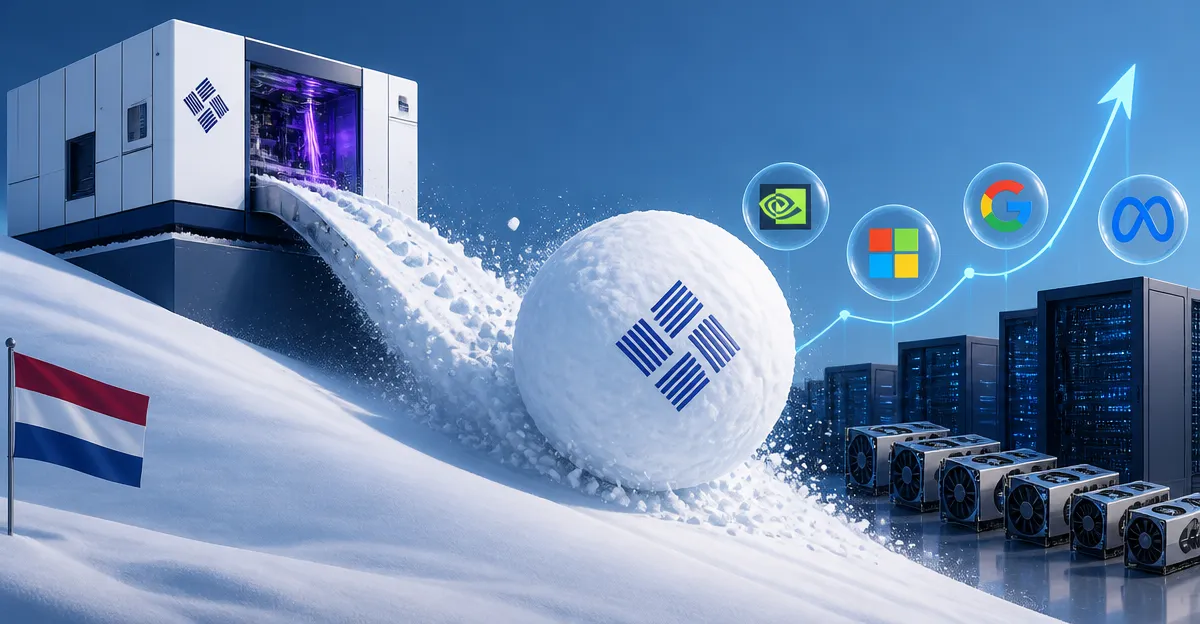
July 15, 2026, (Inside AI) — Dutch chip-equipment titan ASML Holding NV lifted its full-year financial outlook on Tuesday, propelled by surging orders from artificial intelligence chipmakers. The company now projects net sales between €43 billion and €45 billion for 2026, with gross margins in the 54% to 56% range. This upgrade follows a second quarter where revenue hit €9.3 billion, comfortably beating analyst consensus of €8.8 billion, and gross margin reached 54%, ahead of its earlier 51% to 52% guidance.
The results underscore how AI demand is reshaping the semiconductor supply chain. ASML’s extreme ultraviolet (EUV) lithography machines are essential for producing the most advanced logic and memory chips used in AI accelerators from Nvidia and AMD. With AI capex showing no signs of slowing, ASML’s order book has swelled, pushing its market capitalization to around €624 billion.
In a move to address persistent supply concerns, ASML announced plans to expand manufacturing capacity for its low-NA EUV systems by 30% in 2027, with the same increase possible in 2028. This expansion directly targets fears that ASML has become a bottleneck in the AI hardware pipeline. Each high-NA EUV tool costs over $350 million and takes months to build and install, so boosting output is a multi-year engineering challenge.
Chief Executive Officer Christophe Fouquet now faces a delicate balancing act. While near-term demand is robust, the cyclical nature of the semiconductor industry looms. Historically, chip equipment booms have been followed by sharp downturns. ASML’s own history shows that after the 2021-2022 supply crunch, growth moderated. The key question is whether the current AI investment cycle will follow the same pattern or represent a structural shift.
Read: AI Trade Wobbles: Chip Stocks Slide Globally as Investors Question Capex Sustainability
Some analysts argue that AI’s compute requirements are insatiable, driven by scaling laws that demand ever-larger models and datasets. If true, ASML’s growth could be sustained for years. Others point to potential efficiency gains through algorithmic improvements or novel architectures that could reduce the need for leading-edge chips. The tension between these views will define ASML’s trajectory beyond 2028.
ASML’s capacity expansion also carries geopolitical weight. The company’s EUV technology is subject to export controls, particularly concerning China. While the current guidance focuses on non-China demand, any easing or tightening of restrictions could materially impact sales. For now, ASML’s non-China backlog is strong enough to absorb the capacity increase.
Investors reacted positively, sending shares up roughly 4% in early trading. Yet the stock already trades at a premium, reflecting high expectations. The challenge for Fouquet is to convince the market that this is not the peak of the cycle. As one industry veteran noted, “The moment you think you’ve figured out semiconductor demand, the cycle turns.”
Read: TSMC Set for Fifth Record Profit Quarter as AI Boom Powers Taiwan Chip Giant
Looking ahead, ASML’s ability to execute on its capacity ramp will be critical. Supply chain constraints, talent shortages, and the sheer complexity of EUV technology could introduce delays. The company’s success in navigating these hurdles will determine whether it can maintain its dominant position in a market that is both its greatest opportunity and its biggest risk.