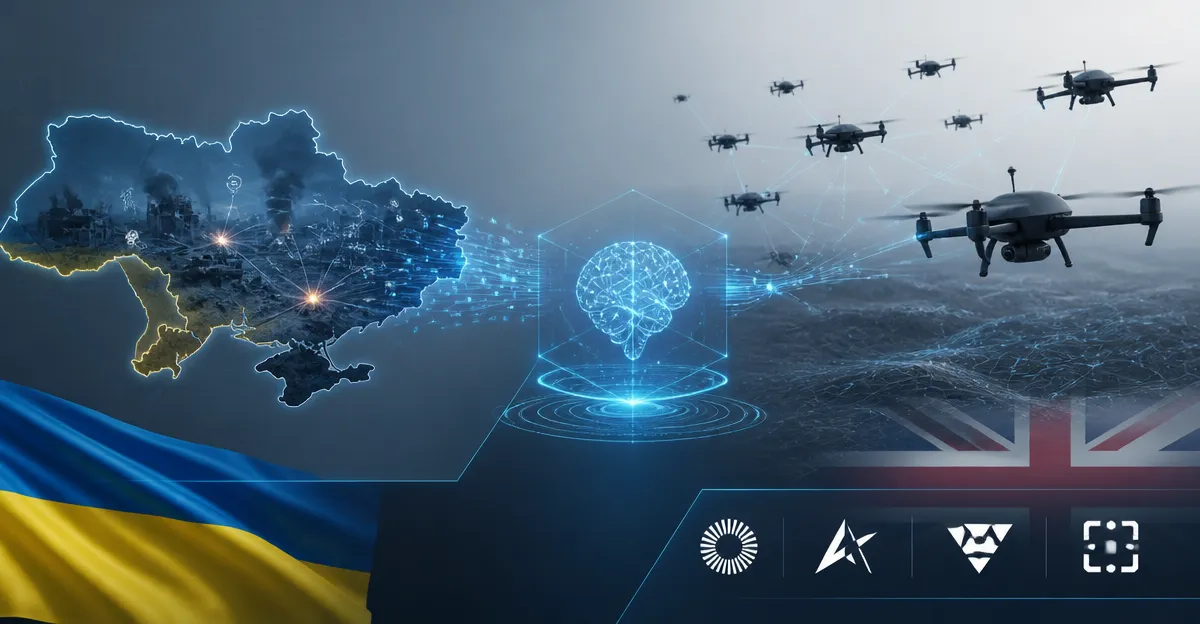
September 25, 2026, (Inside AI) — The United Kingdom will grant British defense firms access to battlefield data from Ukraine to train artificial intelligence models for drone swarm operations, the government announced Friday. The move marks a significant step in integrating real-world combat data into autonomous weapons development, raising questions about the future of warfare and the ethical boundaries of AI in conflict.
The decision allows UK companies to leverage a vast repository of sensor feeds, flight telemetry, and engagement logs collected during the ongoing war in Ukraine. These datasets, gathered from thousands of drone missions, offer an unprecedented resource for training AI systems to coordinate swarms, identify targets, and adapt to electronic warfare tactics. The government did not disclose which firms will participate or the exact scope of data sharing, but officials framed the initiative as a way to accelerate military innovation.
Drone swarms represent a shift from single remotely piloted aircraft to groups of autonomous or semi-autonomous units that communicate and act collectively. AI models trained on real combat data could improve their ability to operate in contested environments, where communications jamming and GPS denial are common. Ukraine has become a testing ground for such tactics, with both sides deploying thousands of small drones for reconnaissance and strikes. The UK’s access to this data could give its defense industry a competitive edge in developing next-generation systems.
“The battlefield in Ukraine has become a laboratory for autonomous warfare,” said a defense official who spoke on condition of anonymity. “Using this data will help us build AI that is more resilient and effective, but we are also mindful of the need for robust oversight.”
Read: AI Safety Debate: Pacing the Frontier vs. Trump's Acceleration
This initiative aligns with the UK’s broader push to modernize its armed forces through AI and autonomy. In recent years, the Ministry of Defence has funded projects on swarm intelligence, such as the Autonomous Swarm Exercise and partnerships with tech startups. However, integrating live combat data introduces new complexities. Unlike simulated or controlled test data, battlefield information is messy, incomplete, and often reflects specific tactical conditions that may not generalize to other conflicts.
Legal and ethical concerns also loom. International humanitarian law requires that weapons systems allow for human judgment in targeting decisions. Fully autonomous swarms that select and engage targets without human intervention could violate these principles. The UK government has stated that human control will remain in the loop, but the line between supervised autonomy and full independence can blur as AI models become more capable.
“There is a risk that using real-world data from an active conflict normalizes the use of AI in lethal decision-making,” said a researcher at a European security think tank, who requested anonymity to speak freely. “We need clear rules on how these models are trained and deployed.”
The announcement follows similar efforts by other nations. The United States has invested heavily in AI for drone swarms, and China has showcased swarm demonstrations. Ukraine itself has developed AI-enabled targeting systems, sometimes with Western support. The UK’s move could deepen its military-technical cooperation with Kyiv, which has been a recipient of British weapons and training since 2022.
Industry analysts note that access to battlefield data is a double-edged sword. It can speed up development, but it also ties AI models to the specific characteristics of the Ukraine conflict, such as the types of drones and electronic warfare used there. A model trained solely on that data might struggle in a different theater, like the Indo-Pacific, where conditions differ.
“You want diversity in your training data,” said a defense industry consultant not involved in the project. “Ukraine data is valuable, but it is not a silver bullet. Companies will need to combine it with simulations and other sources.”
Read: UN Chief Calls for Global AI Risk Framework in Final Assembly Address
The government did not specify how data will be sanitized or shared, nor did it address potential security risks. Battlefield data could contain sensitive information about Ukrainian tactics and capabilities. Ukraine has not publicly commented on the arrangement, and it is unclear whether it has approved the transfer.
As AI continues to reshape military affairs, the UK’s decision underscores a growing trend: the pursuit of combat-proven autonomy. The outcomes of this initiative will likely influence how other nations approach AI weapons development, and whether the use of real conflict data becomes a standard practice. For now, the focus is on turning Ukraine’s hard-won experience into an algorithmic advantage.