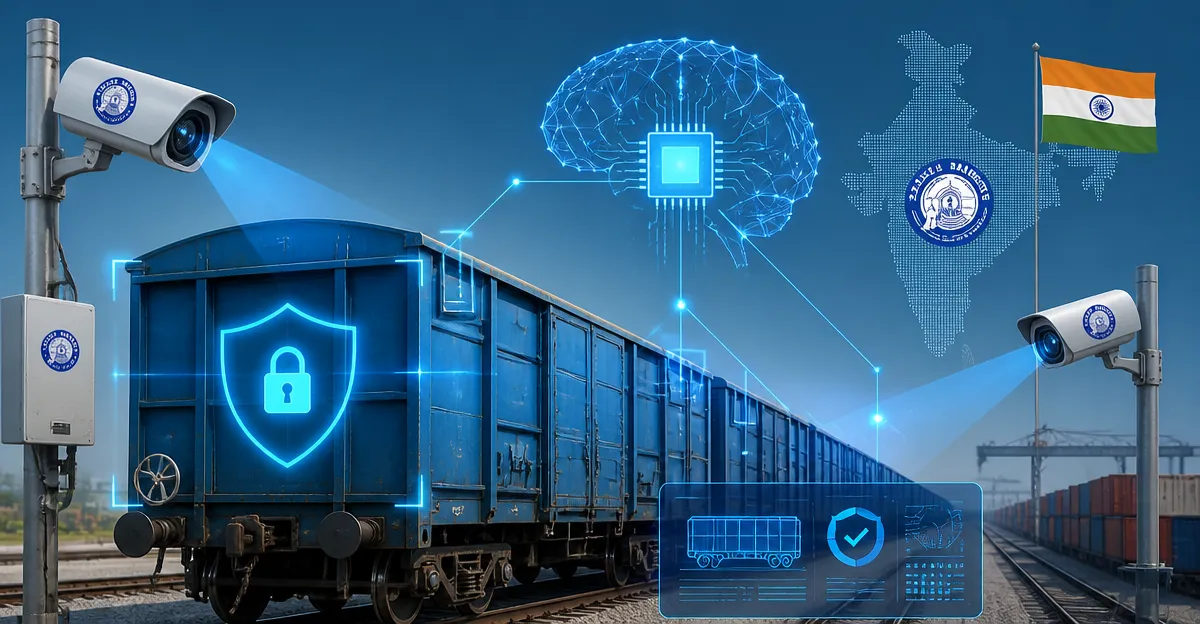
September 27, 2026, (Inside AI) — Indian Railways has deployed an artificial intelligence system to inspect freight wagon doors, locks, and seals, replacing a labor-intensive manual process that often struggled under poor lighting and harsh weather. The system, called Project DRISHTI, was developed by Northeast Frontier Railway (NFR) in collaboration with IIT Guwahati.
The technology uses high-speed cameras, intelligent lighting, and secure networking to capture and analyze images of freight wagons as trains pass through designated monitoring points. The AI then identifies wagon numbers and checks whether doors, locks, and seals remain intact or show signs of tampering.
NFR officials say the system will support frontline staff, including Railway Protection Force (RPF) and commercial personnel, by flagging potential irregularities faster than manual inspection allows. The deployment marks one of the largest operational uses of computer vision in Indian freight rail security.
Why Northeast Frontier Railway Needed This
Northeast Frontier Railway operates across some of India's most difficult terrain, including mountainous stretches and regions prone to heavy monsoon rains. Road transportation in these areas is often unreliable, making rail freight a critical link for industries, agriculture, and supply chains.
Read: Phillips 66 refinery AI
Ensuring wagon doors stay closed and seals remain unbroken is essential to protecting consignments during transit. But manual checks are slow, inconsistent, and particularly challenging at night or during adverse weather.
"The technology-enabled monitoring is expected to help safeguard consignments, reduce delays and facilitate the work of frontline railway personnel, including RPF and commercial staff. By enabling faster identification of possible irregularities, the system is expected to strengthen freight monitoring while reducing the dependence on manual inspection alone," said Kapinjal Kishore Sharma, Chief Public Relations Officer of NFR.
The system records inspection findings digitally, allowing staff to respond to issues more quickly. That digital trail could also help railway authorities audit freight security over time, a capability that manual logs rarely provided with consistency.
Indian Railways has experimented with AI for crowd management, predictive maintenance, and passenger safety. But freight security has remained a stubbornly manual domain. Project DRISHTI signals a shift toward automating that layer of oversight.
What the AI Can and Cannot See
Project DRISHTI focuses on visual inspection. It can detect whether a seal or lock appears intact, identify wagon numbers, and flag possible irregularities. It does not physically verify seal integrity or detect tampering that leaves no visual trace.
That limitation matters. A sophisticated thief could reseal a wagon in a way that passes visual inspection. The system also depends on cameras capturing clear images as trains move, which means lighting, speed, and weather conditions still affect performance.
Read: Employees Override AI Systems
Inside AI could not independently verify the system's accuracy rates or how it performs in low-visibility conditions. NFR did not release technical specifications or error rates.
Still, the collaboration with IIT Guwahati suggests a research-backed approach. The institute has worked on computer vision and AI projects for infrastructure monitoring, giving the railway access to academic expertise that pure commercial vendors might not provide.
For now, Project DRISHTI remains a monitoring tool, not a replacement for human judgment. Railway staff still make the final call on whether to halt a train or investigate a flagged wagon.
The system's success will likely be measured by whether it reduces freight delays and catches irregularities that manual checks missed. Indian Railways has not announced plans to expand the system to other zones, but a successful pilot in the Northeast could pave the way for broader adoption.