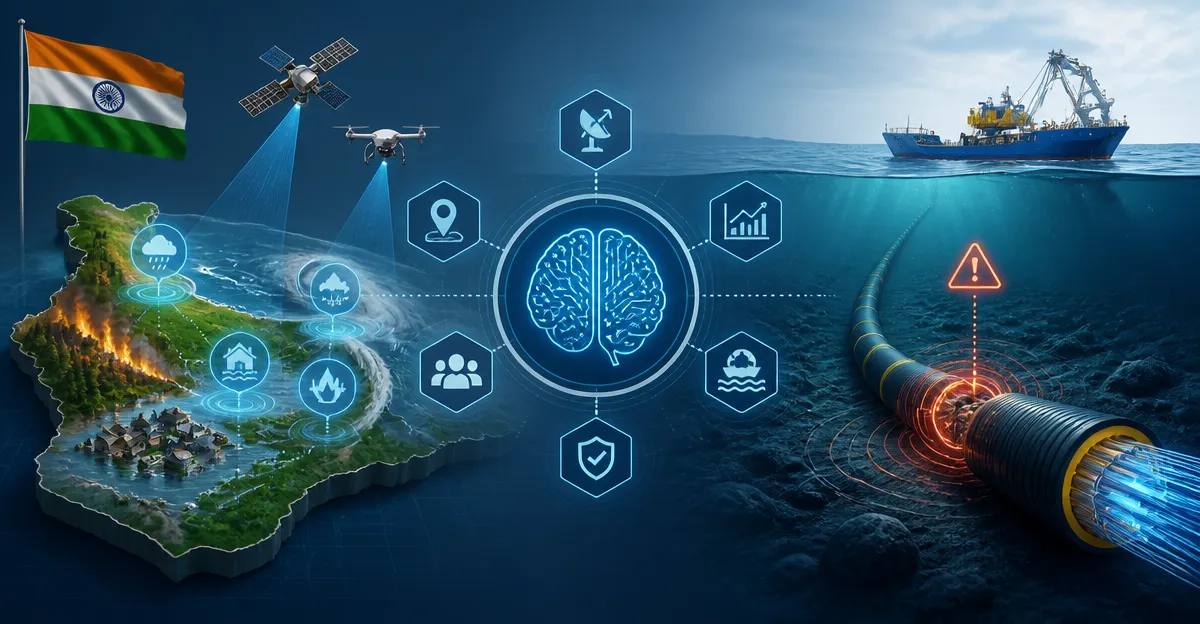
September 29, 2026, (Inside AI) — India's civil services examination has turned its lens on two of the most consequential technology questions of the decade. The latest GS-3 Mains practice module asks aspirants to assess how Artificial Intelligence is reshaping disaster management across the full cycle of preparedness, response, recovery and rehabilitation. A second question examines why subsea cables remain vulnerable to disruption or sabotage, and what such failures would mean for national security and economic stability.
The two prompts sit inside the UPSC Essentials answer-writing series, a weekly exercise that pairs static syllabus themes with live developments. Both topics carry unusual weight this year. India's weather agency has moved from testing to deploying AI forecasting tools, and the world's digital backbone keeps absorbing physical shocks.
On disaster management, the framing has shifted from reaction to anticipation. AI models now study decades of past weather data alongside live feeds to produce faster, more local forecasts, particularly for heavy rain and floods. These systems work beside traditional physics-based models rather than replacing them. The India Meteorological Department has already tested global architectures including Pangu, GraphCast and FourCastNet.
In 2026, the department launched AI rain forecasting tools capable of predicting rainfall down to a 1-kilometre area in a trial for Uttar Pradesh. The system draws on weather stations, satellites and radars. When combined with hazard maps, the output sharpens risk pictures and strengthens early warnings.
The response phase shows similar gains. Phones, drones and satellites generate enormous volumes of messy data during disasters. AI sorts that noise quickly. During the Nepal disaster, an AI system cross-referenced public reports of missing people with official government records and used satellite imagery to map destroyed buildings. Drones carrying thermal cameras detected human heat signatures beneath debris, helping rescue teams locate possible survivors.
Recovery and rehabilitation benefit too. AI identifies broken roads and buildings, flags isolated towns, and tells officials where food and medicine should go first. Risk assessments, satellite imaging and damage mapping help authorities mark dangerous locations and revise future catastrophe plans. In Jammu and Kashmir, GIS-based multi-hazard risk mapping and early warning systems reflect a wider push toward technology-enabled disaster risk reduction.
"AI can help at every level of disaster management, from hyperlocal prediction and early warning to rescue, damage assessment, relief, and rehabilitation," the module notes, adding that success depends not on technical sophistication alone but on integration with strong institutions, human skills and resilient systems.
The second question turns to infrastructure that rarely makes headlines until it fails. Subsea cables carry more than 99 per cent of all internet traffic. They also move financial transactions, government communications and defence traffic. Their vulnerability is therefore not a telecom matter alone. It is a national security and economic resilience question.
Cables rest on the seabed, exposed to ship anchors, fishing trawlers, strong currents and earthquakes. Damage is likelier in shallow waters where human activity concentrates. Strategic importance makes them targets for deliberate interference, including cable cutting and cyber disruption. Recent incidents and the spread of specialised cable-cutting capabilities have raised alarms.
Geography compounds the risk. Cables converge at designated landing stations and chokepoints. A disruption at a key route or landing point can ripple across entire regions. Repairing a damaged cable is technically hard, slow and costly. It requires locating the fault, deploying specialised vessels and working beneath the sea.
Ownership adds another layer. Much of the subsea network belongs to private consortia of telecom firms and large technology companies. That raises questions about coordination, strategic dependency and digital sovereignty. For India, a disruption could jeopardise secure government and defence communications, exposing weak points in critical digital infrastructure. Financial transactions, cloud services, e-commerce and telephony would all feel the strain.
The module suggests India needs more redundancy in connectivity, alternative cable routes, stronger domestic repair skills and better monitoring of important maritime infrastructure. Its conclusion frames subsea cables as vital national infrastructure whose protection demands a comprehensive approach spanning maritime security, technical surveillance, infrastructural redundancy, domestic repair capability and international cooperation.
Both questions carry a common thread. Technology delivers capability, but institutions decide outcomes. AI forecasting is only as good as the data pipelines and local officials who act on it. Cable protection is only as strong as the maritime cooperation behind it. The examination's points to ponder push further, asking about data quality, digital infrastructure, privacy and technological dependence in one case, and the role of international maritime-security mechanisms in the other.
The series also links back to earlier practice weeks and a previous year's question on why maritime security is vital to India's sea trade. For aspirants, the message is clear. The syllabus now expects fluency in how emerging technologies intersect with the state's core duties.