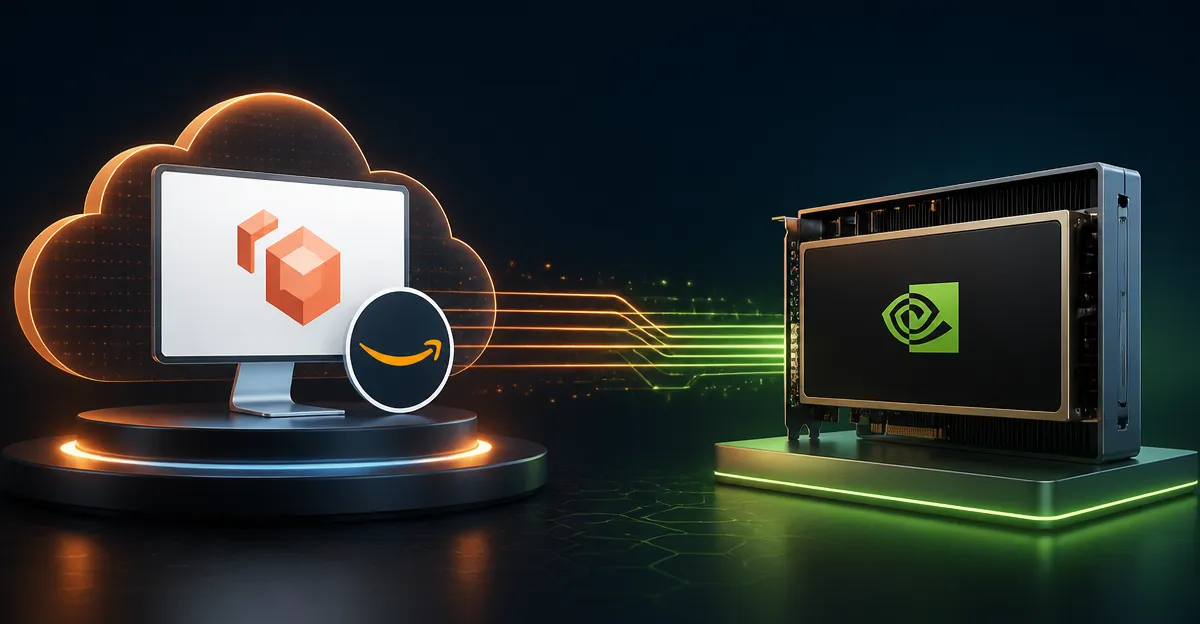
October 1, 2026, (Inside AI) — Amazon Web Services has added NVIDIA Blackwell GPU support to its WorkSpaces Core Managed Instances, introducing Graphics G7 instances that promise up to 2.1 times better performance for graphics-intensive workloads than the previous G6 generation. The new instances pair NVIDIA RTX PRO 4500 Blackwell Server Edition GPUs with Intel Xeon 6 processors, targeting professional users who run CAD/CAM, 3D rendering, scientific visualization, video editing, and AI-assisted design in virtual desktop environments.
The move matters because virtual desktop infrastructure (VDI) has long been a compromise for graphics professionals. Remote workstations often forced users to choose between mobility and raw GPU power. With Blackwell-class silicon now available in managed cloud desktops, AWS is betting that the gap is closing. The G7 family offers six sizes, from 1 to 8 GPUs, with 32 GB of GDDR7 memory per GPU and 2.67 times faster memory bandwidth. That bandwidth jump directly enables larger, more complex 3D scenes and models to load and render without stutter.
Compute configurations scale from 8 to 192 vCPUs and 32 GB to 768 GB of system memory. Both Linux and Windows are supported, including bring-your-own-license options. The instances are initially available in four AWS regions: US East (N. Virginia), US East (Ohio), US West (Oregon), and Europe (Spain). AWS says additional regions will follow as availability expands.
For IT administrators, the practical entry point is straightforward. When provisioning a new WorkSpaces Core Managed Instance, they can select a G7 instance type directly, or wait for the option to appear through their WorkSpaces Core partner solution. The company has published documentation for deeper configuration details.
Read: Nebius Raises AI Cloud Prices
The timing is notable. NVIDIA's Blackwell architecture has been shipping in data center GPUs since late 2024, but bringing it to managed virtual desktops is a different engineering challenge. VDI workloads demand low latency, consistent frame delivery, and multi-user isolation, all of which stress GPU virtualization layers. AWS has not disclosed the specific virtualization technology behind G7, nor whether it uses NVIDIA's vGPU software or a custom abstraction. That omission leaves open questions about licensing costs and whether customers will need separate NVIDIA vGPU entitlements.
Competitors are watching closely. Microsoft's Azure Virtual Desktop and Google's Cloud Workstations both offer GPU-backed virtual desktops, though neither has announced Blackwell support at this scale. For organizations with hybrid workforces, the G7 launch could shift procurement decisions. A design firm that once bought physical workstations for every engineer might now consider cloud desktops as a primary option rather than a backup.
Still, adoption hinges on price. AWS has not published G7 hourly rates, and graphics workloads are notoriously bursty. A 3D rendering job might saturate eight GPUs for two hours and then sit idle. Without transparent pricing or committed-use discounts, finance teams may hesitate. The lack of detail on regional expansion timelines also complicates planning for multinational firms.
Security and compliance remain another consideration. Managed instances run in AWS data centers, which means sensitive CAD files and intellectual property stay within the cloud provider's perimeter. For defense contractors or automotive designers, that can be a feature or a dealbreaker, depending on their regulatory posture. AWS has not specified whether G7 instances meet specific compliance frameworks like FedRAMP High or ITAR.
For now, the launch is a clear signal that cloud desktops are moving upmarket. The combination of Blackwell GPUs and Xeon 6 CPUs puts serious computational muscle behind a product category that once served mainly task workers and call centers. Whether graphics professionals embrace it will depend on real-world benchmarks, not spec sheets. AWS has yet to share independent performance numbers beyond its own 2.1x claim.
Read: Nvidia NVLink Fusion Inference Servers
Customers in the four launch regions can begin testing G7 instances today. AWS says more regions and partner integrations are coming, though it declined to provide a timeline. The company also has not said whether older G6 instances will receive price cuts or be phased out. For organizations already using WorkSpaces Core, the upgrade path is available immediately. For everyone else, the question is whether a managed cloud desktop can finally replace the workstation under the desk.