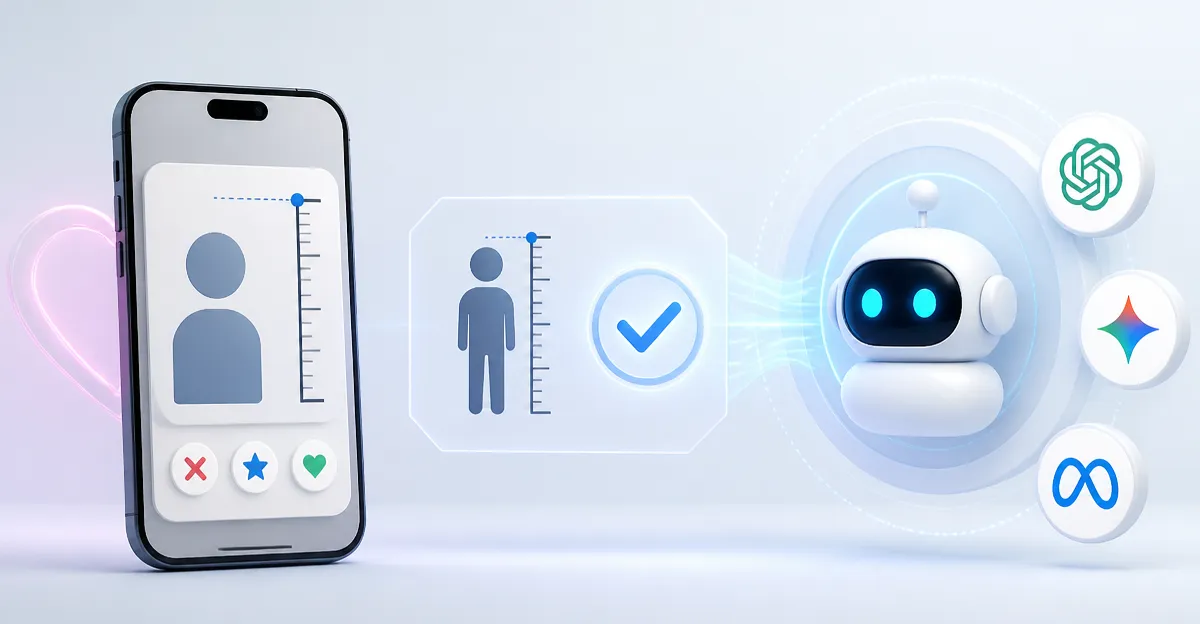
October 15, 2026, (Inside AI) — A viral social media trend has seen singles upload photographs of their dating app matches to AI chatbots to estimate their height, exposing a gap between what profiles claim and what a date's proportions suggest. The practice gained traction after a woman named Alexis described on a radio show how an AI tool concluded her date, Jason, was 5'7" despite his profile listing 6'2". Jason eventually admitted to being 5'8", according to a video shared by Hits 96.1.
The episode has turned a private anxiety about online dating exaggeration into a public test of AI's ability to measure the human body from a single image. Height has long been one of the most commonly inflated attributes in dating profiles, and the idea that a chatbot can act as a digital tape measure has obvious appeal. But experts say the technology is far less precise than the trend implies, and its use raises unresolved privacy questions.
"AI's ability to estimate a person's height from photos can be quite limited in terms of accuracy," said Poras Pratap Singh, a researcher at Neuritis AI in Indore, Madhya Pradesh. "While AI models can analyse features in images, such as proportions and angles, many factors can introduce errors. For example, the perspective of the image, the distance of the subject from the camera, and even the posture of the person can affect how their height is perceived."
Singh explained that some models trained on large datasets of human figures can make rough estimates by comparing body proportions, but without specific reference points or standardised scales, those estimates can be off by several inches. "At best, AI may provide a ballpark figure, but it cannot guarantee an exact height measurement unless additional data is provided, such as the height of objects around the person," he said.
Read: Google AI Overviews: When to Trust Them and When to Skip
The technical obstacles are well documented. Perspective distortion can make a person appear taller in a low-angle shot and shorter in a top-down one. Without a known object in the frame, such as a door or a piece of furniture, the AI has no reliable scale. Body proportions vary widely between individuals, undermining simple rules based on arm length or leg-to-torso ratios. Posture and loose clothing can further confuse the model.
"Given these limitations, AI's height estimates from photos are typically rough approximations and not precise measurements," Singh concluded.
The trend also carries privacy risks that users may not consider. Many AI applications require uploading images, which developers may store or reuse. If a tool analyses facial features or body proportions, it may retain biometric data. That data could be misused for tracking, surveillance, or body shaming. "Users should always review the privacy policy of any AI service to ensure that their photos and biometric data are protected and not used for unintended purposes," Singh advised.
Despite these caveats, the viral nature of the height-checking trend reflects a broader cultural shift. Daters are increasingly turning to AI to verify claims made in profiles, from age to occupation. The same technology that powers these checks is also being used to generate fake profiles and deepfake images, creating an arms race between deception and detection. Inside AI could not independently verify the specific chatbot Alexis used or the accuracy of its estimate in her case.
Read: ChatGPT Now Transcribes Zoom and Meet Recordings
For now, the episode serves as a reminder that AI's ability to interpret the physical world from a photograph remains constrained by the same ambiguities that humans face. A single image rarely tells the whole story, and a few inches of difference can depend on the angle of the camera as much as the honesty of the person in the frame.