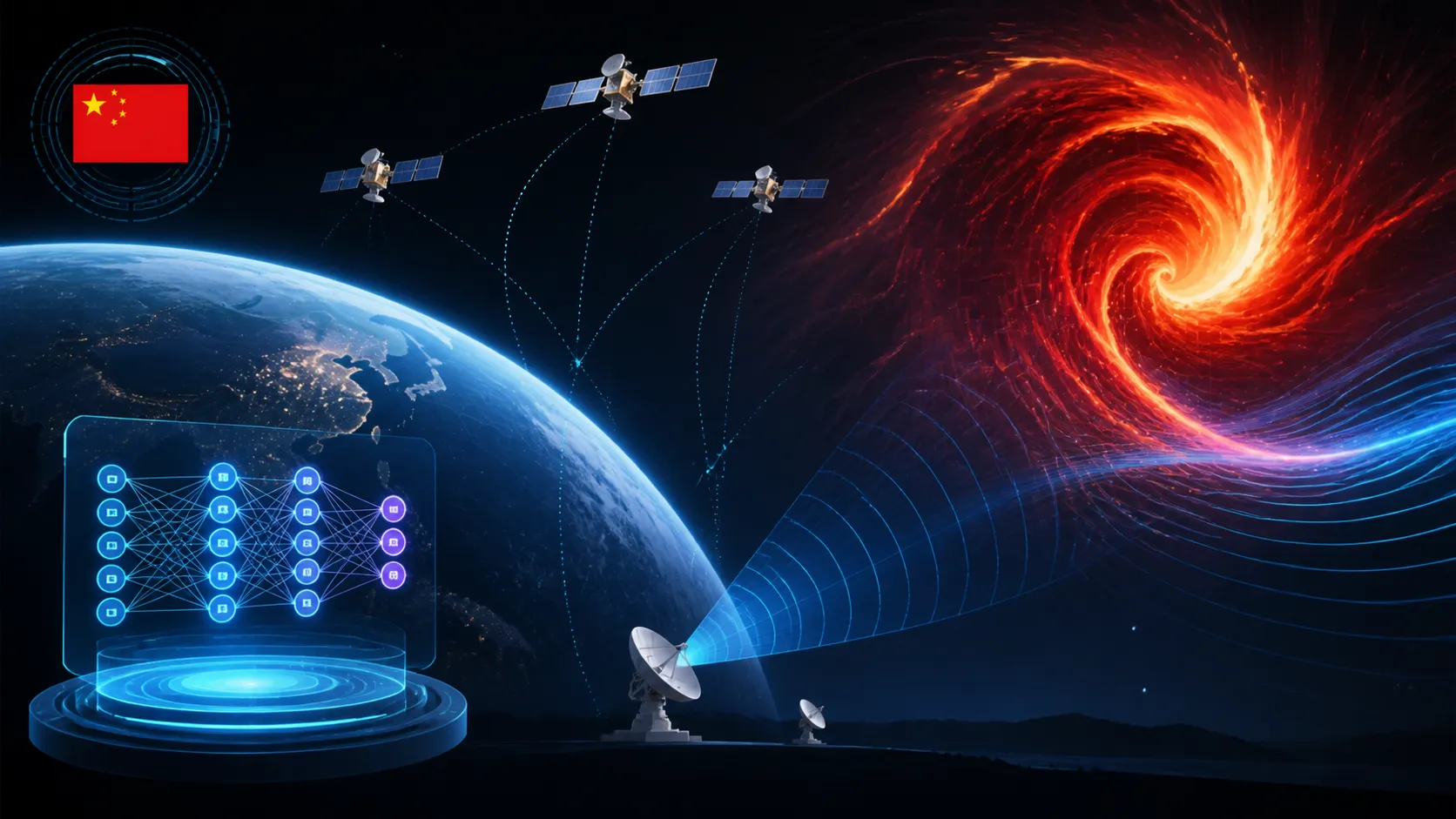
June 21, 2026, (Inside AI) — A China-led research team has built an AI system that automatically detects space hurricanes. These are vast, spinning auroras near Earth’s magnetic poles that can scramble satellite signals, radar, and radio communications.
The Invisible Storm Threatening Modern Infrastructure
Space hurricanes are not mere curiosities. They churn plasma across thousands of kilometers in the ionosphere, generating severe space weather that degrades GPS accuracy and disrupts over-the-horizon radar. Until now, scientists had to comb through ultraviolet satellite images by hand, a slow and error-prone process that missed many events.
The new system changes that. It uses deep learning to scan ultraviolet imagery and pinpoint these storms in near real time. The work was published on May 23 in the journal Space Weather.
How a Neural Network Learned to See the Unseen
The team trained a convolutional neural network on years of archival data from NASA’s TIMED satellite. They fed it 10,000 labeled images showing the distinctive spiral signature of space hurricanes against background noise. The model learned to ignore artifacts like dayglow and sensor noise.
Read: Chinese AI Cracks Typhoon Intensity Mystery as Hong Kong Faces Super Storms
In tests, the system achieved a detection accuracy above 92 percent. It also reduced false positives by a factor of three compared to earlier automated methods. Crucially, it can process a full day’s worth of global imagery in under 10 minutes on a standard GPU.
A New Eye in the Sky Demands Smarter Analysis
The timing is deliberate. The China-Europe Smile satellite, launched earlier this year, carries an ultraviolet imager that will produce a firehose of data. Manual inspection would be impossible. The team explicitly designed their AI to handle Smile’s output, expecting it to catalog hundreds of events annually.
“A space hurricane is a recently discovered space weather event that appears as a massive, spinning aurora near Earth’s magnetic poles,” the team wrote in their paper. The phenomenon was first confirmed in 2021 after scientists reanalyzed old satellite data.
Why Earlier Methods Fell Short
Previous detection relied on threshold-based algorithms that looked for bright patches. But space hurricanes often have diffuse edges and can be masked by other auroral activity. The new AI learns shape and motion patterns, not just brightness.
Some Western researchers caution that the model’s performance may degrade during extreme geomagnetic storms, when the ionosphere becomes chaotic. The team acknowledges this and plans to incorporate magnetometer data in future versions.
From Tropical Cyclones to Cosmic Vortices
The name is no accident. Space hurricanes mirror the structure of tropical cyclones: a calm “eye” surrounded by spiraling arms of plasma. They transfer enormous energy from the solar wind into the upper atmosphere, heating it and altering its composition.
Read: China Deploys AI Weather Models Alongside Traditional Systems During Typhoon Dolphin
Understanding them is not just academic. Airlines, militaries, and shipping firms depend on reliable radio and satellite links. A single undetected space hurricane can black out communications over the polar cap for hours.
What Comes Next
The team has open-sourced their code and training dataset, inviting other researchers to improve the model. They are also exploring a real-time alert system that would warn operators when a space hurricane is forming. If successful, it could become a standard tool for space weather forecasting centers worldwide.