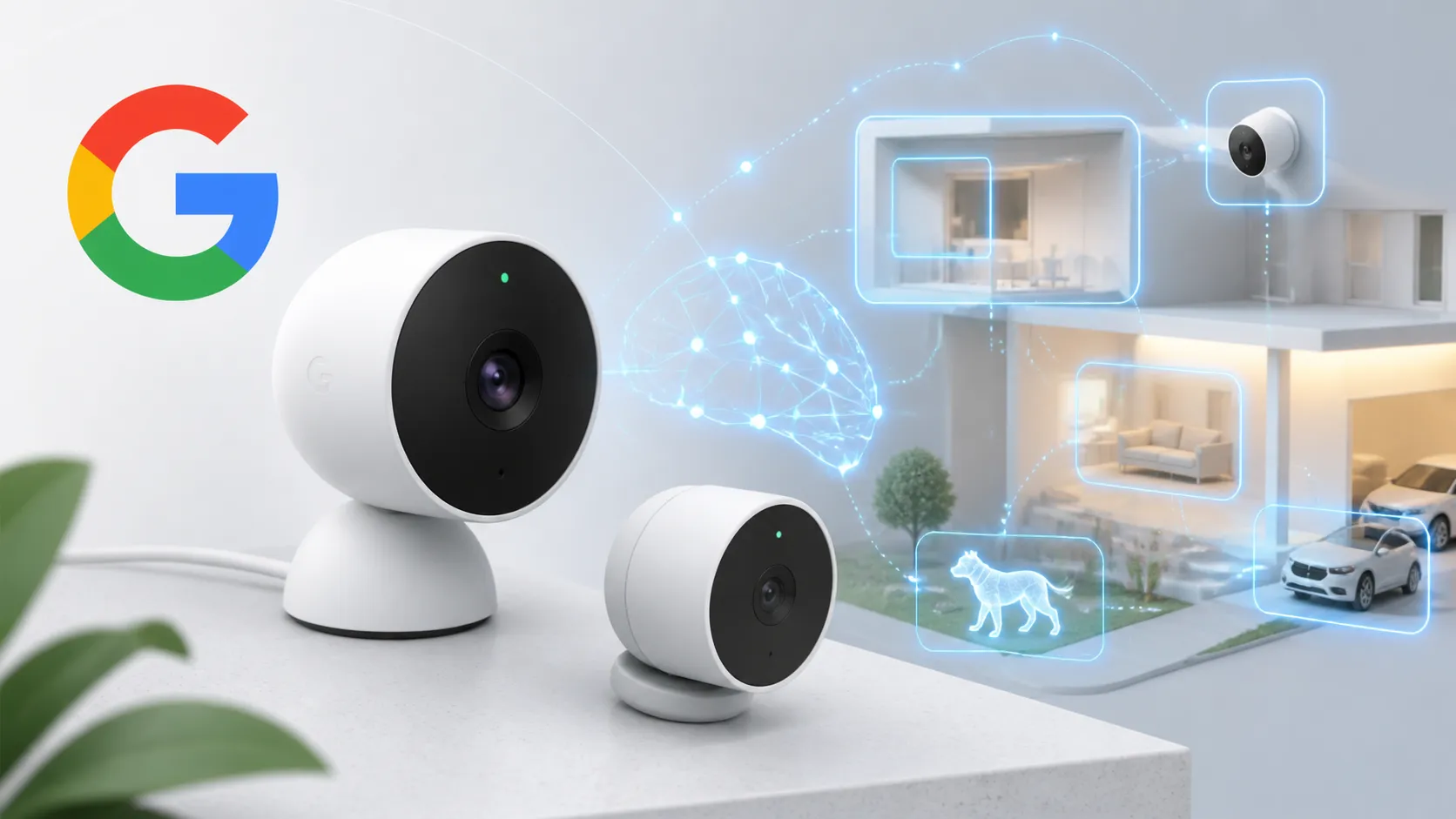
June 24, 2026, (Inside AI) — Google is deploying a suite of AI upgrades across its Nest camera lineup and Google Home ecosystem, sharpening the accuracy of person recognition and enriching event descriptions with audio context. The updates, rolling out now, modify the Familiar Faces feature to identify individuals even when their faces are obscured, and they inject specific sound detections into activity summaries.
The Familiar Faces library, which previously depended on clear facial data, now leverages secondary cues—body shape, clothing color, and other visual traits—to tag known people. Google states that users’ pre-tagged household members can be recognized from behind or in poor lighting, slashing false stranger alerts.
Concurrently, the library self-refreshes with recent images of each person, phasing out outdated reference photos that often trigger misidentifications. This dual approach—multimodal matching plus dynamic profile updates—targets a long-standing pain point in consumer AI cameras.
Audio-Aware Summaries and HVAC Vigilance
Nest cameras now parse environmental sounds and embed them in AI-written event descriptions, even when the source sits outside the camera’s view. Notifications may cite dogs barking, footsteps, alarms, or other notable audio cues, giving homeowners a richer, glanceable narrative without scrubbing through footage.
Read: Gemini Live Now Recalls Past Chats and Taps Apps for Smarter Voice AI
This audio layer builds on Google’s Gemini-powered push to make Nest cameras more conversational. Recent iterations already generate descriptive captions; adding sonic context is a logical next step toward ambient intelligence.
Separately, Google Home version 4.20 introduces System Health alerts for compatible Nest thermostats. The feature monitors heating, ventilation, and air conditioning (HVAC) systems and flags anomalies before they balloon into costly repairs—a move that marries predictive maintenance with the smart home.
Matter Expansion and Competitive Landscape
Google is also broadening support for Matter-compatible smart switches, reinforcing interoperability across connected home brands. This aligns with the industry’s gradual shift away from walled gardens, though Matter adoption remains uneven.
The Familiar Faces overhaul arrives as rivals like Amazon’s Ring and Apple’s HomeKit push their own on-device intelligence. Ring’s radar-based 3D motion detection and Apple’s focus on local processing illustrate a market split between cloud-dependent smarts and privacy-forward designs. Google’s hybrid model—processing some data in the cloud to enable richer AI—invites scrutiny over data handling, a topic the company did not address in its announcement.
Industry analysts note that multimodal person recognition, while impressive, raises questions about bias and false positives across diverse body types and clothing styles. Google has not disclosed validation metrics for the new algorithms.
Read: Google Reveals 11 Ways Gemini Boosts Workplace Productivity in 2026
The updates land as smart home adoption plateaus; Parks Associates reported in 2025 that 42% of U.S. internet households own a smart home device, but growth has slowed. Features that reduce nuisance alerts and provide actionable insights could rekindle consumer interest.