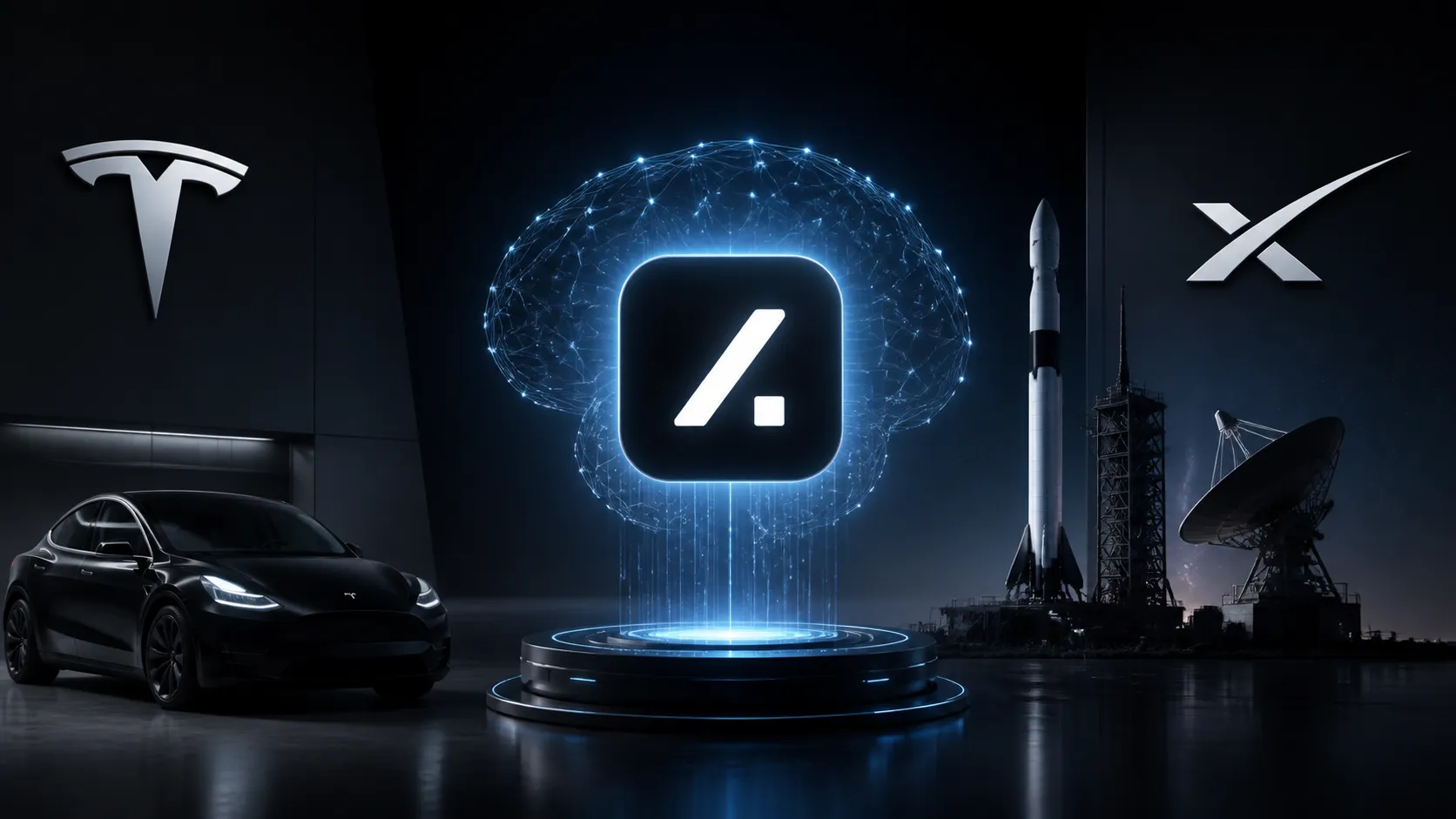
June 29, 2026, (Inside AI) — Elon Musk disclosed Sunday that Grok 4.5 has entered private beta testing, with trials underway at SpaceX and Tesla. The model is built on a 1.5-trillion-parameter V9 foundation model and incorporates Cursor data during a supplemental training phase. Musk claimed early evaluations approach or surpass Opus, the leading model from Anthropic.
The announcement signals an aggressive push in Musk’s AI strategy, with SpaceX planning to release entirely new models trained from scratch every month this year. No independent benchmarks or third-party testing have verified the performance claims, and access remains restricted to Musk’s companies for now.
Technical Underpinnings and Performance Claims
Grok 4.5’s architecture rests on a 1.5-trillion-parameter V9 foundation model, a significant scale-up from previous iterations. Musk highlighted the integration of Cursor data during a supplemental training phase, suggesting a focus on code generation and developer tooling. This aligns with the model’s testing at Tesla and SpaceX, where engineering applications are paramount.
Musk stated that initial evaluations show the model approaching or potentially surpassing Opus, Anthropic’s flagship system. He emphasized rapid improvement through reinforcement learning, noting that the Grok Build harness advances daily. These claims lack external validation, as the beta remains confined to Musk’s ecosystem.
The training methodology appears iterative, with Musk indicating that SpaceX will train new models from scratch every month. This cadence far exceeds industry norms, where major releases typically span quarters or years. The approach leverages Musk’s vast compute infrastructure, reportedly one of the largest AI training systems globally.
Strategic Integration and Market Ripples
Grok 4.5’s private beta at Tesla and SpaceX underscores Musk’s ambition to embed advanced AI across his ventures. The model already powers features on X, Musk’s social platform, and a stronger version could deepen integration into autonomous driving, rocket engineering, and satellite operations. This vertical alignment gives Musk a unique testing ground, but it also raises questions about transparency.
Competing viewpoints emerge from industry observers. Some analysts see the monthly training cadence as a potential breakthrough in rapid iteration, while others warn of resource waste and model instability. Without public benchmarks, comparisons to Opus remain speculative. Anthropic has not commented on Musk’s claims, and the broader AI community awaits reproducible results.
Historical context is instructive. Musk co-founded OpenAI before departing and later launched xAI to pursue an alternative vision. The Grok series has consistently aimed for raw capability, often eschewing the safety guardrails that define competitors like Claude. This beta release continues that pattern, prioritizing speed and scale over external validation.
What’s missing is independent evaluation. Musk shared the update personally, bypassing formal launch protocols. No third party has tested the model, and the private beta limits scrutiny. The reliance on internal metrics echoes past controversies in AI, where early hype sometimes outpaced real-world performance.
The roadmap’s monthly training cycle could strain resources but also accelerate learning. If successful, it may pressure rivals to adopt faster release schedules. For now, the wider public must wait for a public release, while Tesla and SpaceX engineers explore the model’s potential in closed environments.