July 14, 2026, (Inside AI) — A sweeping new study tracking over 26,000 Chinese students reveals a stark trade-off: while generative AI tools like Alibaba’s Qwen boost homework efficiency, they slash exam performance by up to a fifth, with the damage deepening over time.
Researchers from Stockholm University and the University of Hong Kong followed middle and high school students in a central Chinese county for 30 months, from September 2022 to June 2025. They compared AI users with non-users across homework grades, completion times, monthly tests, and high-stakes entrance exams.
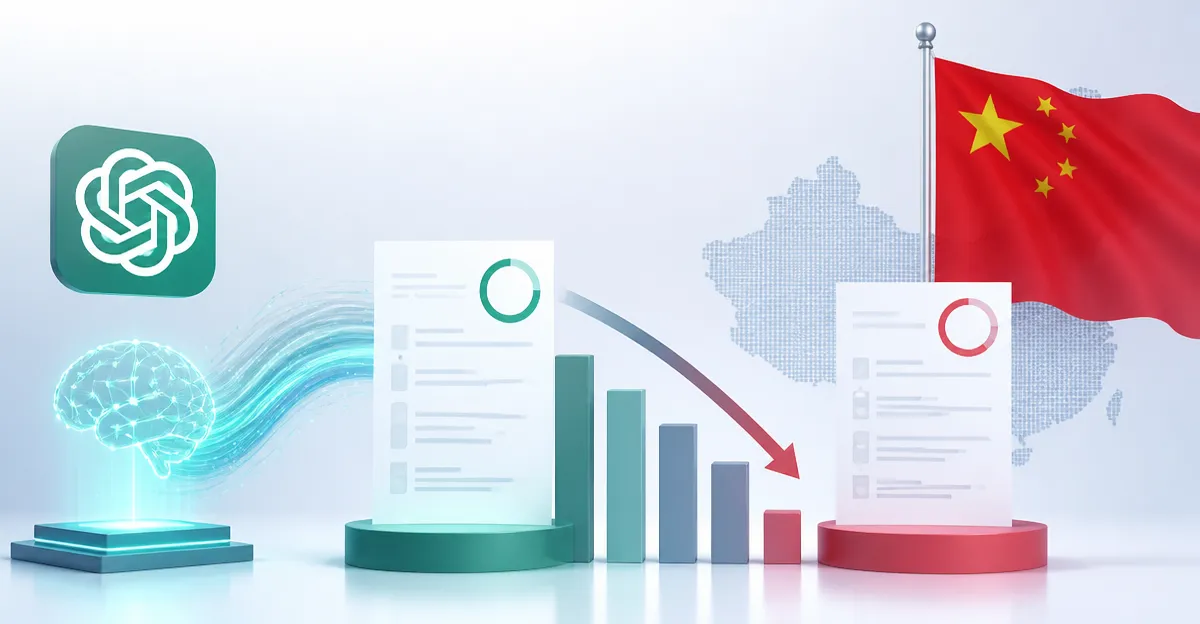
The findings, published as a working paper, show that AI initially delivers a productivity windfall: homework scores rose 18% and completion time shrank from 64 to 45 minutes. But within six months, monthly exam scores dropped by 20%. After two years, the gaokao—China’s brutal college entrance exam—saw an 18% decline, while the zhongkao high school entrance exam plunged 24%.
The Brain Drain Timeline
The study documents what researchers call a “brain drain” effect that unfolds in stages. Short-term gains mask a gradual erosion of foundational skills, as students outsource thinking to chatbots. The pattern held across subjects and school types, suggesting a systemic risk.
Read: Norway Bans Generative AI in Elementary Schools to Protect Cognitive Skills
“AI boosted short-term efficiency but harmed long-term learning,” the authors note. The two-year lag before full impact emerges is especially troubling, as it may hide damage until critical exams.
This isn’t the first warning. A 2024 University of Pennsylvania study found that ChatGPT users solved 48% more math problems during practice but scored 17% worse on tests. The Chinese data, however, is far larger and longer, capturing real-world academic trajectories rather than lab settings.
Critics argue that AI’s role in education isn’t inherently harmful. Properly designed, it could act as a Socratic tutor—asking guiding questions rather than giving answers. But most students use it as a shortcut, copying solutions without understanding.
China’s AI Classroom Experiment
The study’s context is uniquely Chinese. Alibaba’s Qwen is deeply integrated into educational platforms, and AI homework helpers are widely marketed. Yet China’s exam-centric system leaves no room for error: a few points on the gaokao can determine lifetime career paths.
“This is a wake-up call for policymakers everywhere,” said Dr. Li Wei, an education technology researcher not involved in the study. “We need to rethink how AI is deployed in schools—not as a crutch, but as a coach.”
The findings also raise questions about equity. Students with less access to AI may be forced to develop stronger independent skills, potentially widening gaps in unexpected ways.
Read: US University of Chicago Law School Bans Laptops to Combat AI in Classrooms
Meanwhile, AI companies continue to push classroom tools. Google’s LearnLM and Khan Academy’s Khanmigo promise personalized tutoring, but long-term impact studies remain scarce. The Chinese research may force a reckoning.
As schools worldwide rush to adopt AI, this study suggests a cautious approach: integrate it in ways that build understanding, not bypass it. Otherwise, the next generation may ace their homework but fail the test of real knowledge.