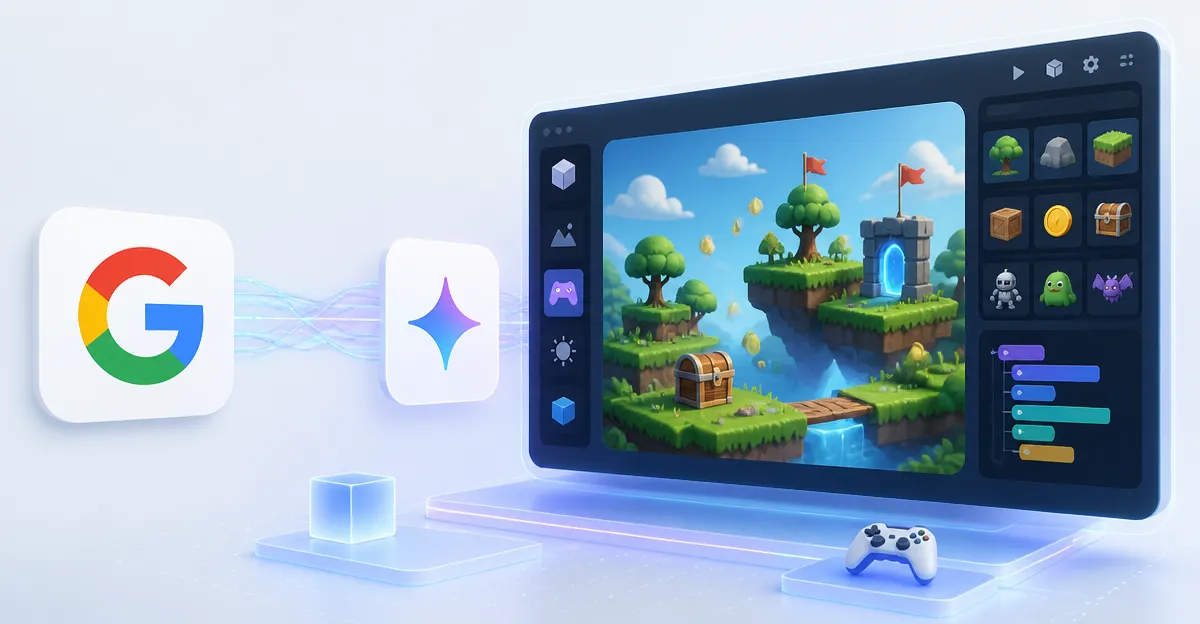
October 8, 2026, (Inside AI) — Google Labs has officially launched Playground, an experimental browser-based platform that lets users build, play, and share custom games using simple text prompts. The service is available now to users aged 18 and older in the United States, with international expansion planned for later.
The launch marks Google's most direct move yet into AI-assisted game creation. It also puts the company in immediate competition with Roblox, which recently announced its own natural-language Build feature. For Google, Playground extends a long and uneven history in gaming, spanning the shuttered Stadia cloud service and the more recent YouTube Playables initiative.
Playground removes traditional barriers to entry. Historically, game development demanded programming skill, engine expertise, and art production capacity. The new platform requires none of those. Users describe mechanics, gameplay, and visual style in plain language. The AI handles the rest.
The workflow is conversational. Creators begin from a blank canvas, use guided support, or remix starter prompts. They select a genre such as trivia or racing, choose between 2D and 3D visuals, and decide between single-player or multiplayer modes. From there, they describe what they want. They can tweak physics, rewrite rules, customize characters, and overhaul environments through text alone.
Read: Tencent Tests Goose Dimension AI Gaming Companion With Live Screen Recognition
Personal visual uploads are supported. The AI transforms those uploads into game assets that match the project's overall art style. Testing happens in real time during creation. Creators can keep modifying projects even after release.
Playground runs entirely in the browser, so games work on both mobile devices and computers. Once finished, creators control visibility. They can keep projects private, share them via direct link, or publish to the Explore gallery. Published games feature in-game leaderboards, and select genres support multiplayer.
Users need a Play Games profile. That profile allows a custom handle, game likes, high-score competition, and creator following. The Explore gallery surfaces fresh games based on player ratings and play activity. Google puts every published game through safety screenings aligned with its Community Guidelines and relies on user reporting as an additional layer.
Access carries a cost structure. Browsing the catalog and playing games is free. Game generation uses a weekly token system. The free tier provides a limited number of tokens. Google One AI subscribers receive higher usage limits and tiered creation access.
Looking ahead, Google will soon offer an integration with Unity Spark, currently in testing ahead of a closed beta. That update promises high-fidelity 3D capabilities, professional-level game mechanics, and the flexibility of the Unity runtime ecosystem.
The competitive stakes are clear. Roblox's Build feature targets a similar audience with natural-language creation. Google's advantage lies in distribution through its browser ecosystem and its existing Google One subscriber base. The token system, however, introduces a usage ceiling that could frustrate heavy creators.
Google has not disclosed token allotment specifics or pricing for expanded access. The company also has not detailed how safety screenings handle user-generated content at scale. Inside AI could not independently verify those operational details.
For now, Playground remains an experiment under the Google Labs banner. Its long-term viability depends on whether casual creators embrace text-driven development and whether the token economy sustains engagement beyond initial curiosity.