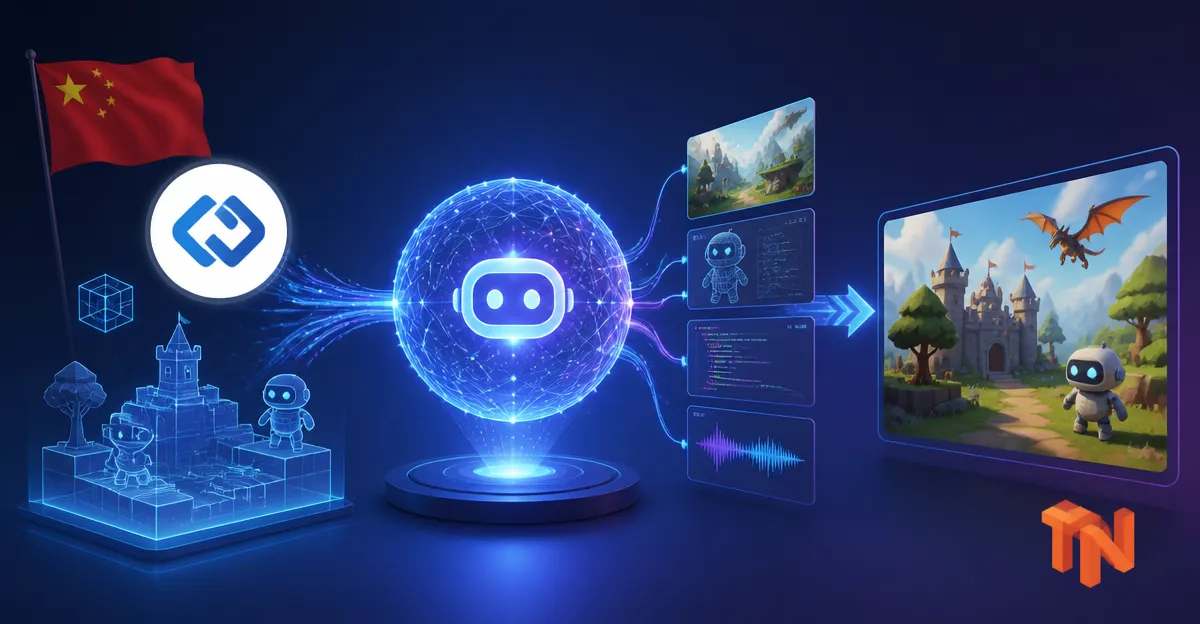
September 25, 2026, (Inside AI) — Chinese game technology company JIYI has raised nearly RMB 100 million ($14 million) across two funding rounds for its AI-powered game creation platform SOON, which promises to compress the game development process from months of specialized work into minutes of natural-language prompting. The platform, incubated by gaming company Kingnet Network, represents one of the most aggressive bets yet that generative AI can automate not just individual game assets but entire production pipelines.
SOON's core proposition differs fundamentally from existing AI game tools. Rather than helping developers create characters or environments within traditional engines, the platform attempts to generate complete playable games from text descriptions. During its second testing round, users created more than 3,000 game projects in 45 days, with the system generating code, game logic, characters, scenes, and user interface elements.
The company's investor roster includes Bingo Group, Zhongxu Future, and Hengdian Capital. Industry recognition has followed. At the 2025 China International Artificial Intelligence Conference, SOON was named one of the year's 10 most innovative AI products, alongside offerings from Huawei, JD Logistics, and Inspur Cloud. In July 2026, it won Best AI Game Creation Platform at the seventh Feifan Awards.
From No-Code Engines to Natural Language
SOON's approach builds on two decades of efforts to democratize game development. GDevelop, an open-source engine launched in 2008 and incorporated as GDevelop France in 2021, pioneered visual, event-based game creation that eliminated most coding requirements. The Paris-based platform supports 2D and 3D development across web, desktop, and mobile.
Read: Runway Unveils Solaris, an AI Model That Generates Interactive App Interfaces
SOON pushes further by attempting to remove the need to learn an engine's internal logic altogether. Users describe what they want, and AI handles execution. The trade-off is deliberate: SOON currently focuses on 2D and mini-game projects, a narrower scope that allows more stable automated output.
"Rather than simply making an engine easier to use, it aims to reduce the amount of manual work a creator performs inside that engine-like workflow," according to sources familiar with the platform's development strategy.
This positioning places SOON between two extremes. Traditional engines like Unity and Unreal Engine offer maximum control but require years of learning. Asset-generation tools like Meshy in the U.S. and Hyper3D's Rodin in China save time for existing developers but fit within established workflows rather than replacing them.
SOON attempts something broader: bringing code, logic, art, and interface into a single AI-driven process aimed at producing playable results.
The Gap Between Generation and Engagement
The technical challenge extends beyond generating assets or code. A successful game depends on mechanics, pacing, challenge, and feedback working together to sustain player interest. Research on game design consistently emphasizes factors like immersion, progression, and reward systems that keep players returning.
Generating a coherent, engaging experience from text prompts remains an unsolved problem. The platform's testing data shows volume, but whether those 3,000 projects produced games people actually want to play is unclear. Inside AI could not independently verify the quality or retention metrics of these user-created games.
Read: YouTube Unveils AI Creator Tools and Shopping Features at Annual Event
Competitors are attacking adjacent problems. Inworld AI provides tools for adding intelligent characters and real-time interactions to games built in Unreal and Unity. Tripo AI is developing persistent multiplayer worlds through Project Eden. Runway has explored real-time AI-generated game environments that respond to player input.
Each approach reflects a different bet on where AI adds most value. SOON's wager is that end-to-end generation, even with quality limitations, will prove more transformative than incremental assistance.
"Large commercial games still depend on experienced teams, precise control, and sophisticated development environments," according to industry observers. "But for prototypes, small projects, and creator-driven games, SOON is already showing what its approach can do."
JIYI has also partnered with CMGE to launch GamePartner.AI, an AI agent designed to help developers publish games to Apple's App Store and Google Play while connecting them with advertising monetization through AppLovin. The move suggests JIYI sees distribution and monetization as part of the same accessibility problem.
China's gaming ecosystem provides advantages for this kind of experimentation. The country hosts one of the world's largest video game markets, with deep pools of developers, publishers, and production talent. That infrastructure gives startups like JIYI access to expertise and feedback that pure software companies might lack.
Whether AI can genuinely reshape game production or remains a powerful but limited assistant will depend on results. SOON's bet is that speed and accessibility will matter more than polish for a growing segment of creators. The platform is still in development, and the gap between generating a game and generating a game worth playing remains wide.