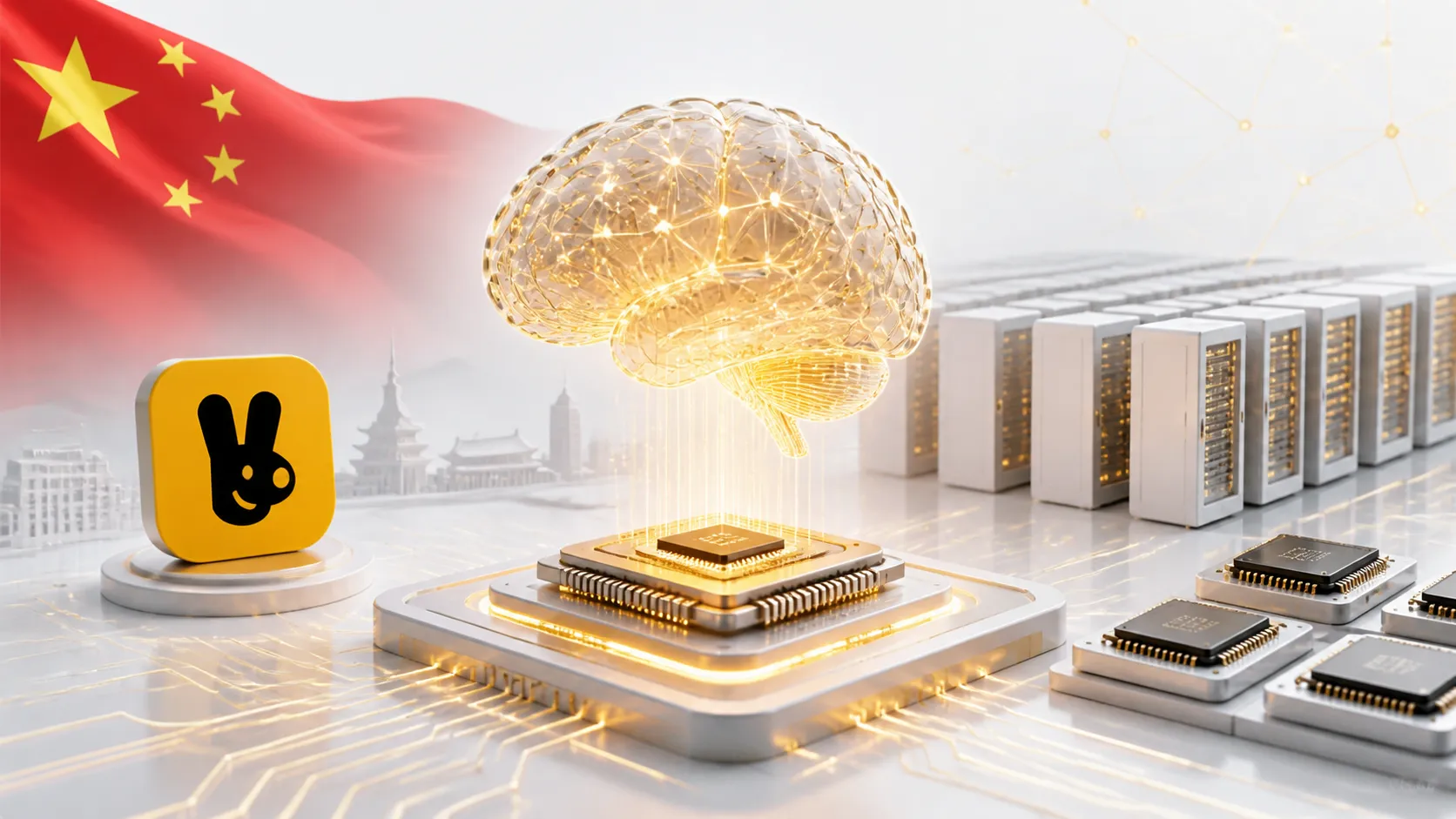
June 30, 2026, (Inside AI) — Meituan, China’s dominant food delivery platform, has open-sourced LongCat-2.0, a 1.6 trillion-parameter large language model trained entirely on domestic chips. The Beijing-based company claims it is China’s first trillion-parameter AI model to use home-grown hardware for both pre-training and inference.
The model’s scale matches DeepSeek-V4-pro, launched in April, but Meituan says its approach differs critically. While DeepSeek’s flagship used local chips only for inference—the lighter task of running a trained model—LongCat-2.0 consumed domestic hardware during the far heavier pre-training phase, where models learn patterns from vast datasets.
Meituan disclosed the model was built on “large-scale clusters of tens of thousands of AI ASIC superpods,” demonstrating frontier-scale training on alternative hardware. ASICs, or application-specific integrated circuits, are custom chips designed for specific workloads, unlike general-purpose processors such as GPUs.
The company did not name its chip supplier but revealed it used the Huawei Collective Communication Library (HCCL) to stabilize training. HCCL is Huawei’s chip-to-chip communication system, analogous to Nvidia’s NCCL, suggesting a deep reliance on Huawei’s Ascend AI accelerators. This aligns with China’s push to build an independent AI stack amid U.S. export controls on advanced semiconductors.
LongCat-2.0 also features a 1 million-token context window, enabling it to process extremely long documents. The model’s open-source release on Tuesday signals Meituan’s ambition to move beyond its core commerce business into foundational AI research, joining rivals like Alibaba and ByteDance in the LLM race.
Industry analysts note the achievement underscores China’s rapid progress in domestic chip capabilities, but questions remain about performance parity with models trained on Nvidia hardware. Meituan has not yet published detailed benchmark comparisons, leaving the model’s real-world competitiveness unclear.
Meituan’s move also reflects a broader trend of Chinese tech firms repurposing massive compute clusters—originally built for recommendation algorithms—for LLM training. The company’s logistics network generates petabytes of data daily, providing a rich training corpus for specialized AI applications in on-demand services.