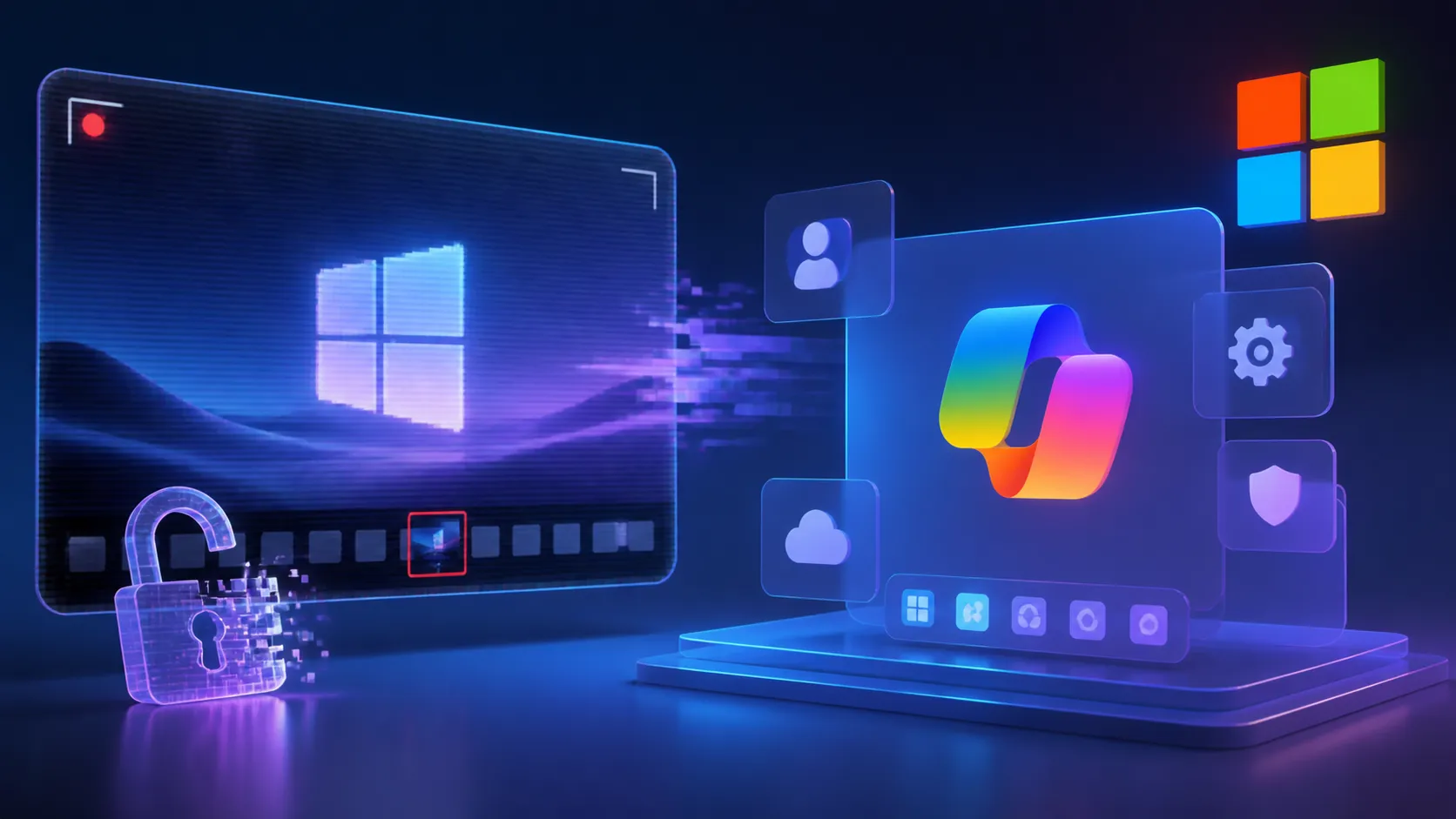
July 4, 2026, (Inside AI) — A leaked internal video reveals Microsoft explored a dedicated Copilot operating system built around agentic AI. The project, codenamed Aion, places a multi-modal Copilot at the core of a web-first desktop experience. The three-minute clip, first shared on a Discord server, shows working code from 2024 and walks through a radical reimagining of the PC interface.
The footage, deemed genuine by sources, presents Aion as a web-based agent OS. The narrator describes Copilot as “built into the shell,” replacing the traditional desktop with a central input box for finding files, launching apps, and browsing. A taskbar and Start menu-like layout remain, but the system runs on a stripped-back codebase called Win3 that drops legacy Win32 app support. Instead, it relies on web apps and Windows 365 Cloud PC streaming for desktop software.
Microsoft declined to comment on the leak. However, the video’s timing aligns with the company’s broader push toward agentic computing. Earlier this year, Microsoft announced Project Solara, a similar agentic OS effort, suggesting Aion may have evolved into that initiative. The experiment underscores a strategic bet: that AI agents will become the primary interface for productivity, not just an add-on.
Inside Aion: How the Agent OS Reimagines the Desktop
The Aion interface centers on a multi-modal input box that accepts text, voice, and drag-and-drop actions. Users can ask Copilot to locate documents, adjust settings, or orchestrate tasks across apps. A feature called Spaces groups related applications and websites into buckets, allowing users to reopen entire workflows with a single click. This design borrows from virtual desktop concepts but ties them directly to AI-driven context.
Under the hood, Aion’s Win3 kernel is optimized for modern hardware. By excising decades of backward compatibility, Microsoft claims faster updates, longer battery life, and improved security. Yet the trade-off is stark: no native support for Win32 applications. For enterprises reliant on legacy software, the OS leans heavily on Windows 365 to stream a full Cloud PC, effectively making the local machine a thin client.
The video’s narrator emphasizes the agent’s proactive role:
“Aion places Copilot at the very heart of the experience.”
This framing positions the OS not as a passive tool but as an active collaborator that anticipates needs. It reflects a growing industry trend where AI agents move from reactive chatbots to autonomous task executors, a shift also seen in Google’s Project Mariner and Apple’s Intelligence framework.
From Hackathon to Product: The Uncertain Path of Aion
Sources caution that the leaked video may represent an early hackathon project rather than a committed product roadmap. The footage is dated 2024, and internal experiments often explore extremes before being scaled back. Still, the concepts echo Microsoft’s public trajectory. Project Solara, announced in May 2026, similarly envisions an agentic OS layer that spans devices, though it retains broader app compatibility.
Competing viewpoints highlight the tension between innovation and practicality. Analyst Carolina Milanesi of Creative Strategies notes, “Web-first OS experiments have a checkered history, from Chrome OS to Windows 10X. The challenge is always the app gap.” Indeed, Microsoft’s own Windows 10X attempted a streamlined, containerized approach before being canceled in 2021. Aion’s reliance on cloud streaming may address this, but it raises questions about offline functionality and latency.
Another missing piece is developer buy-in. For an agent OS to succeed, third-party apps must expose APIs for Copilot to interact with. Microsoft has been building this foundation with Copilot extensibility and Windows Copilot Runtime, but adoption remains nascent. Without a rich ecosystem, Aion risks becoming a walled garden of web apps.
Historically, Microsoft has oscillated between simplifying Windows and preserving backward compatibility. The Windows RT debacle in 2012 showed the market’s resistance to losing Win32 apps. Aion’s concept revisits that gamble, this time with AI as the differentiator. Whether enterprises and consumers are ready to trade app compatibility for an agentic experience remains an open question.
The leak also surfaces at a time when Microsoft is integrating AI deeply into existing Windows 11 via Copilot+ PCs and Recall features. These incremental steps may be a safer path, using telemetry to gauge user appetite for an AI-first OS. Aion, in contrast, represents a clean-slate disruption that could fragment the Windows ecosystem if ever released.
For now, the video serves as a time capsule of Microsoft’s internal debates. It reveals a company willing to question the desktop paradigm it created four decades ago. As agentic AI matures, the ideas in Aion—whether through Solara or future updates—will likely surface in more polished forms, challenging users to rethink how they interact with computers.