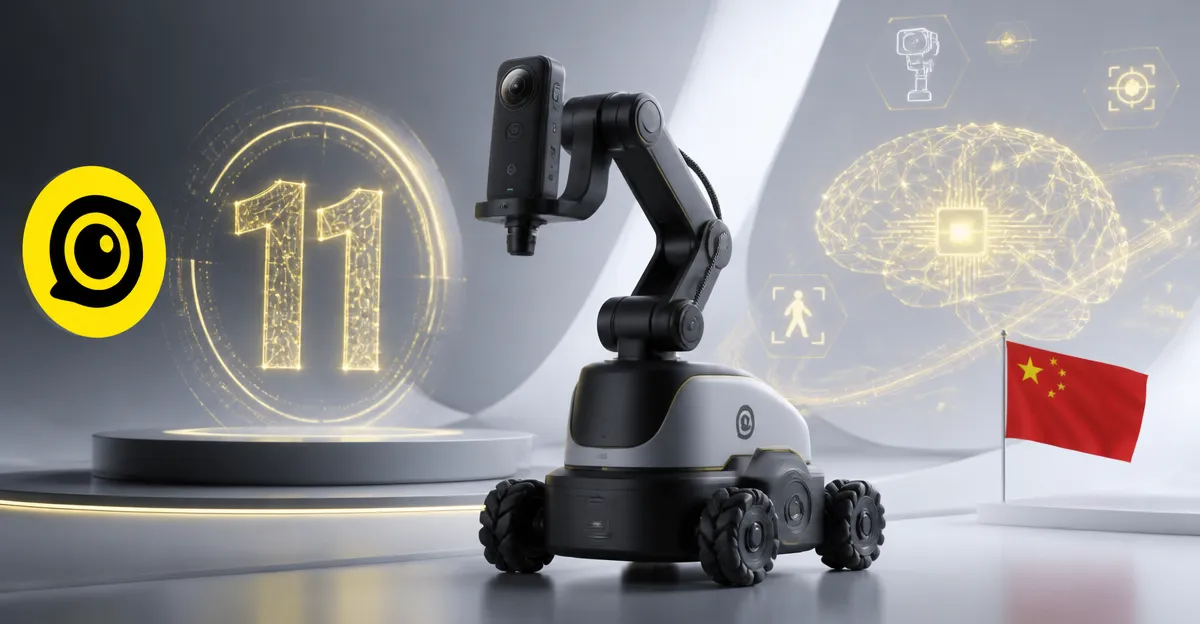
July 10, 2026, (Inside AI) — Insta360, the Shenzhen-based camera maker, marked its 11th anniversary by revealing a bold vision: an AI-powered photography robot called Cameraman. Unlike a single product, Cameraman is an AI agent concept designed for autonomous filming, with panoramic drones as early prototypes. The company says it has already built core technologies for the robot’s brain, eyes, ears, neck, and torso, while its Luna Ultra dual-camera gimbal serves as a key intermediate step.
The announcement came via an internal letter from founder Liu Jingkang, who framed the project as a mission beyond commercial gain. He said the company aims to tackle problems others are unwilling to solve, using innovation to explore creativity, aesthetics, and romance. This vision positions Insta360 at the intersection of robotics and content creation, a space where few consumer tech firms have ventured.
Cameraman represents a shift from passive capture devices to active, intelligent agents. Insta360’s panoramic expertise—evident in its One X series—provides a foundation for a robot that can understand and frame scenes. The Luna Ultra gimbal, with its dual-camera setup, likely contributes to the robot’s “eyes” and “neck,” enabling smooth, precise movements.
Industry observers note that autonomous camera robots have been a niche pursuit. Sony’s Aibo and Panasonic’s balloon drone were early experiments, but none achieved mass adoption. Insta360’s approach, leveraging AI agents, could offer more adaptive filming. However, challenges like real-time scene understanding, battery life, and user trust remain significant.
Read: Genesis AI Unveils Eno: A Non-Humanoid Robot with Human-Level Dexterity
Competing viewpoints highlight the gap between concept and reality. Dr. Sarah Chen, a robotics researcher at MIT, told Inside AI: “Autonomous filming requires not just object tracking, but aesthetic judgment—something AI still struggles with. Insta360’s panoramic data might give it an edge, but the leap to a fully autonomous cameraman is enormous.” Meanwhile, DJI, a rival in the drone space, has focused on automated flight paths without venturing into humanoid robotics.
Insta360’s history of innovation supports its ambition. Founded in 2015, the company popularized 360-degree cameras and has since expanded into action cams and webcams. The Cameraman concept aligns with a broader industry trend toward AI agents that perform complex tasks. Google’s Project Starline and Apple’s rumored home robot show tech giants exploring similar ideas, but Insta360’s focus on filming could carve a unique niche.
Technical details are scarce. The “brain” likely involves on-device AI processing, possibly using neural networks trained on vast panoramic footage. The “ears” might enable voice commands or sound-based tracking. Insta360’s existing FlowState stabilization and AI editing features, like Auto Frame, hint at the underlying algorithms. Yet, integrating these into a mobile robot demands robust SLAM (simultaneous localization and mapping) and obstacle avoidance—areas where competitors like Boston Dynamics excel.
Financial analysts view the announcement as a long-term bet. Insta360, backed by investors like IDG Capital, has seen steady growth but faces pressure to diversify. The global camera robot market, valued at $3.2 billion in 2025, is projected to reach $8.7 billion by 2030, per MarketsandMarkets. Insta360’s panoramic IP could give it a first-mover advantage if it delivers a viable product.
Founder Liu Jingkang’s letter emphasized romance and aesthetics, a rare tone in tech announcements. He stated:
“We aim not only to pursue commercialization and efficiency, but also to tackle problems others are unwilling to solve, using innovation to explore creativity, aesthetics, and romance.”
This philosophy may resonate with creators seeking tools that blend art and AI. However, skeptics argue that romanticizing technology can obscure practical hurdles. “It’s a beautiful vision, but the road from gimbal to autonomous cameraman is paved with unsolved engineering problems,” said Mark Thompson, a tech analyst at Forrester.
Read: Nvidia Ramps Up Robotics Talent Hunt in China with Over a Dozen Roles
In the near term, the Luna Ultra gimbal will test market appetite. If successful, it could fund further R&D. Insta360 has not provided a timeline for the Cameraman robot, but its 11th anniversary reveal suggests a multi-year roadmap. The company’s ability to execute will determine whether this vision becomes a breakthrough or a footnote in AI hype.