July 9, 2026, (Inside AI) — In 2010, the world learned that code could break things. Not just data or networks, but physical machinery. Stuxnet, the first known cyber weapon, crossed from the digital realm into the real world to sabotage Iranian nuclear centrifuges. Fifteen years later, as AI agents like Anthropic’s Mythos autonomously hunt zero-day vulnerabilities, Stuxnet’s blueprint has never been more relevant.
The malware’s discovery sent shockwaves through the security community. It was found in June 2010 by Belarusian expert Sergey Ulasen, but it was investigative journalist Brian Krebs who brought it to global attention on July 15, 2010. Stuxnet wasn’t just espionage or data theft—it was physical destruction by remote control.
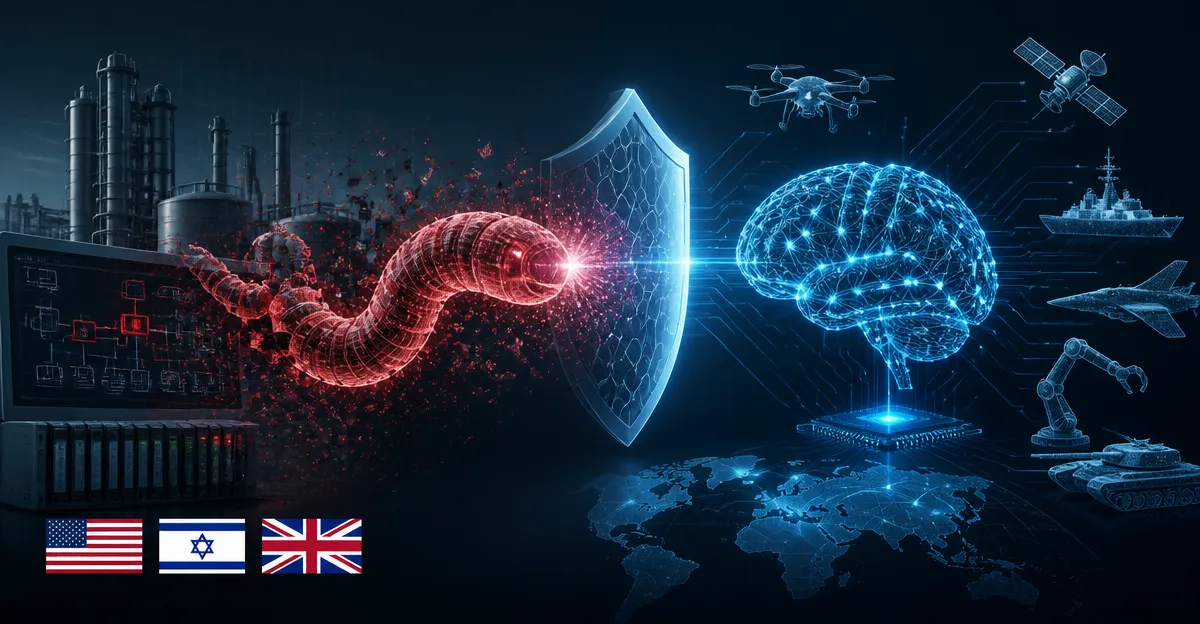
Operation Olympic Games, reportedly a joint U.S.-Israeli effort, aimed to derail Iran’s nuclear ambitions. Security journalist Kim Zetter called it the world’s first cyber weapon because it shattered the boundary between the cyber and physical worlds. Its sophistication became the template for future state-sponsored operations and a stark warning for the AI era.
How Stuxnet Crossed the Air Gap
Iran’s Natanz facility was air-gapped—no internet connection. Attackers couldn’t just hack in. They used a time-tested vector: human carriers. The operation first infected five vendor companies supplying parts to Natanz. Workers unknowingly carried the malware on USB drives into the facility.
Once inside, Stuxnet targeted Microsoft Windows systems but its real prey was Siemens industrial software—STEP7, WinCC, and PCS 7. These controlled the programmable logic controllers (PLCs) and SCADA systems managing the centrifuges. The malware lay dormant for days, recording normal operations to build a convincing facade.
Then came the sabotage. Stuxnet periodically altered valve pressures and centrifuge speeds, disrupting uranium enrichment. All the while, it fed prerecorded routine data to the SCADA monitors. Engineers saw nothing wrong. According to the IAEA, inoperable centrifuges spiked sharply starting in 2009, coinciding with Stuxnet’s deployment.
The attack set back Iran’s program by years—without a single missile. It proved that code alone could achieve strategic military objectives. This shifted the paradigm from cyber espionage to cyber-physical warfare.
Stuxnet’s Offspring and the AI Threat
Stuxnet’s DNA spread fast. Duqu (2011), Flame (2012), and Havex (2013) borrowed its architecture. Later, Industroyer took down Ukraine’s power grid in 2016. Triton targeted Saudi petrochemical safety systems in 2017. Pipedream (2022) showed a modular design for disrupting multiple industrial sites. Each echoed Stuxnet’s core lesson: operational technology (OT) and industrial control systems (ICS) are prime targets.
Now, AI is supercharging that threat. By 2026, agentic AI models are embedded in OT and ICS, automating vulnerability discovery and exploitation. Anthropic’s Mythos model can autonomously find and exploit multiple zero-days in legacy operating systems critical to infrastructure. In September 2025, Mythos reportedly uncovered a largely AI-orchestrated cyber espionage campaign with minimal human input.
This raises urgent questions. Stuxnet took years of human intelligence and custom engineering. AI could compress that timeline to days or hours. The attack surface is expanding as critical infrastructure—from energy grids to pharmaceutical plants—becomes smarter and more connected. Defenders face an adversary that learns and adapts without direct human control.
Stuxnet was a warning written in code. As AI models like Mythos and Fable evolve, that warning echoes louder. The line between cyber and physical destruction is now a highway for autonomous agents. What took a multinational operation may soon be achievable by a single well-trained model.