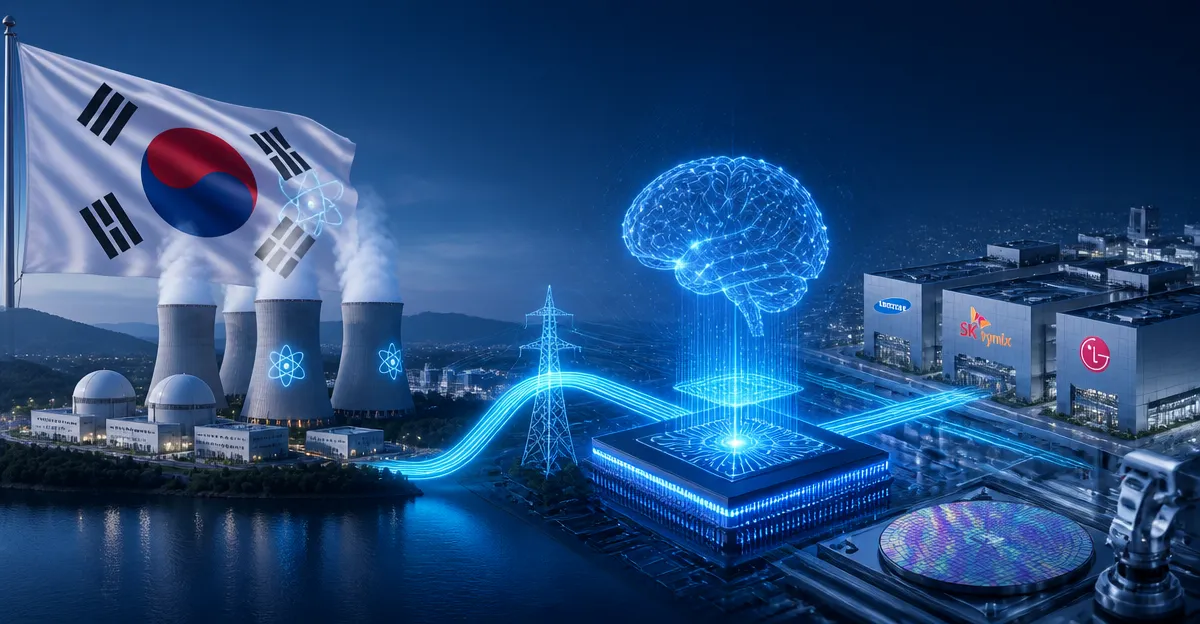
July 13, 2026, (Inside AI) — South Korea is making an abrupt U-turn on energy policy, reviving nuclear power to fuel a colossal expansion of semiconductor fabrication plants and AI data centers. The government has concluded that renewables alone cannot meet the relentless 24/7 baseload demand of these mega-projects, abandoning its post-Fukushima nuclear phase-out.
The pivot is driven by sheer necessity. A new southwestern semiconductor cluster for Samsung Electronics and SK hynix, coupled with massive AI data centers, will require an additional 24.7 gigawatts (GW) of generation capacity. This comes on top of a national grid already straining toward a projected peak demand of 129.3 GW by 2038. A separate chip cluster in Yongin demands another 15 GW.
Time is the immediate enemy. The first southwestern fabs are slated to open by 2030, but new nuclear reactors take at least seven to ten years to build. The initial four fabs alone will draw 6.3 GW, forcing planners to lean on the existing Hanbit Nuclear Power Plant, solar power, and energy storage systems as a stopgap.
Industry leaders are pressing for more. Samsung Electronics Vice Chairman Jun Young-hyun recently urged the government to expand nuclear power and liquefied natural gas (LNG) cogeneration without fail. Climate, Energy and Environment Minister Kim Sung-whan echoed this, confirming that new reactors are highly likely if the southwest cluster scales up to match the Yongin project.
Officials are discussing adding four new reactors to the Hanbit and Saeul sites, leveraging existing infrastructure to bypass lengthy permitting. State-run Korea Hydro & Nuclear Power recently selected Yeongdeok for two large-scale 2.8 GW reactors and pinpointed Busan’s Gijang County for a 700-megawatt small modular reactor (SMR).
But electricity is only half the story. The southwestern cluster also needs 650,000 tons of water daily for cooling and operations, risking environmental damage and conflicts with agriculture. The government plans to upgrade existing infrastructure rather than build new dams, raising the Dongbok Dam to secure 300,000 tons per day and tapping the Juam and Jangheung dams for the rest.
South Korea’s nuclear reversal mirrors a global trend. Nations from Japan to France are extending reactor lifespans or building new ones to meet AI-driven energy demands. The International Energy Agency projects data center electricity consumption could double by 2030, reaching 1,000 terawatt-hours. In the U.S., tech giants are striking direct deals with nuclear operators, while small modular reactors attract billions in investment.
Yet critics warn of nuclear’s long lead times and cost overruns. South Korea’s own experience with the Shin Hanul reactors saw delays and budget blowouts. The government’s bet on SMRs remains unproven at scale, with no commercial SMR operating globally. The water crunch adds another layer of complexity, as climate change intensifies droughts in the region.
Ultimately, South Korea’s computing expansion is no longer just a tech investment story. It is a high-stakes energy infrastructure problem. If power and water delivery arrive late, billions of dollars in digital infrastructure will sit completely useless.