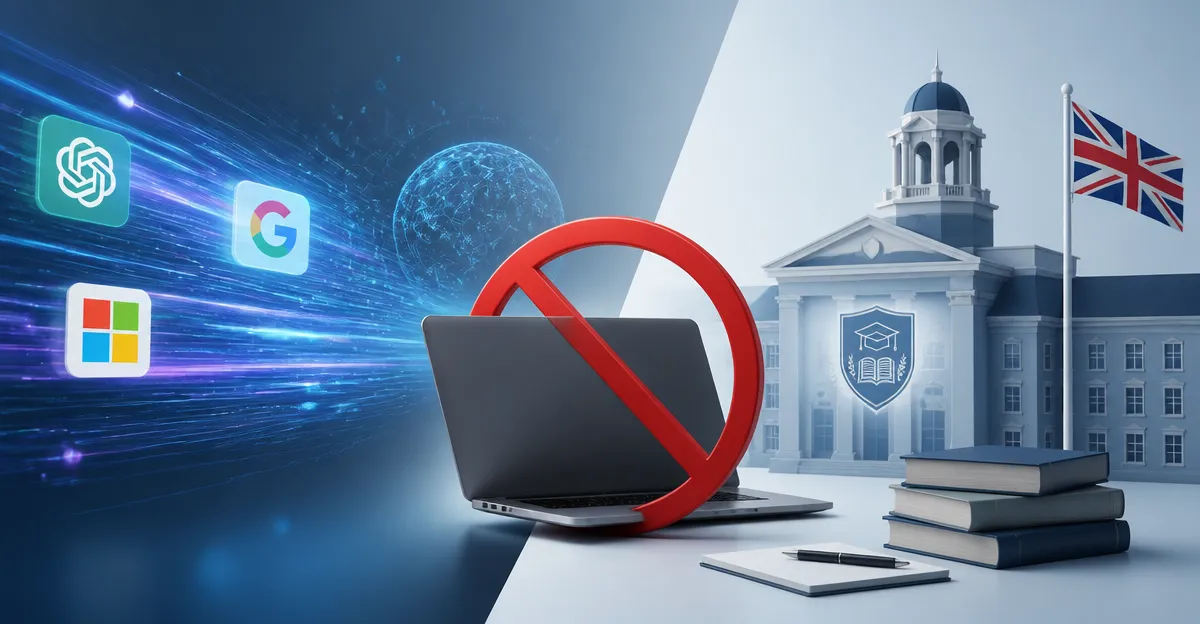
July 13, 2026, (Inside AI) — The University of Chicago Law School will ban laptops and smartphones for first-year students starting the 2026-2027 academic year, aiming to foster independent critical thinking in an era of pervasive AI tools.
The policy, part of a broader “AI-resilient pedagogy and assessments” strategy, eliminates electronic devices during classes and mandates in-person, internet-free examinations. The move comes as the legal profession grapples with automation risks and the rapid integration of AI into daily practice.
The law school’s new AI strategy states:
“We need to ensure that our students actually learn to think critically, strategically, and independently without relying on AI.”
Read: Norway Bans Generative AI in Elementary Schools to Protect Cognitive Skills
It adds:
“Technology is changing too fast. Thus, all the changes we are currently making will be subject to review, reconsideration, and revision as we learn more and as both technology and the practice of law evolve.”
The ban targets only first-year students, a foundational period when core analytical skills are developed. Upper-year courses may still integrate AI tools, as the school acknowledges AI is already “a pervasive part of legal practice.” The curriculum will include training on using AI “responsibly, effectively, and ethically.”
This decision reflects a growing tension in higher education. While many institutions rush to incorporate generative AI into classrooms, Chicago is betting that a temporary tech-free environment will produce more capable lawyers. The approach mirrors earlier debates about calculators in math classes—where initial bans gave way to thoughtful integration once pedagogical goals were secured.
A Profession Under Siege by Automation
The legal sector faces unprecedented automation pressure. An April 2026 AI Exposure Index found that 100% of legal occupations are classified as “high exposure,” meaning AI can perform cognitive tasks central to the profession. Document review, legal research, and even drafting are increasingly handled by machine learning systems.
Last month, UK-based Garfield AI made history by winning a trial using an AI lawyer to gather witness statements and prepare the case. A human barrister presented it in court. CEO Philip Young wrote on LinkedIn:
“This is the first trial ever won by an AI lawyer against human opposition, anywhere, ever. It’s the dawn of a new age of access to justice.”
Read: AI Use Slashes Chinese Students’ Exam Scores by 20% in 30-Month Study
Such milestones amplify the urgency felt by law schools. If AI can already win cases, what does that mean for the human skills taught in traditional classrooms? Chicago’s answer is to double down on uniquely human competencies: strategic judgment, ethical reasoning, and the ability to challenge AI outputs rather than passively accept them.
Critics, however, argue that banning devices is a Luddite response. Dan Rodriguez, a legal education scholar at Northwestern University, notes: “You don’t teach digital natives to swim by keeping them out of the water. The real skill is learning to use AI as a tool, not a crutch.” Other law schools, like Stanford and Harvard, have embraced AI-assisted legal research in their clinics, treating AI literacy as a core competency.
Historical Echoes and Future Uncertainty
Chicago’s move echoes past pedagogical battles. In the 1970s, calculators were banned from many classrooms over fears they would erode arithmetic skills. Over time, educators learned to design curricula that assumed calculator use while still teaching underlying concepts. The AI debate may follow a similar arc, but the stakes are higher: law schools are not just teaching skills but shaping the ethical framework of future justice systems.
The policy’s built-in review clause signals humility. The school explicitly states that all changes are subject to revision as technology evolves. This adaptive stance may prove more important than the ban itself, acknowledging that no one truly knows what legal practice will look like in five years.
Meanwhile, the broader legal industry is watching closely. Major firms are already deploying AI for e-discovery and contract analysis, but they still rely on human lawyers for courtroom strategy and client counseling. Chicago’s experiment could either produce graduates better equipped for that hybrid reality or leave them playing catch-up with tech-savvy peers from other institutions.
As AI’s role in law grows, the definition of “essential human skills” will keep shifting. The University of Chicago’s gamble is that a brief, enforced disconnection will forge lawyers who can not only use AI but also rise above it when justice demands.