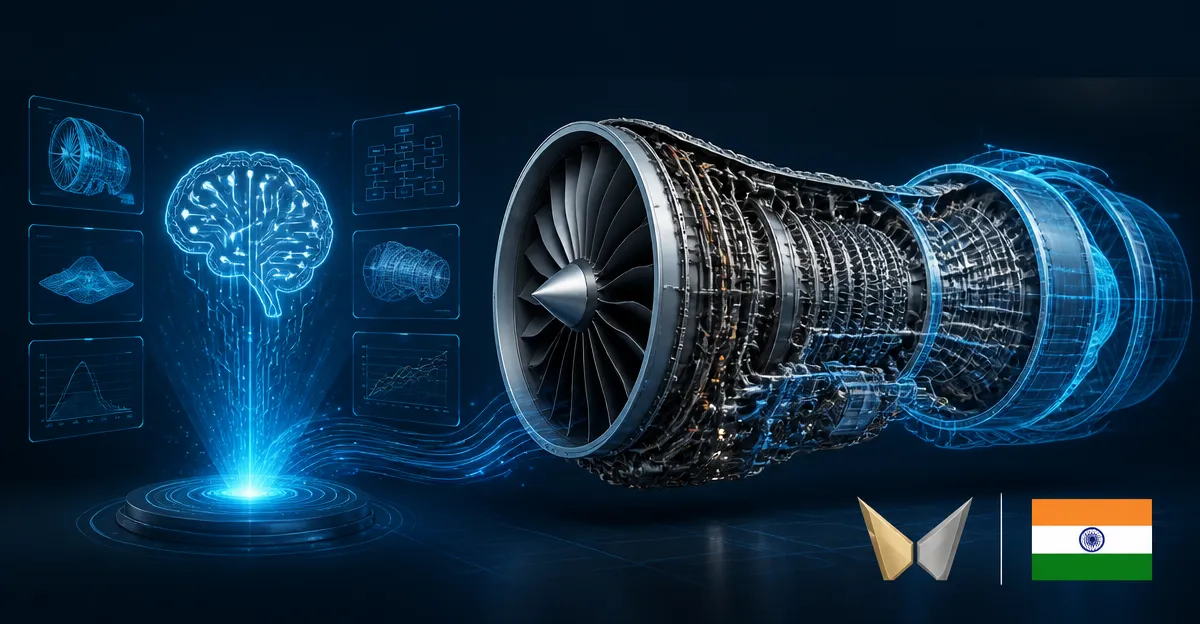
July 15, 2026, (Inside AI) — Can artificial intelligence design and build a jet engine? The JARVIS Challenge at MIT put that question to the test, pitting undergraduate teams against a four-week sprint to create a working gas turbine using AI as their primary engineering partner.
The results reveal a nuanced picture: AI can dramatically accelerate design exploration and fill knowledge gaps, but engineering judgment, hands-on experience, and manufacturing realities remain stubborn bottlenecks. The winning team, 811 Crew, largely resisted AI, relying instead on fundamentals and teamwork.
The JARVIS Challenge (Jet-engine AI Research and Validation Intensive Sprint) gave 31 students access to MIT Parley, a platform aggregating frontier large language models, with unlimited usage funded by sponsors including Safran and Voyager Technologies. The goal: build a single-spool engine producing 50-100 pounds of thrust, running on Jet-A fuel, and completing five 60-second runs.
Teams used AI to summarize textbooks, learn design software, source vendors, and compare architectures. But by week two, when detailed CAD work and prototyping began, hallucinations and a lack of physical understanding eroded trust. “The moment the engineer doesn’t know what is going on and the AI is in charge is the moment the design becomes unreliable,” said Elizabeth Tupaj of team 811 Crew.
Read: Research: The Innovation Problems AI Can’t Solve
Teaching assistant John Zhang noted that early frustrations with AI led some students to abandon it later. Meanwhile, vendor relationships proved critical: AI-sourced suppliers often ignored tight timelines, while personal connections delivered.
Of three finalists, only Fast and Fractured achieved first-attempt ignition of their mini-combustor, heavily using AI for trade studies. But their engine test was cut short when the rotor seized. Team 811 Crew, with more turbomachinery experience, emerged victorious, generating net thrust after transitioning to Jet-A.
“We had people who were at least somewhat familiar with the design software, mechanical engineers who knew how to build anything, and aerospace engineers who had taken classes on the design of gas turbine engines specifically,” Tupaj said.
The Human Factor in AI-Native Engineering
Professor Zolti Spakovszky, director of the MIT Gas Turbine Laboratory, emphasized that AI can accelerate safety-critical hardware engineering, but engineering judgment remains decisive. “An AI-native engineer is not defined by using AI, but by leading it—knowing when to trust it, when to challenge it, and how to translate AI outputs into working hardware,” he said.
This aligns with broader industry debates. While companies like Boeing and Airbus explore AI for generative design, experts caution that complex physical systems demand deep domain knowledge. A 2025 National Academies report on AI in aerospace highlighted similar gaps: AI excels at optimization but struggles with novel failure modes and integration challenges.
Professor Andreea Bobu observed a sweet spot: “The team that moved fastest in the sprint was experienced and leaned heavily on AI to get there. The team that eventually won was more resistant to AI; they had the expertise, but that skepticism made them slower.” She stressed training engineers to have both judgment and instinct for AI tools.
Read: IIT Hyderabad Student’s AI Tool Cuts Cold-Forging Defects, Wins Japan Job
The competition also revealed a stark experience multiplier. Performance correlated strongly with year in school, reinforcing that AI amplifies existing expertise rather than replacing it. “My main takeaway is that in the AI era, education is more valuable than ever,” said Professor Zachary Cordero, associate director of the Gas Turbine Lab.
Manufacturing Remains the Rate-Limiting Step
Despite AI’s design assistance, physical fabrication proved the ultimate bottleneck. “Manufacturing—not engineering design or analysis—remained the fundamental rate-limiting step,” Spakovszky said. Vendors, material constraints, and machining realities dictated timelines more than any algorithm.
This mirrors findings from DARPA’s Adaptive Vehicle Make program, which found that digital design far outpaces physical production. The JARVIS Challenge underscores that for tough-tech industries, AI copilots can compress early stages but hit a wall when atoms must be reshaped.
Sponsors saw the experiment as a glimpse into engineering’s future. “You’re honing skills that are not just nice to have—they’re going to be the future baseline in the engineering workforce,” said Ryan Hefron of Voyager Technologies. Vincent Garnier of Safran Tech praised students’ rapid adaptation: “It makes me confident that this generation of leading engineers will probably not fall prey to easy and shortsighted use of AI.”
The JARVIS Challenge suggests that while AI won’t soon replace engineers, those who master its use—with critical thinking intact—may redefine competitive dynamics in aerospace and beyond.