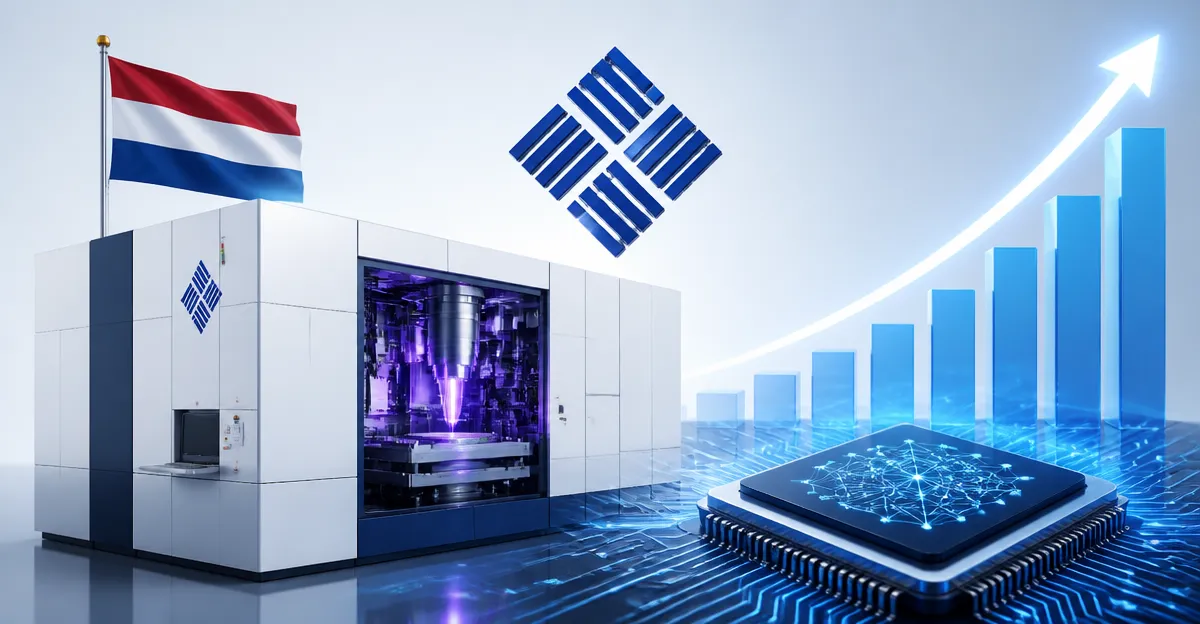
July 15, 2026, (Inside AI) — ASML Holding NV, the Dutch semiconductor equipment giant, reported second-quarter financial results that surpassed analyst expectations, driven by robust demand from artificial intelligence chipmakers. The company posted revenue of 9.33 billion euros ($10.90 billion) for the period ending June 30, exceeding the 8.80 billion euros forecast by analysts polled by LSEG. Net income reached 2.92 billion euros, comfortably ahead of the 2.62 billion euros consensus estimate.
The outperformance underscores ASML’s pivotal role in the AI supply chain. As the exclusive producer of extreme ultraviolet (EUV) lithography machines essential for manufacturing cutting-edge logic and memory chips, ASML directly benefits from the capital expenditure boom among AI chip designers and foundries. Orders for its most advanced systems remain strong even as broader geopolitical tensions cloud the semiconductor landscape.
AI Demand Offsets China Export Headwinds
ASML’s results highlight a bifurcated market. While AI-related orders surged, the company continues to navigate tightening export controls on advanced chipmaking equipment to China. The Dutch government, under pressure from the United States, has progressively restricted shipments of ASML’s most sophisticated tools to Chinese firms. In its earnings statement, ASML acknowledged that “uncertainty over sales to China” persists, yet the sheer volume of AI-driven demand compensated for any shortfall.
This dynamic reflects a broader industry trend. Global spending on AI infrastructure—from data center GPUs to high-bandwidth memory—has forced chipmakers to accelerate fab expansions. Taiwan Semiconductor Manufacturing Co. (TSMC), Samsung Electronics, and Intel are all ramping up capacity for advanced nodes, each requiring ASML’s lithography systems. According to a recent report by Counterpoint Research, spending on semiconductor equipment for AI applications is expected to grow 30% year-over-year in 2026.
Peter Wennink, ASML’s outgoing CEO, stated during the earnings call:
“The secular growth trend in AI is structural, not cyclical. We see no signs of a slowdown in demand for the most advanced nodes, which is where our value proposition is strongest.”
Wennink’s successor, Christophe Fouquet, who assumed the role in April 2026, echoed this sentiment, emphasizing that the company’s backlog remains at record levels, providing visibility well into 2027.
Lithography Leadership and Competitive Moats
ASML’s dominance in EUV technology gives it an unassailable competitive advantage. No other company has commercialized EUV lithography, which uses light with a wavelength of 13.5 nanometers to etch features smaller than 7nm. The complexity and cost of these machines—each high-NA EUV system costs over 350 million euros—create enormous barriers to entry. As AI models grow larger, requiring more powerful and efficient chips, the industry’s reliance on ASML’s tools intensifies.
However, some analysts caution that ASML’s reliance on a handful of mega-customers introduces concentration risk. In a note to clients, Jefferies analyst Janardan Menon wrote:
“While AI tailwinds are undeniable, ASML’s order book is increasingly skewed toward three or four key accounts. Any capex digestion phase could lead to lumpy quarters.”
Still, the near-term outlook appears robust. ASML reiterated its full-year guidance, projecting revenue growth of approximately 25% compared to 2025. The company’s shares rose 2.3% in early Amsterdam trading following the announcement.
Beyond financials, ASML continues to invest in next-generation technologies. The company is developing hyper-NA EUV systems with a numerical aperture above 0.75, targeting sub-2nm chip production by the end of the decade. Such advancements are critical for sustaining Moore’s Law and enabling future AI models that demand exponentially more compute.
Geopolitical risks remain the wild card. The U.S. presidential election in November 2024 could reshape export control policies, and any escalation in tech tensions between Washington and Beijing could impact ASML’s ability to service existing Chinese customers. For now, though, the AI gold rush is drowning out those concerns.