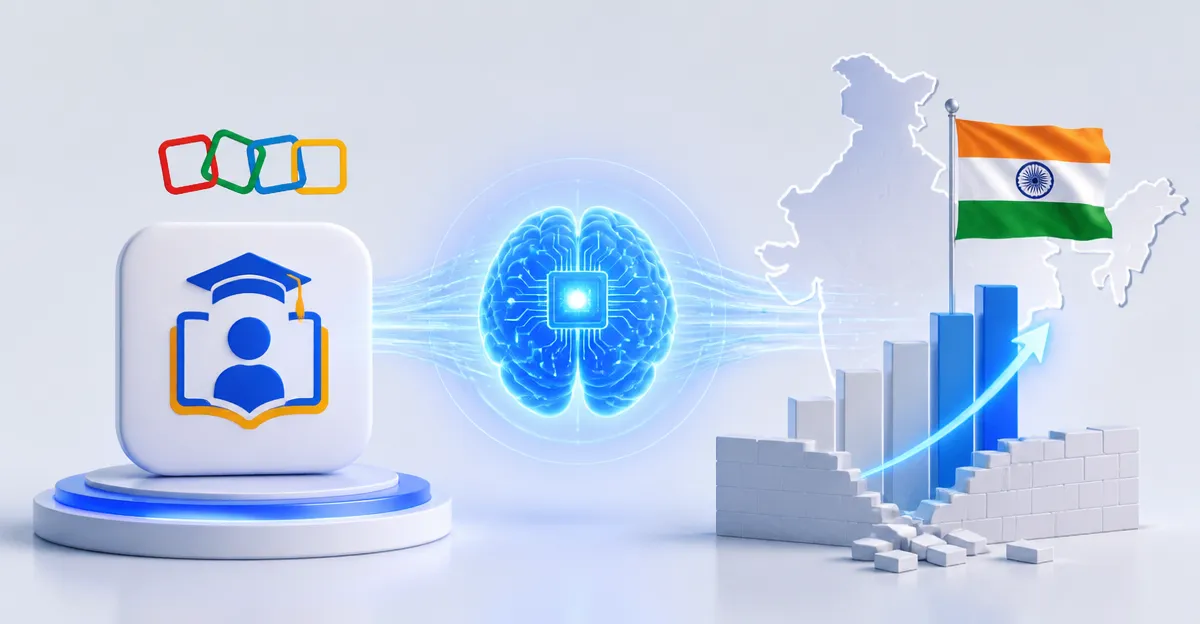
July 15, 2026, (Inside AI) — Zoho has launched Classes 2.0, a major update to its learning management system, embedding artificial intelligence across lesson planning, grading, and a subject-locked AI tutor. The platform, first built during the Covid-19 pandemic as a simple assignment tool, now targets students, teachers, and institutions in India’s strained education system.
Dev Anand Ramasamy, vice-president of product management at Zoho, said the redesign follows nearly five years of feedback from over 1,000 teachers. “I would have personally met at least 1,000 teachers during this period,” he noted, tracing the product’s evolution from a stopgap to a full platform used by state governments, universities, and schools.
Ramasamy framed the update around three pain points. Students, he said, are “digital natives” who disengage quickly. Indian teachers lack the administrative support common in the US, where graduate assistants handle grading. “Teachers have to do everything all by themselves,” he said, eating into classroom time. Institutions face mounting compliance demands from bodies like the All India Council for Technical Education (AICTE), with penalties for shortfalls.
“If we put AI in the middle of this mix, it can help students learn better, free up teachers’ time, and help institutions manage compliance,” Ramasamy said. That philosophy drives Classes 2.0’s feature set.
Read: Maharashtra Mandates AI Training for All School Teachers by September 30
AI Tutor With Guardrails, Not a Free-for-All
The AI tutor is deliberately restricted to a student’s enrolled subjects. “It will first show you the subjects that you are being allotted… anything outside that will not be supported,” Ramasamy explained. This design choice aims to curb hallucinations by narrowing context to specific courses and semesters. Zoho remains “model agnostic” and uses tight prompting to boost accuracy. “We haven’t received any complaints of such cases so far,” he said on factual errors.
Other additions include a Duolingo-style micro-learning feature with daily streaks, an AI career counseling tool, and an AI course builder that can generate a full course—description, outcomes, and thumbnail—in under 30 seconds across 22 Indian languages. Ramasamy demonstrated the builder, stressing that output needs teacher review: “It is an editor. You can open the editor and then add your own content.”
For teachers, the platform automates lesson planning, replacing shared Excel sheets, and offers AI-assisted grading for computer science assignments. Ramasamy estimated this could save roughly 150 hours of manual grading per teacher per semester. Crucially, AI-generated feedback is not sent directly to students. “It is up to the teacher to edit and then return to the student,” he said.
Institutions get a course-outcome mapping tool to ease accreditation reporting. On privacy, Ramasamy stressed transparency: “You cannot use it like your own personal chatbot.” Institutions can disable AI access for students entirely. Offline access is limited to cached content on the mobile app, not full downloads, due to device constraints.
Free for Government, Paid for Private—A Deliberate Split
Zoho offers Classes 2.0 free to central and state government institutions, a move Ramasamy linked to removing budget barriers. Individual teachers can also use it free for up to 100 students. Private schools and colleges pay Rs 500 per teacher per month, with a professional tier for custom needs. The government free tier “remains free” regardless of monetization elsewhere.
Ramasamy said Zoho may charge for dedicated regional-language support staff in specific cases, but not for the core license. The platform supports 22 scheduled Indian languages; interface translation was handled separately, while AI features use the underlying model’s multilingual capabilities.
Read: Anthropic Launches Free Claude Access for US K-12 Teachers
This launch lands amid a broader push for AI in Indian education. Google recently unveiled its ‘ATL Saathi app for teachers’, and the government’s DIKSHA platform integrates AI tools. Yet critics note that AI in education often amplifies existing divides—between well-resourced private schools and underfunded government ones, or between urban and rural connectivity. Zoho’s free tier for government institutions directly addresses the cost barrier, but the offline limitations and device requirements may still leave some students behind.
Ramasamy reflected on the product’s larger goal: “Education has been a great leveller. AI is just going to enhance that further.” Whether Classes 2.0 can truly level the field depends on execution beyond the feature list—especially in India’s most underserved classrooms.