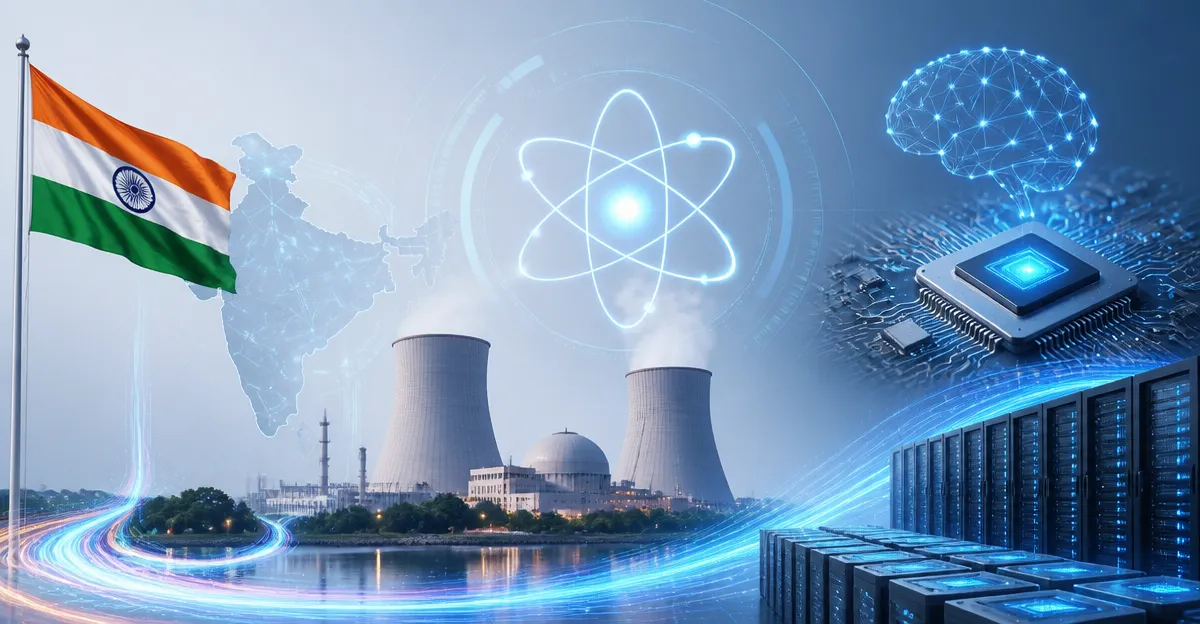
August 15, 2026, (Inside AI) — India will need massive new electricity generation to power its expanding AI, semiconductor, and data centre ambitions. Prime Minister Narendra Modi has set a target of 100 GW of nuclear power by 2047, with five new reactors commissioned this decade.
Speaking during his Independence Day address, Modi tied the nuclear push directly to emerging technology demand. He said the new digital economy cannot run without reliable energy.
“It will be difficult to run this new world without energy, and therefore, whether it is chips, AI or data centres, we will need very large amounts of electricity,” Narendra Modi, Prime Minister, India
The announcement follows the SHANTI Act, passed last year, which opened India’s civil nuclear sector to wider private participation. On Friday, the Department of Atomic Energy released draft rules under the Act covering licensing, safety oversight, and nuclear liability.
Read: South Korea’s Power Demand to Soar 25-30 GW on AI Boom as Nuclear Expansion Weighed
India’s current nuclear fleet stands at 25 operational reactors with 8.7 GWe capacity. Ten reactors with about 8 GWe are under construction. Another ten units with 6.6 GWe are in pre-project stages. Reaching 100 GW by 2047 would require more than a tenfold expansion in just over two decades.
Small reactors anchor a two-track deployment plan
The government is pursuing both large conventional reactors and small modular reactors (SMRs). Indigenous pressurised heavy water reactors remain the backbone, but SMRs are seen as faster to deploy and more flexible for industrial decarbonisation.
India’s Bhabha Atomic Research Centre is designing three SMR types. These include the 200 MWe Bharat Small Modular Reactor, a 55 MWe unit, and a 5 MWt high-temperature gas-cooled reactor for hydrogen production.
The Nuclear Energy Mission has a budget of Rs 20,000 crore for SMR research and deployment. The government is also studying old thermal power plant sites for repurposing into nuclear sites, which may suit smaller reactors better than large ones.
International collaboration is shifting toward SMRs. In May, an American nuclear delegation was told India wants to enter the SMR manufacturing value chain. Foreign partnerships are likely to focus on SMRs rather than large light water reactors due to cost concerns.
Fast breeder milestone reshapes fuel security math
India’s three-stage nuclear programme aims for long-term fuel self-reliance. The first stage uses natural uranium in PHWRs. The second stage uses fast breeder reactors to convert thorium into usable fuel. The third stage will run primarily on thorium-derived uranium.
In April, India’s first indigenous fast breeder reactor at Kalpakkam attained criticality. This is a major step toward using India’s abundant thorium reserves and reducing dependence on imported uranium.
Read: Brookfield Sees 6.5 GW of AI Data-Centre Capacity Coming Online in India
“This year, India crossed an important milestone by mastering fast breeder nuclear technology. With this, we have taken a major step towards achieving self-reliance in nuclear fuel and have made significant progress in that direction,” Narendra Modi, Prime Minister, India
The fast breeder milestone matters for AI infrastructure. Data centres and chip fabs need continuous, carbon-neutral baseload power. Nuclear offers that, while renewables require balancing from other sources.
India’s nuclear liability framework remains under scrutiny. The Supreme Court is examining liability limits under the SHANTI Act. Global suppliers from Russia, the US, and France have shown interest, but liability concerns have slowed past deals.
The 100 GW target is ambitious. India added only about 2 GW of nuclear capacity in the past decade. Hitting the target will require sustained political will, private capital, and faster regulatory approvals.