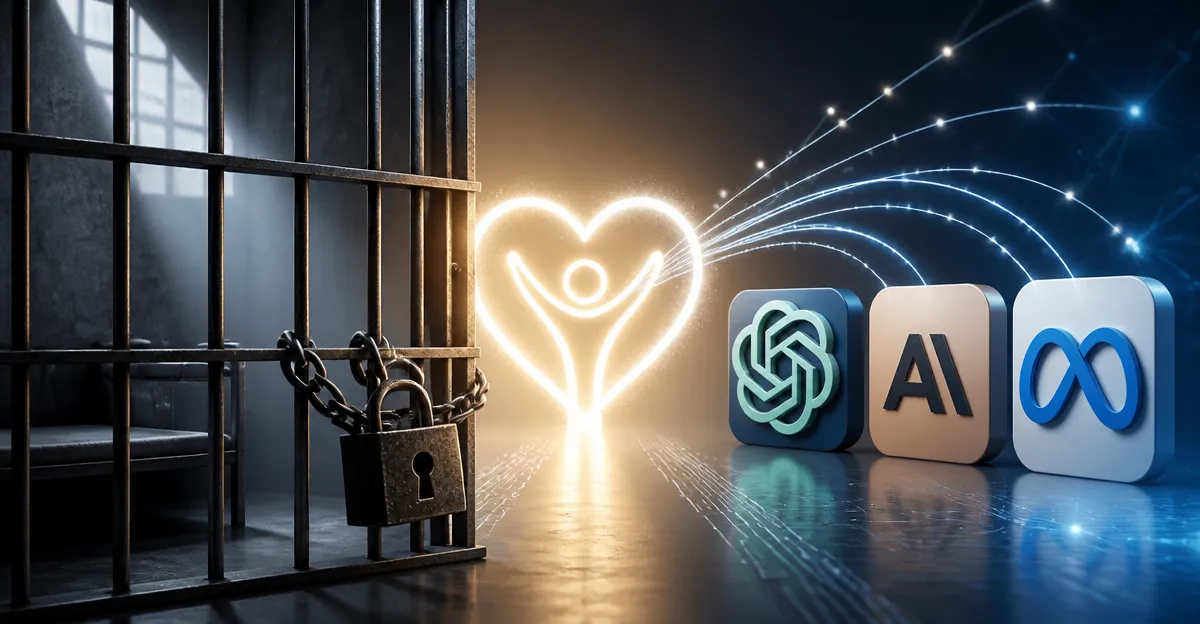
August 16, 2026, (Inside AI) — Wynd Kaufman, a 69-year-old retired teacher from Berkeley, surrendered to San Francisco authorities on Friday, becoming the first person jailed for protesting artificial intelligence. Her crime: chaining and locking the front doors of OpenAI’s headquarters last year with the activist group StopAI.
Kaufman was convicted in June of interfering with a business, trespassing with intent to interfere, unlawful assembly, and refusal to disperse a riot. On Friday, sheriff’s officers handcuffed her as supporters sang to the tune of the Battle Hymn of the Republic: “Rise up, rise up and join us/Do not let the tech bros destroy us.”
Her case marks a turning point in the escalating conflict between AI developers and those who warn the technology poses an existential risk. Prosecutors framed the verdict as a defense of public safety, while activists see a moral crusade being criminalized.
Kaufman rejected the label of martyr. Before entering custody, she said she acted to sound an alarm, not to seek punishment. Her message to the CEOs of OpenAI, Anthropic, and Meta was blunt: “regain your humanity.”
From Sit-In to Jail Cell: A Necessity Defense Rejected
The protest stemmed from a February 2025 sit-in at OpenAI’s San Francisco office. Kaufman refused to move, arguing she was legally justified in preventing a greater harm: the uncontrolled development of artificial superintelligence.
San Francisco District Attorney Brooke Jenkins said the guilty verdict sent “a resounding message rejecting the notion that protesters can endanger public safety as a means to an end.”
Kaufman saw it differently. Before imprisonment, she said:
“It’s absolutely frightening and appalling that these CEOs and AI experts know the dangers and they are pursuing it anyway. That to me is unconscionable and reprehensible.” Wynd Kaufman, retired teacher and activist
Her defense called Stuart Russell, a leading AI professor at UC Berkeley and president of the International Association for Safe and Ethical AI. Russell testified that OpenAI’s activities “pose an unacceptable risk,” alleging the company deployed AI systems with inadequate safeguards.
Russell said further development “must be conditioned on rigorous guarantees of safety, which are currently unavailable.” After the verdict, he added:
“Wynd stood up for her beliefs and is being punished. What is unreasonable is allowing a process to continue whereby private entities knowingly create a substantial extinction risk for private gain.” Stuart Russell, UC Berkeley professor
Escalating Warnings Amid a Trillion-Dollar Race
Kaufman’s jailing coincides with louder alarms from mainstream figures. This week, US Senator Bernie Sanders demanded a pause on AI development, citing fears it could “lead to new bioweapons that result in the deaths of tens of millions of people.”
Over 1,000 researchers at frontier AI labs signed a letter this summer warning of “a real risk that capability development rapidly accelerates beyond our ability to understand or control the resulting systems.”
David Kreuger, a University of Montreal AI safety expert, drew a historical parallel. He said Kaufman “could go down in history as the Rosa Parks of AI risk,” referencing the civil rights icon whose act of defiance catalyzed a movement.
Kaufman played down the comparison, noting her short sentence. But she said the analogy had crossed the campaign’s mind, given she is believed to be the first AI protester jailed.
The stakes are financial as well as existential. Frontier AI labs are racing toward IPOs forecast to reach trillions in valuation. Washington and Beijing compete for AI supremacy, creating a disincentive for tougher safety regulation.
Kaufman’s target audience is ordinary people. Her demand: “stop the progress of this technology. Let’s get a global ban on the race to superintelligence.”
StopAI itself faces internal turmoil. Co-founder Sam Kirchner, 27, went missing last November after an internal dispute over violent tactics. He reportedly told colleagues the “non-violence ship has sailed,” raising fears of action against OpenAI employees. StopAI says it remains committed to non-violent direct action.
OpenAI did not respond to a request for comment. Kaufman, meanwhile, braces for prison life: an orange jumpsuit, “horrible food, dirt [and] you can’t sleep.” She has been jailed before, for activism spanning Nicaragua, nuclear disarmament, Western Sahara, and Palestine.
Her verdict may be the first of many. As AI capabilities accelerate, the line between civil disobedience and criminal trespass is becoming a frontline in the debate over who controls the technology’s future.