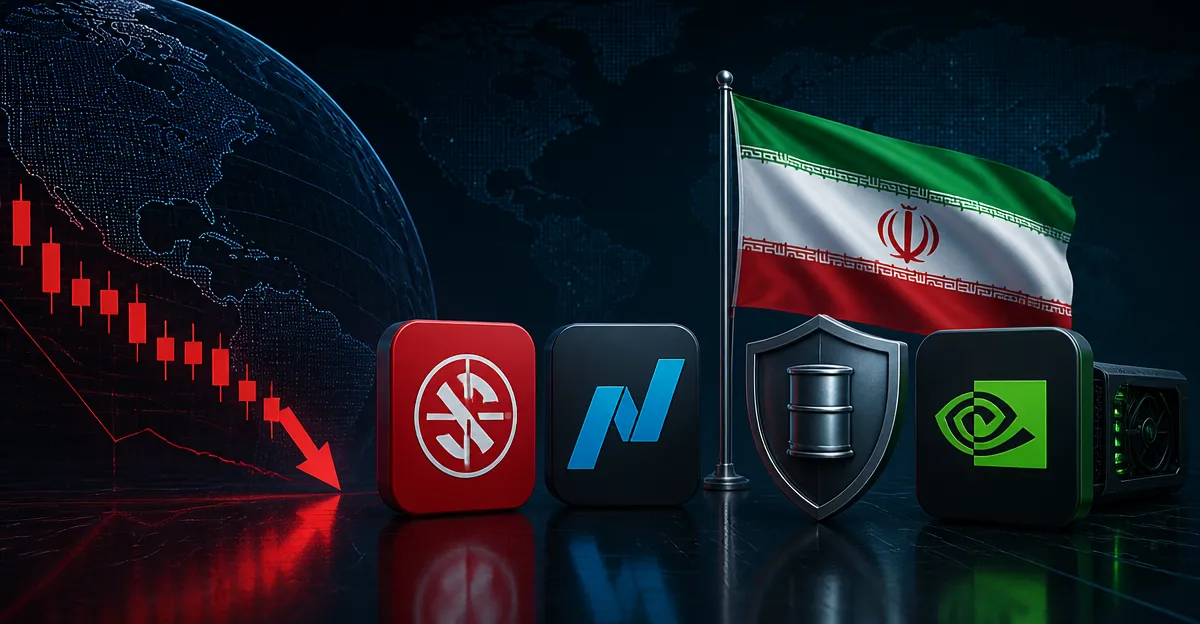
August 24, 2026, (Inside AI) — U.S. stock futures slipped on Monday as investors braced for a week shaped by three forces: fresh sanctions on Iran, Federal Reserve Chair Kevin Warsh’s Jackson Hole speech, and Nvidia’s quarterly results.
S&P 500 E-minis fell 12.75 points, or 0.17%, while Nasdaq 100 E-minis dropped 176.5 points, or 0.60%, by 05:30 a.m. ET. Dow E-minis were down 12 points, or 0.02%.
The U.S. is preparing what it calls “the greatest financial offensive ever,” with Treasury Secretary Scott Bessent scheduled to hold a press conference Monday afternoon. The sanctions target Iran’s trade partners, yet oil prices fell over $1 a barrel as traders booked profits ahead of the announcement.
Last week’s surge in Treasury yields, with the 30-year yield touching a 19-year high, hammered technology stocks. The S&P 500 Information Technology sector lost more than 3% for the week. Higher energy costs and ballooning government debt drove the yield spike before the Treasury announced support measures.
Now attention shifts to Nvidia, the world’s most valuable company, which reports earnings Wednesday. Any sign of slowing growth could reignite worries about stretched valuations and the durability of the AI-driven rally.
“Stellar results may not guarantee a positive reaction given the souring sentiment around AI heavyweights recently,” said Ipek Ozkardeskaya, senior analyst at Swissquote Bank.
“With strong Q2 earnings already baked into prices, AI financing worries and political/geopolitical headlines are gently taking control of market action.”
Bloomberg News reported Saturday that some of Nvidia’s largest customers have been told prices of servers containing its AI chips would rise by more than 15% in many cases.
Trading in megacaps was mixed. Apple rose 0.5% and Nvidia added 0.1% before the bell, while Alphabet fell 0.4% and Amazon.com lost 0.2%. Most chipmakers were lower. Data storage companies Sandisk dropped 4.5% and Seagate lost 3.3%.
U.S.-listed shares of Alibaba slipped 3.4% after the Chinese e-commerce giant launched a $10.2 billion share sale at a sharp discount to fund its AI ambitions.
Financing of the AI buildout through various methods is weighing on free cash flow at many hyperscalers. Investors are questioning how far spending can stretch without hurting bottom lines.
Warsh’s speech at the Fed’s annual Jackson Hole symposium in Wyoming will be parsed for clues on monetary policy amid rising oil prices and bond yields.
“We no longer know who will ultimately control the long end of the U.S. yield curve: the Treasury, the Fed, or the bond market itself… In the wake of last week’s reaction to Treasury’s announcement, the market still has the last word,” said Ozkardeskaya.
“Jackson Hole gathering will bring some clarity on how the Fed will fit into this.”
Money market participants are fully pricing in one 25-basis-point interest rate hike by the end of 2026, according to LSEG data. A benign inflation report earlier this month significantly reduced chances of an immediate rate hike.
The convergence of geopolitical risk, monetary policy uncertainty, and AI earnings pressure creates a fragile backdrop for equities. Nvidia’s results will serve as a litmus test for whether the AI trade can withstand higher yields and mounting financing concerns.