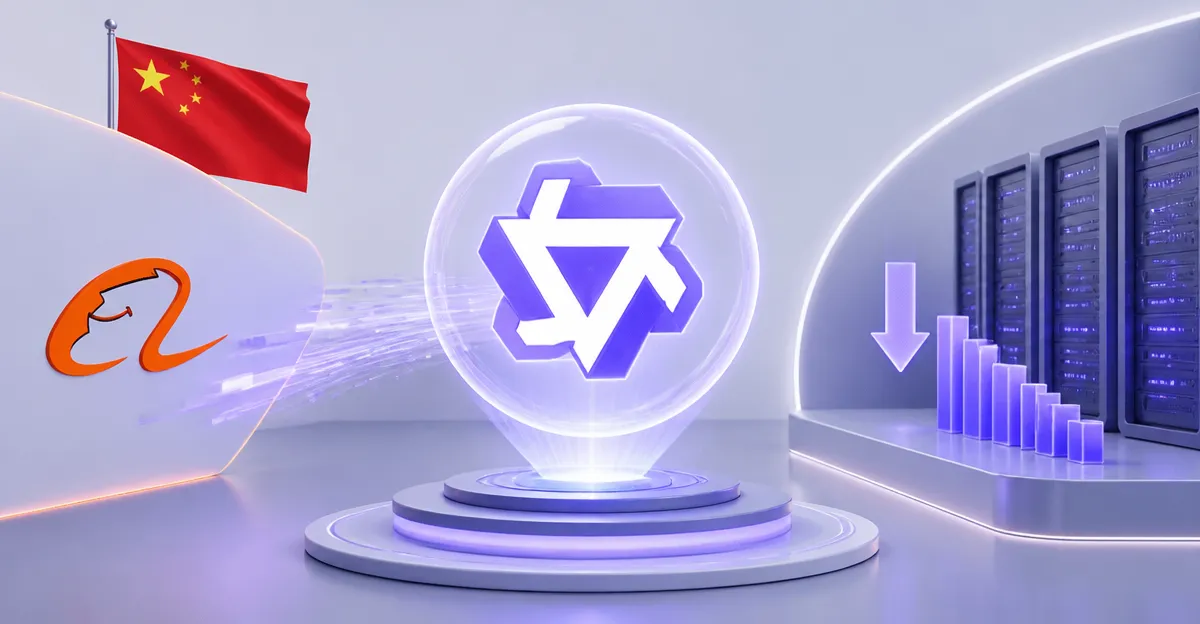
August 26, 2026, (Inside AI) — Alibaba‘s Qwen research unit has released Qwen3.8-Flash, a multimodal model that improves coding and office-task performance while reducing training costs, according to a statement published on social media.
The announcement marks a strategic push into efficient AI development, targeting enterprises that need capable models without massive compute budgets. The release comes amid intensifying competition in China’s AI sector, where cost efficiency has become a key differentiator.
Qwen3.8-Flash handles text and visual inputs, positioning it for document processing, spreadsheet analysis, and code generation. The model’s architecture builds on Qwen’s earlier Flash series, which prioritized speed and lower resource consumption over maximum parameter count.
Industry analysts note that multimodal capabilities are no longer optional for enterprise AI. Companies increasingly demand models that can read charts, interpret screenshots, and generate structured outputs from mixed data sources. Qwen’s focus on office tasks suggests a direct challenge to Microsoft‘s Copilot ecosystem and Google‘s Gemini for Workspace.
Read: DeepSeek-V4-Flash API Launches on China’s Supercomputing Internet
The cost reduction claim is significant. Training large language models typically requires thousands of GPUs and millions of dollars. If Qwen3.8-Flash achieves comparable performance with lower training costs, it could pressure competitors to adopt similar efficiency techniques such as sparse architectures, distillation, or optimized data pipelines.
Qwen did not disclose specific benchmark scores or the exact percentage of cost savings in the statement. This lack of detail leaves room for skepticism. Without independent verification, performance claims remain unproven.
China’s AI market has seen rapid model releases from DeepSeek, Baichuan, and Zhipu AI. Each has emphasized efficiency as a selling point, partly due to export restrictions on advanced Nvidia chips. Chinese developers must achieve more with less compute, driving innovation in model compression and training optimization.
Qwen’s strategy aligns with this reality. The Flash line targets developers who need fast inference and lower API costs. By improving coding and office performance, Qwen aims to capture workflow automation budgets rather than compete solely on general chatbot benchmarks.
The release also signals Alibaba’s broader AI ambitions. The company has integrated Qwen models into its cloud services, e-commerce platforms, and enterprise software. A more efficient multimodal model strengthens Alibaba’s position against domestic rivals and international players.
However, the announcement lacks technical details. Model cards, training data sources, and safety evaluations were not included in the social media statement. This opacity is common in Chinese AI releases but frustrates researchers seeking reproducibility.
Read: Z.ai Opens First Tmall Store to Sell AI Coding Subscriptions
For enterprise buyers, the practical question is integration cost. Deploying a new model requires fine-tuning, prompt engineering, and infrastructure changes. Lower training costs help Alibaba, but customers care about total cost of ownership, including inference latency and API pricing.
Qwen3.8-Flash enters a market where OpenAI‘s GPT-4o mini and Anthropic‘s Claude Haiku already offer low-cost multimodal options. The competitive landscape will force Qwen to prove its advantages through real-world benchmarks and developer adoption.
The company has not announced API pricing or availability outside China. International developers may gain access through Alibaba Cloud’s global regions, but regulatory and data residency requirements could limit adoption.
Analysts expect further releases in the Flash series as Qwen iterates on efficiency techniques. The model’s name suggests an intermediate step between Qwen3 and a future Qwen4, indicating rapid development cycles.
For now, the industry will watch for independent evaluations and customer case studies. Claims of lower training costs are meaningful only if performance holds up under scrutiny. Qwen3.8-Flash could become a benchmark for efficient multimodal AI, or it could fade into the crowded landscape of incremental model updates.