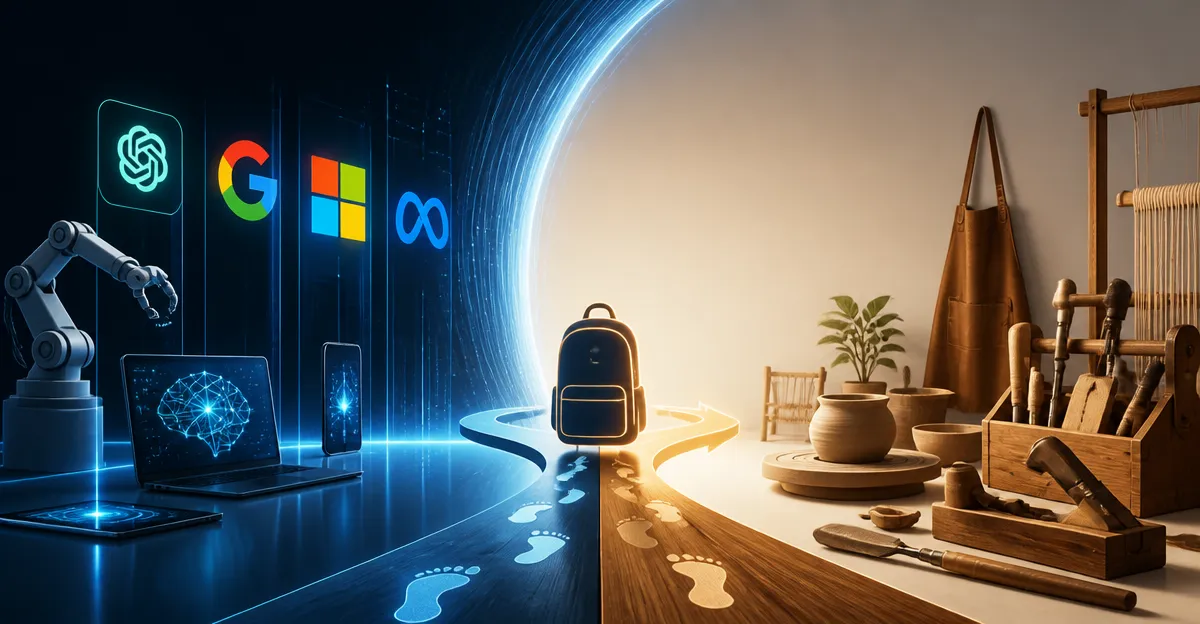
August 27, 2026, (Inside AI) — Young workers are abandoning screens for saws, glue pots, and forges. A growing number of graduates and early-career professionals are turning to heritage crafts like bookbinding, metalwork, and boatbuilding, betting that hand skills will outlast algorithms.
At Ludlow Bookbinders in Shropshire, 27-year-old politics graduate Eryn Lawley is a second-year apprentice. She left the digital world behind for a trade whose core techniques have barely changed in centuries. “Even just staring at a screen too long was bad for me,” she said. “I always wanted to do something more material, and I think there is something more inherently valuable to something when it is made by a person.”
The shift is not just about personal satisfaction. It is a direct response to a job market where entry-level white-collar roles are being automated at speed. Accountants, junior lawyers, and software engineers now compete with generative AI that can draft contracts, write code, and produce designs in seconds.
Heritage craft employers say they are seeing a surge in interest. Cox London, a design house specialising in artistic metalwork, launched its apprenticeship scheme last year. This year it received more than 160 applications for just two places.
“People want to make things and work with materials, [to] have that closeness with it,” said Nicola Cox, a co-founder. “There is AI-proofness about art that is made with someone’s hands. There is a real resonance in something that has a mark and the energy of human hands.”
Hand Skills Outlast Algorithms in a Disrupted Job Market
The appeal of craft is partly economic. Heritage trades often lack formal training pipelines, but demand for handmade goods remains strong among high-end buyers. Paul Kidson, chief executive at Ludlow and a fourth-generation bookbinder, estimates fewer than 50 handcraft-operating bookbinders remain in Britain.
“British bookbinding has a terrific reputation across the world, but like so many things in the 50s, 60s and 70s, the training just started to dry up,” Kidson said. “All the formal apprentice schemes collapsed in the early 1980s, and the industry got no training at all.”
He added that the company must train its own people because no volume recruitment pipeline exists. Yet he sees a new desire among young people for the satisfaction of making something physical.
Publishers are also betting on human craft. Joanna Reynolds, chief executive of the Folio Society, said her company rejects generative AI in its creative processes. The publisher partnered with Ludlow for a limited edition of a Game of Thrones book.
“We do not use AI in terms of our art,” she said. “We believe in the importance of supporting the creative world, and we know there is huge pressure on them at the moment. Their skills and their abilities need to be supported by as many people as possible.”
Apprenticeship Demand Spikes as AI Floods Applications
The National Theatre in London runs technical apprenticeships spanning IT, wig-making, costume design, prop-making, and metalwork. Kath Geraghty, head of technical qualifications, said the programme addresses a critical skills gap.
“These theatre crafts are dying out – our metalworkers are all over 50, wig-making as a skill is really dying,” she said. “There’s a real need to create our own talent.”
But the surge in interest has created a new problem. The most recent recruitment round drew 728 applications for a single role. Many were AI-generated, making it impossible for staff to review them carefully.
“We used to think that 100 applicants was a popular apprenticeship,” Geraghty said. “We haven’t yet worked out how to manage it, because it’s not viable for our staff to read 700 applications with care and attention.”
Apprentices themselves are pragmatic. Lucky Emerson, an apprentice at Cox London, said there is a “worrying feeling” that AI is taking over the creative world. “The physicality of actually making things is incomparable, especially when people crave originality,” Emerson said.
Fellow apprentice Nazifa Tabassum sees AI as a tool, not a replacement. “For me it isn’t just about making things with my hands,” she said. “It’s about continuously developing my skills, and using technology where it adds value, while still providing the expertise and craftsmanship that people can’t easily automate.”
Sarah Ray-Dobson, a 27-year-old prop-maker apprentice at the National Theatre, said her work remains untouched by AI for now. “Everything I’ve been doing for the past two years is very hands-on,” she said. “At my level, it has not been affected by AI.”
The turn toward craft is not a rejection of technology wholesale. It is a bet that some human skills, tactile judgment, patience, and the ability to read materials, will remain scarce even as software improves. For a generation entering a volatile job market, that scarcity looks like security.