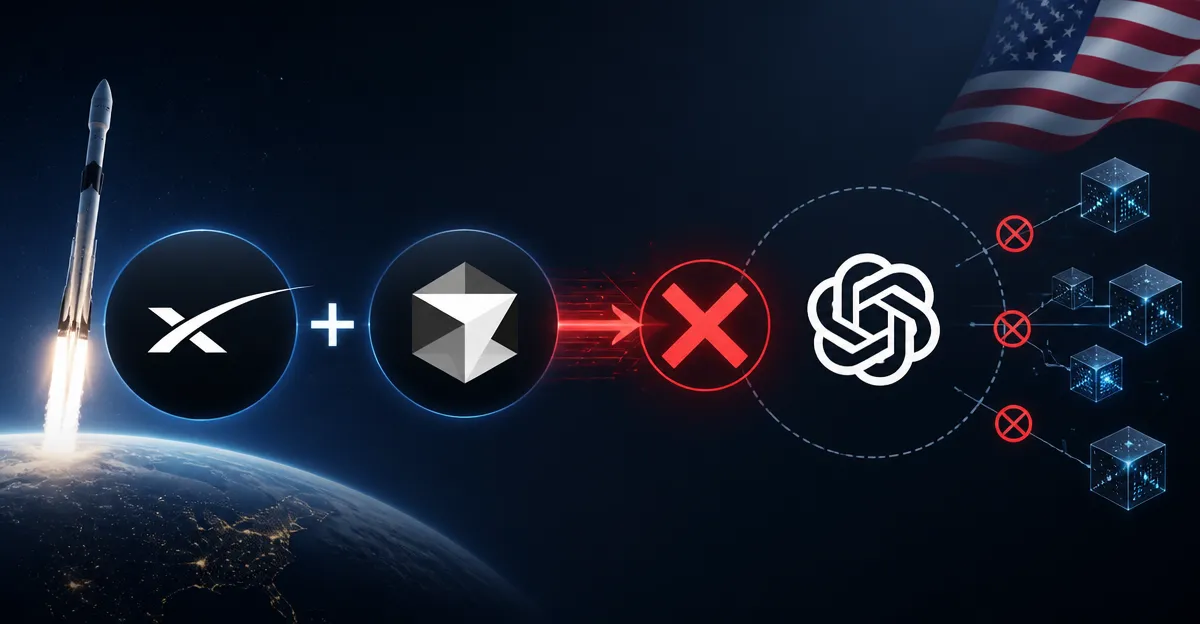
August 29, 2026, (Inside AI) — Developers who rely on Cursor to access OpenAI models have until November 12, 2026 before the plug is pulled. The cutoff date, announced on Friday, August 28, gives users roughly 76 days to migrate their workflows.
The decision stems from the SpaceX acquisition of Anysphere, the startup behind Cursor, completed earlier this month. OpenAI said it cannot guarantee that a Musk-led company will honor its contract terms.
The move escalates a long-running feud between Sam Altman and Elon Musk. Earlier this year, a federal jury ruled against Musk in his $150 billion lawsuit against OpenAI, finding he filed too late.
Cursor launched in 2022, founded by Aman Sanger and three other MIT graduates. Its model-agnostic design let developers pick between OpenAI, Anthropic, and other large language models.
That neutrality was a key selling point. Developers also valued Cursor’s zero-data-retention arrangements. But the $60 billion all-stock deal with SpaceX in June raised immediate concerns about model access.
OpenAI cited past experiences with Musk-owned firms. It alleged that X and xAI had previously violated its terms of service. The company also pointed to its upcoming model, Astra, saying it must ensure usage aligns with its terms given the model’s advanced capabilities.
Michael Truell, a Cursor co-founder now an executive at SpaceX, said the team is speaking with OpenAI to resolve the issue.
“Cursor was one of the very first users of OpenAI, we’ve worked closely with their team for years, and we’ve trusted their platform to be neutral infrastructure for our business,” Truell said in an X post on Friday.
The withdrawal does not affect Cursor’s support for other models. Anthropic has not announced any change. But the incident highlights the fragility of partnerships when ownership shifts.
For enterprise developers, the timeline is tight. Teams using OpenAI models inside Cursor must evaluate alternatives or negotiate direct API access. The November 12 deadline aligns with the maximum notice allowed under the existing agreement.
Why OpenAI’s Contract Fears Are Not Hypothetical
OpenAI has reason to be cautious. In 2025, xAI launched Grok with features that OpenAI argued mimicked its own models. Internal documents from the Musk trial showed xAI engineers had accessed OpenAI API outputs at scale.
The Astra model, expected in early 2027, is described internally as a frontier reasoning system. OpenAI has tightened API terms for models above a certain capability threshold. Pulling from Cursor fits that pattern.
Industry analysts note that SpaceX is not a software company. Its acquisition of Cursor is widely seen as a talent and infrastructure play. Integrating OpenAI models into SpaceX workflows could raise export control and data governance issues.
The Broader Fight Over Model Neutrality
Cursor’s rise was built on being neutral. Developers could switch between OpenAI, Anthropic, and open-source models like Llama. That flexibility attracted a loyal user base.
The SpaceX deal changed the calculus. Some developers have already migrated to alternatives like Windsurf and Zed. Others are waiting to see if Anthropic follows OpenAI‘s lead.
Anthropic has remained silent. A spokesperson declined to comment on whether it would review its Cursor partnership. The company’s Claude models are deeply embedded in Cursor’s enterprise tier.
For now, the November 12 deadline is the only certainty. Developers face a forced migration during the fourth quarter, a period already crowded with product deadlines.
The OpenAI-Cursor split is not just a business dispute. It is a signal that model providers will increasingly use access as leverage. Neutral platforms may become collateral damage in the AI industry’s escalating rivalries.