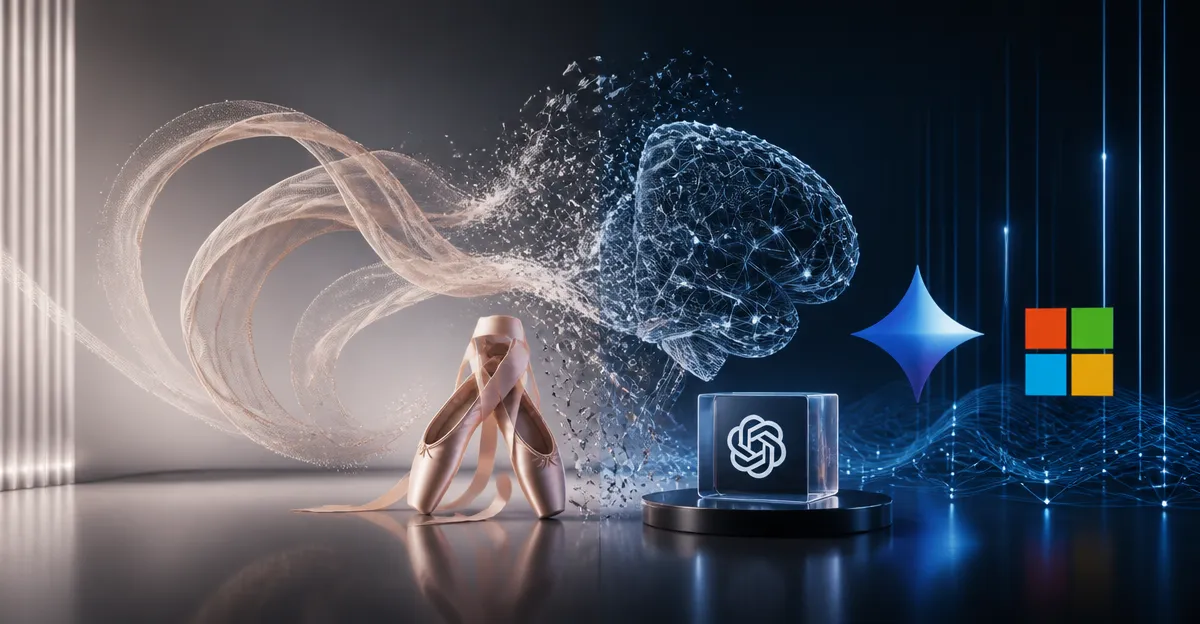
August 30, 2026, (Inside AI) — San Francisco Ballet has brought a bold reimagining of the Pandora myth to the Edinburgh International Festival, fusing dance, live orchestral music, and digital visual art into a production that interrogates the age of artificial intelligence. The work, titled Mere Mortals, premiered at the Edinburgh Playhouse and runs through the festival’s closing weekend.
The production marks the first major commission under artistic director Tamara Rojo, who brought together choreographer Aszure Barton, composer Sam Shepherd (known as electronic producer Floating Points), and multidisciplinary studio Hamill Industries. Their shared starting point: the ancient Greek story of Pandora’s box, updated to reflect the unknowns unleashed by modern AI systems.
Hamill Industries, who used some AI tools in their creative process, project morphing, pulsating visuals onto a giant screen above the stage. The imagery resembles lava or the sun’s surface, an intoxicating display that deliberately competes with the dancers for attention. The choreography leans into that tension. Dancers appear en masse in strict, driving maneuvers, their bodies molded into large-scale moving images. Are they mortals, gods, automatons, or lines of code? The ambiguity is intentional.
Barton’s movement vocabulary is eclectic and unpredictable. Classical virtuosity sits alongside contemporary gesture in unstoppable phrases. Jennifer Stahl dances Pandora with commanding presence, while Wei Wang brings a supple, sprightly, puckish energy to the role of Hope. Yet the narrative thread is deliberately obscured. Without prior research, audiences may miss the mythological references entirely. For a story with such clear dramatic beats and a clever contemporary parallel, that opacity feels like a missed opportunity.
Read: Ramanaidu Film School Trains Storytellers to Master AI in Filmmaking
Still, the production has moments of striking human intimacy. Joseph Walsh and Harrison James play Prometheus and Epimetheus as competitive brothers who hug and shove in a single motion. A pas de deux for Pandora and her husband avoids romantic clichés, their bodies folding into uncommon shapes. These scenes offer a counterweight to the digital spectacle, grounding the work in physical vulnerability.
Shepherd’s score is a hybrid of electronics and live orchestra, performed by the Royal Scottish National Orchestra. It pulses with drama, contrast, and propulsive urgency, with hints of Stravinsky in its rhythmic drive. Textures range from slippery strings to ricocheting arpeggios, creating a sonic landscape that mirrors the visual complexity above.
Digital Spectacle Versus Human Bodies
The production raises a pointed question: in an AI-saturated world, does technology overwhelm the human element? The giant screen often steals focus from the dancers, a dynamic that may be the show’s central argument. The choreography itself becomes a data stream, bodies moving in patterns that evoke algorithmic logic. Yet the work never fully resolves whether that is a warning or a celebration.
This ambiguity mirrors broader debates in the arts. Some critics argue that AI-generated visuals risk reducing live performance to a backdrop. Others see tools like those used by Hamill Industries as an extension of the choreographer’s palette. Mere Mortals sits squarely in that contested space, refusing easy answers.
Pandora’s Box as a Modern Metaphor
The myth of Pandora has long served as a cautionary tale about curiosity and unintended consequences. In the context of AI, the parallel is almost too neat: a powerful force unleashed without full understanding of its risks. The production does not moralize, but the imagery of morphing pixels and clay-formed bodies suggests creation and destruction are inseparable.
San Francisco Ballet’s investment in this theme signals a broader shift among major cultural institutions. As AI reshapes creative industries, ballet companies are increasingly commissioning works that engage with technology rather than ignore it. Whether audiences embrace that collision remains an open question.
Read: Designers Should Not Fear Being Replaced by AI, Industry Leaders Say
For those unable to attend Edinburgh, the production may tour internationally in 2027, according to festival sources. The work’s reception could influence how other companies approach AI-themed programming in the coming seasons.