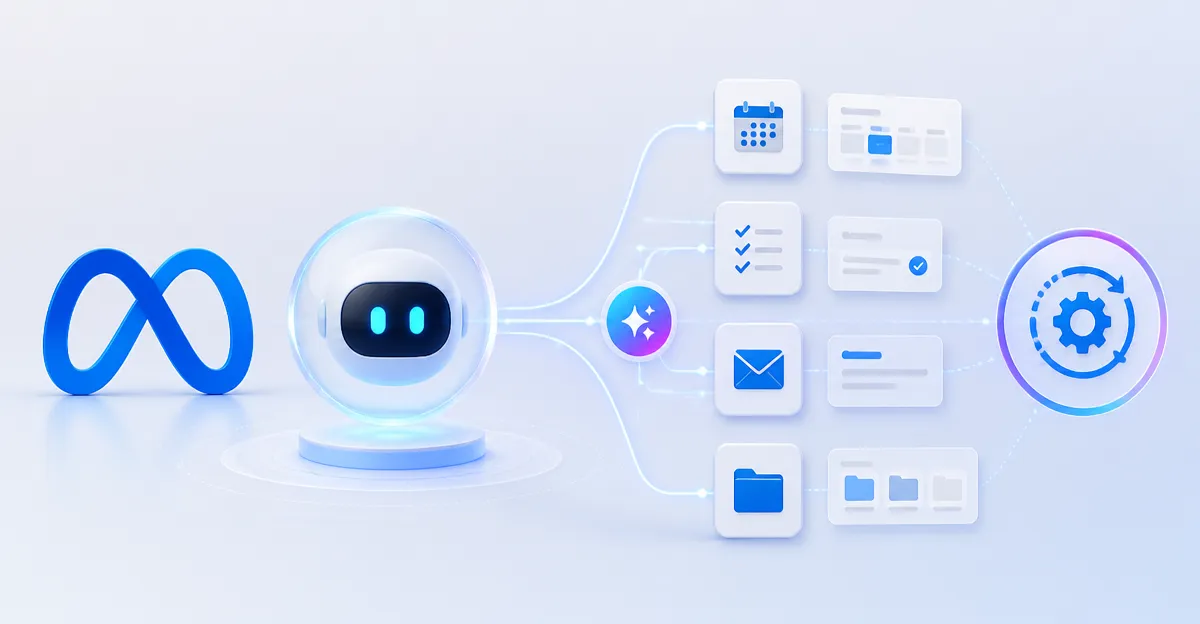
July 25, 2026, (Inside AI) — Meta is activating a new set of autonomous task capabilities for its AI assistant in select markets, powered by the company’s freshly deployed Muse Spark 1.1 model. The update, confirmed Friday, enables the chatbot to understand user context and execute multi-step tasks without requiring constant prompting—a shift from reactive query-response to proactive digital assistance.
The rollout marks Meta’s most aggressive push yet into agentic AI, where the assistant can book appointments, manage schedules, and interact with third-party services on a user’s behalf. Unlike previous versions that needed explicit step-by-step instructions, the new system interprets high-level goals and fills in the execution gaps itself. This mirrors a broader industry race to make AI assistants truly autonomous, but also raises fresh questions about reliability and user control.
Meta confirmed the features are initially limited to select markets, though it did not specify which regions. The company’s decision to gate the release suggests a cautious approach, likely to monitor performance and safety before a wider launch. The assistant’s ability to act independently—while convenient—introduces risks around erroneous actions, privacy, and security that have plagued similar efforts from competitors.
Industry analysts note that the Muse Spark 1.1 architecture is designed for “tool use,” a technical term for AI systems that can call external APIs and manipulate digital environments. This is a departure from earlier models that primarily generated text. Meta’s research team has been advancing this capability through projects like Toolformer, which taught language models to use tools via self-supervised learning. The new assistant likely builds on that foundation, integrating with Meta’s ecosystem of apps and services.
Yet the move comes amid heightened scrutiny of autonomous AI. Just last month, a competitor’s agentic feature was found to make unauthorized purchases during testing. Meta’s challenge will be to balance ambition with guardrails—ensuring the assistant asks for confirmation before high-stakes actions. The company has not disclosed what safeguards are in place, but its Responsible AI framework emphasizes transparency and user control, principles that must now be operationalized in real-time decision-making.
This is not Meta’s first foray into autonomous features. Earlier iterations of Meta AI could handle simple tasks like setting reminders, but the new model represents a step change in complexity. By leveraging Muse Spark 1.1’s improved context retention, the assistant can maintain state across multiple interactions, reducing the cognitive load on users. For example, planning a dinner outing might involve checking calendars, suggesting restaurants, making a reservation, and notifying friends—all from a single request.
The technology also intensifies the platform war among tech giants. Apple, Google, and OpenAI are all racing to embed agentic capabilities into their assistants, viewing them as the next battleground for user loyalty. Meta’s advantage lies in its massive social graph and messaging platforms, where the assistant could become a central hub for coordinating daily life. However, success hinges on trust; a single high-profile failure could set back adoption significantly.
Looking ahead, Meta plans to expand the feature set based on user feedback and safety evaluations. The company is also investing in on-device processing to reduce latency and enhance privacy, a critical factor as assistants handle more sensitive tasks. For now, the limited rollout serves as both a showcase and a testbed—a calculated step toward an AI that doesn’t just answer questions, but acts on them.