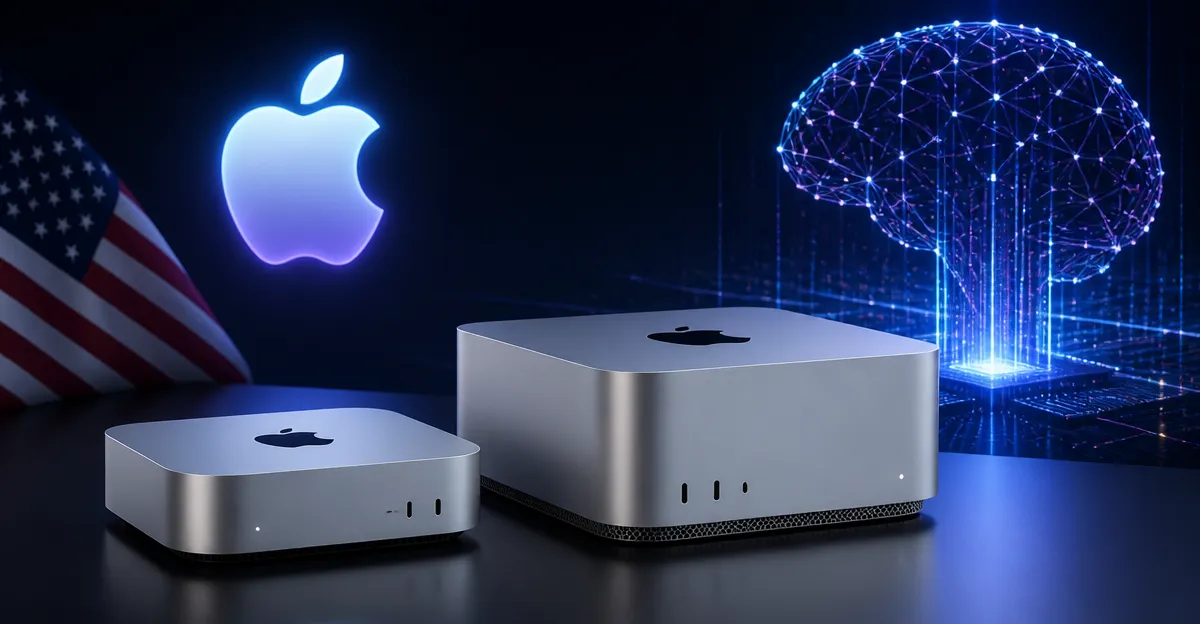
August 25, 2026, (Inside AI) — Apple on Tuesday introduced a faster Mac mini and a refreshed Mac Studio, targeting consumers and developers who run autonomous AI agents on local hardware. The new Mac mini starts at $899, a $100 increase over its predecessor.
The launch is likely the final major product release under CEO Tim Cook, who is expected to hand leadership to hardware executive John Ternus. The transition is one of the most watched in Apple’s history.
M6 Chip Delivers Fourfold AI Speed Boost
The entry-level Mac mini offers either the new 2-nanometer M6 chip or the M5 Pro. Apple says the M6 delivers up to four times faster AI performance and double the graphics and storage speeds compared with the previous M4-powered model.
The higher-end M5 Pro variant includes up to an 18-core central processor and a 20-core graphics processor. It targets professionals working on visual effects and other demanding tasks.
Apple’s hardware chief Johny Srouji said the mini fits multiple roles.
“Whether it’s being used as a home computer, powering a professional studio, or as an always-on agentic device, it’s the little Mac that can do it all,” Johny Srouji, Apple’s senior vice president of Hardware Technologies.
The Mac mini has become popular for running autonomous AI agents like OpenClaw locally. High demand has depleted inventories at several Apple stores, according to sources.
Mac Studio Pricing Jumps as Memory Costs Rise
Apple also refreshed the Mac Studio desktop lineup with M5 Max and new M5 Ultra chips. These machines can run large models on-device and combine computing power across multiple systems for intensive AI tasks.
Pricing starts at $2,499 for the M5 Max version and $5,499 for the M5 Ultra model. That is up from $1,999 for the previous generation.
The price increases reflect mounting cost pressures. Memory chip prices have climbed on strong demand from AI data centers. Apple raised prices on some Mac and iPad models in June for the same reason.
The Mac Studio targets developers and other professional users who need robust local AI performance. Apple did not announce changes to its cloud-based AI services.
The leadership transition from Cook to Ternus adds uncertainty to Apple’s AI strategy. Ternus has overseen hardware engineering, including Apple silicon development. Industry analysts will watch whether he accelerates AI features across the Mac lineup.