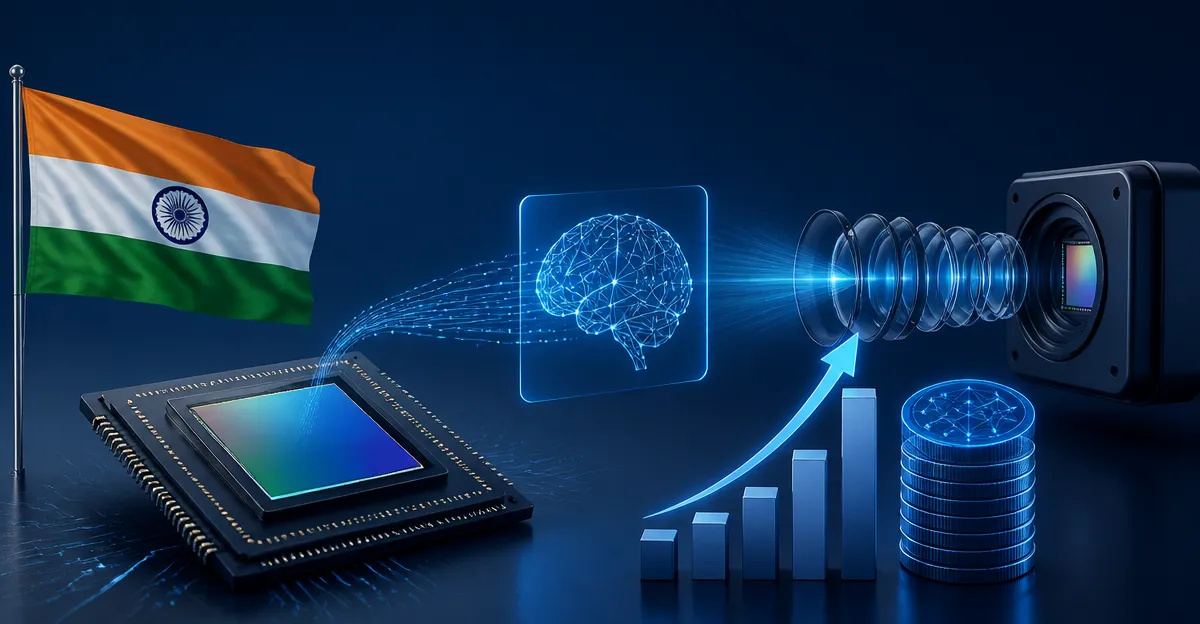
November 16, 2026, (Inside AI) — Bharat Semi, a New Delhi-based semiconductor startup, has raised $24 million in seed funding to develop AI-enabled image sensors that combine image capture, processing, and AI capabilities on a single chip. The all-equity round was led by Info Edge Group, South Park Commons, and Indus Bridge Ventures, with participation from Valour Capital, Micromax, Gaingels, and individual investors. Despite generating zero revenue, the company has already secured design wins with US defense contractor General Atomics and India's Kaynes Semicon. Commercial production is targeted for 2027.
The funding underscores a growing push to embed intelligence directly into sensing hardware, reducing reliance on separate processors and cloud computing. Bharat Semi's approach could lower costs for devices that need visual intelligence, from smart home appliances to drones and surveillance systems. The startup's ability to attract defense and manufacturing partners before shipping a product highlights the demand for integrated, low-power AI sensing solutions.
Can One Chip Replace Three?
Bharat Semi's core pitch centers on cost reduction. Conventional camera systems use three separate components: an image sensor, an image signal processor, and a system-on-chip. By combining all three functions into one programmable sensor, the company claims it can cut system costs by at least 70%. Consequently, devices that need visual intelligence become cheaper to build.
"Our aim here is to move from sensors to sense-making solutions," said co-founder Vrinda Kapoor, a South Park Commons fellow with a healthcare technology background.
Read: Fractile $7 Billion Valuation
The applications span smart homes, industrial automation, surveillance, and aerospace. For example, an air conditioner with Bharat Semi's sensor could detect an empty room and adjust automatically. Similarly, a drone could process visual data on the sensor itself without requiring expensive computing hardware elsewhere in the system.
Kapoor co-founded the company in late 2021 with Vinayak Dalmia, who previously worked at McKinsey and in private equity. Their CTO Boyd Fowler held the same title at OmniVision, a major image sensor manufacturer. That hire gives the startup credibility in a field dominated by established players.
First-generation sensors have already reached the prototyping stage. Meanwhile, second-generation sensors with more advanced AI capabilities should reach prototype by mid-2027. Bharat Semi plans to get those newer sensors into customer hands by the end of 2027.
The startup now employs around 75 people across India and the US. Its American operations in Santa Clara cover engineering and business development with 10 to 12 staff. That headcount should reach 20 by mid-2027. Additionally, the company started hiring engineers in Europe.
Bharat Semi also announced plans for a semiconductor fabrication project in India involving a technology partnership with the US Space Force. However, that initiative remains separate from the sensor business. The company plans to stay fabless for its core product line, outsourcing manufacturing while focusing on design and software. The new $24 million will not fund the fabrication project.
"It's a story of can we build a global technology company out of India," Kapoor said. For South Asia's semiconductor ambitions, the answer to that question carries weight far beyond one startup.
Read: India PCB Supply Squeeze
Bharat Semi's success will depend on executing its ambitious roadmap and converting design wins into revenue. If it delivers, the company could become a blueprint for Indian deep tech, proving that homegrown startups can compete in the global semiconductor arena.

If a research paper dropped this week, Mahesh has already read it. He covers AI tools and vibe coding for builders who need to know what is worth their time and what is not.