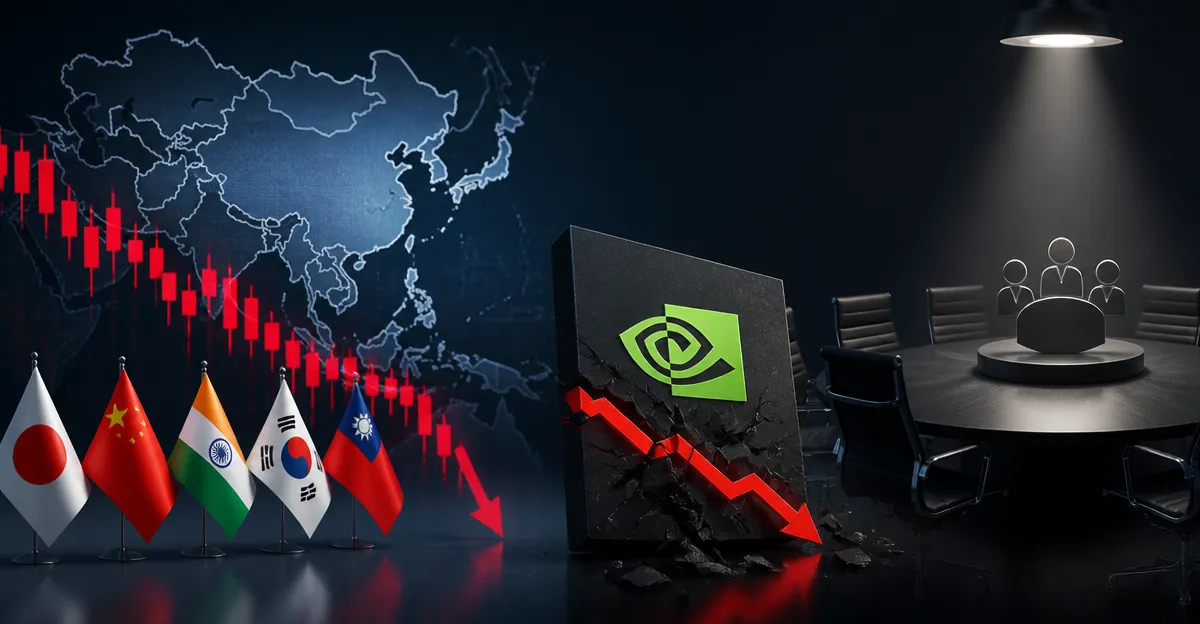
November 12, 2026, (Inside AI) — Nvidia's board of directors met late Wednesday to decide whether to remove longtime CEO Jensen Huang, according to a source familiar with the matter. The meeting follows allegations that Huang had an affair with a suspected Chinese spy, a claim that has rattled the world's most valuable semiconductor company.
The news sent Nvidia shares down more than 8% in after-hours trading. S&P 500 e-mini futures slipped 0.4% as investors weighed the possibility of leadership turmoil at the center of the artificial intelligence boom.
The board's decision could reshape the AI hardware industry. Nvidia's graphics processing units power most large-scale AI training and inference workloads. Any disruption to its leadership raises questions about strategy, customer confidence, and the broader supply chain.
Huang, who co-founded Nvidia in 1993, has led the company for more than three decades. He became the public face of the AI revolution as Nvidia's market value crossed $1 trillion. The allegations, first reported by The New York Times, claim Huang had an affair with a company executive who reported to him. The spy suspicion adds a national security dimension.
Read: Baird Downgrades Nvidia
"It looks bad from every single angle," said Jake Dollarhide, chief executive officer at Longbow Asset Management in Tulsa, Oklahoma.
"I believe the board won't oust him until they have an all-star, a known entity in the tech sector, to replace him," he said. "At the end of the day, let's not forget that the Nvidia chip is the centrepiece of the AI story."
Asian markets opened cautiously on Thursday. South Korea's Kospi rose 0.2%, Taiwan's weighted index gained 0.5%, and Japan's Nikkei 225 climbed 0.5%. The broader MSCI Asia-Pacific index outside Japan was 0.1% lower, dragged down by Hong Kong shares.
Wall Street had rallied on Wednesday before the Nvidia news broke. The S&P 500 rose 1.3%, nearly erasing losses since last week's U.S. midterm elections. Westpac analysts noted renewed optimism around AI, citing positive developments at CoreWeave and Anthropic.
The dollar index held steady at 102.87, its highest since April 9 last year. Traders now price an 87.3% chance of a 25-basis-point Federal Reserve rate hike at the December 9 meeting, according to CME Group's FedWatch tool. Bitcoin slipped 0.9% to $73,617.58, while ether fell 0.9% to $2,049.44.
The allegations against Huang arrive at a delicate moment. Nvidia faces mounting competition from AMD, Intel, and custom chips designed by cloud providers. The company also navigates U.S. export controls on advanced semiconductors to China. A leadership vacuum could slow decision-making on those fronts.
Nvidia's board has not commented publicly on the meeting. The source spoke on condition of anonymity because the discussions are confidential. Inside AI could not independently verify the spy allegation.
Huang's fate now rests with a board he has worked with for years. Directors must weigh reputational risk against operational continuity. Replacing a founder-CEO mid-crisis is rare in tech. Apple removed Steve Jobs in 1985, only to bring him back in 1997. Uber ousted Travis Kalanick in 2017 after a series of scandals.
For now, investors are left guessing. The after-hours drop in Nvidia shares suggests markets see real danger. But Dollarhide's point about the chip's centrality may temper the board's urgency. Nvidia's technology remains indispensable to AI development, regardless of who runs the company.

If a research paper dropped this week, Mahesh has already read it. He covers AI tools and vibe coding for builders who need to know what is worth their time and what is not.