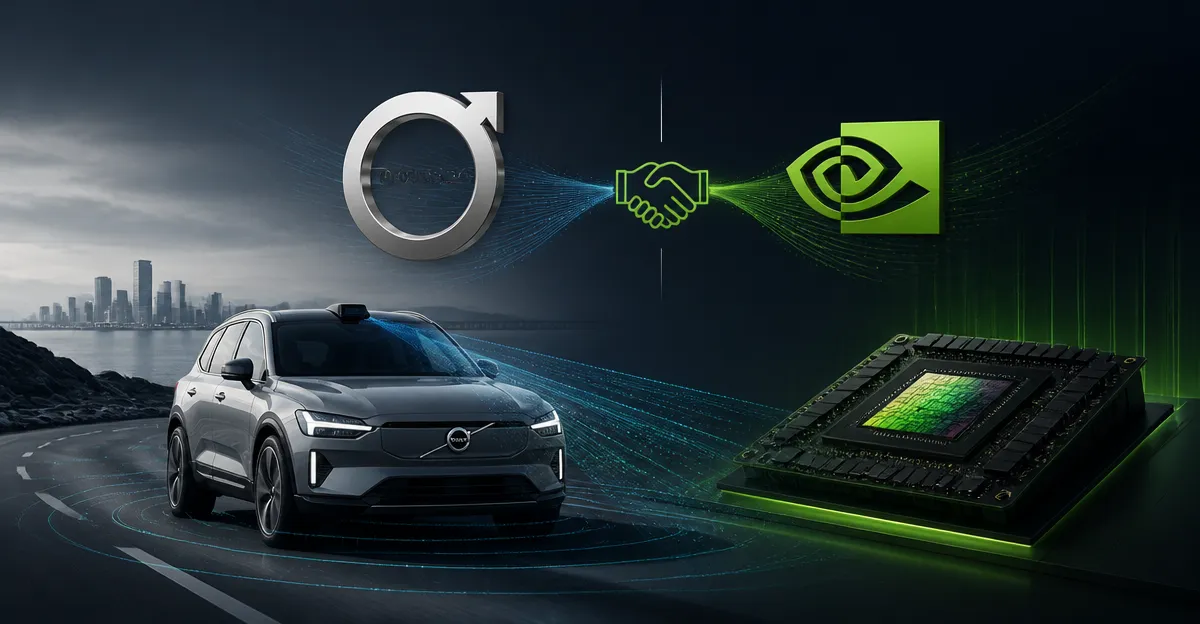
October 16, 2026, (Inside AI) — Volvo Cars and Nvidia have broadened their long-running collaboration to develop a new generation of driver-assistance and automated-driving technology, the two companies said Thursday. The expansion deepens a relationship that already spans multiple vehicle generations and positions the Swedish automaker to push further into hands-free driving features.
The announcement comes as automakers globally accelerate efforts to bring advanced driver-assistance systems (ADAS) and higher levels of automation to market. Volvo, owned by China's Zhejiang Geely Holding Group, has positioned safety as its core brand promise since the 1950s. Nvidia supplies the high-performance computing platforms that underpin many of those ambitions.
Financial terms and specific vehicle timelines were not disclosed. Neither company offered a detailed technical roadmap or named the first model to receive the new hardware and software stack. Inside AI could not independently verify the scope of the expanded work.
Why Nvidia's Automotive Bet Keeps Growing
Nvidia's automotive segment has evolved from a niche graphics supplier to a central player in the race toward autonomous driving. The company's DRIVE platform, now in its latest iterations, bundles system-on-a-chip hardware with software development kits that automakers use to train, simulate, and deploy neural networks inside vehicles.
Read: Microsoft, Nvidia to unveil new AI laptop at San Francisco event
Volvo first partnered with Nvidia in 2017, when it announced plans to use the DRIVE PX platform for its next-generation vehicles. Since then, the partnership has expanded to include core computing for the automaker's electric flagship, the EX90 SUV, which launched with Nvidia's DRIVE Orin system. That vehicle also carries lidar from Luminar and software from Zenseact, Volvo's autonomous driving subsidiary.
The expanded deal likely centers on Nvidia's next-generation DRIVE Thor platform, which promises up to 2,000 teraflops of performance and is designed to consolidate multiple vehicle functions, including automated driving, digital cockpit, and parking, onto a single chip. Nvidia has said Thor will enter production vehicles around 2025, though automakers have been slow to confirm specific model rollouts.
Competitors are moving quickly. Mercedes-Benz has already launched a certified Level 3 system in Germany and parts of the United States, allowing drivers to take their eyes off the road under certain conditions. BMW offers a similar system on the 7 Series. Tesla continues to refine its Full Self-Driving software, which remains a Level 2 system despite its name. Chinese automakers including Xpeng and Nio have introduced urban navigation features that rival those from Western brands.
Volvo's safety-first brand identity raises the stakes. Any automated driving failure would carry outsized reputational risk for a company that has built marketing campaigns around the idea that no one should be killed or seriously injured in a new Volvo by 2020, a goal it later acknowledged it would not meet.
The partnership also reflects a broader trend: automakers are increasingly outsourcing the compute layer to Nvidia while retaining control of software and data. This mirrors the smartphone industry, where chip vendors supply the silicon and device makers differentiate through user experience. For Nvidia, automotive revenue remains a small fraction of its data center business, but the segment offers a hedge against cyclicality in other markets.
Regulatory scrutiny adds another layer. Authorities in the United States and Europe are drafting rules for automated driving systems, and any expansion of hands-free capability will require certification. Volvo has not said which markets will receive the new technology first.
Read: Geely Unveils 4-Minute EV Charging System With AI Safety, Takes On BYD
The two companies have not disclosed whether the expanded partnership includes joint research on artificial intelligence models for perception or planning. Nvidia has been pushing its DRIVE Sim platform, which allows automakers to test driving scenarios in simulation before real-world deployment.
Volvo's shares trade on the Stockholm exchange under the ticker VOLCARb.ST. Nvidia is listed on Nasdaq as NVDA.O. Neither stock moved significantly on the news, suggesting investors had already priced in an extension of the existing relationship.
The announcement follows a string of similar deals across the industry. General Motors, Ford, and Toyota have all deepened ties with chipmakers and software suppliers in recent months. The common thread: automakers want to own the customer experience but are willing to buy the brains.
For Volvo, the Nvidia expansion is a bet that computing power will define the next phase of automotive safety. Whether that bet pays off depends on execution, regulation, and the willingness of drivers to trust machines with their lives.