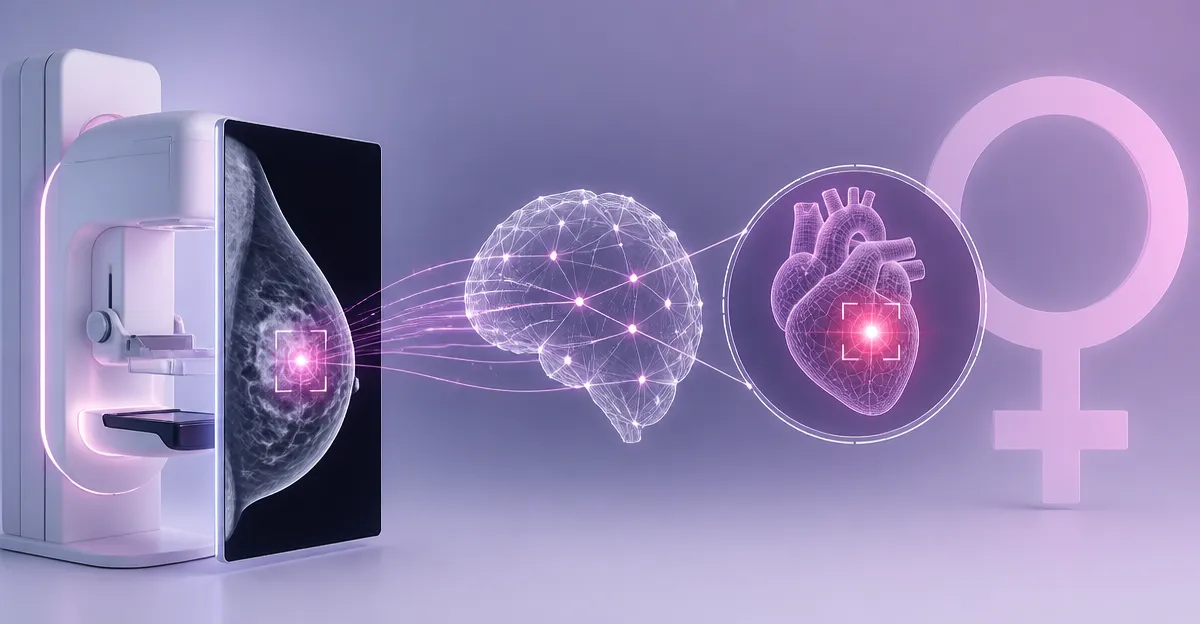
August 27, 2026, (Inside AI) — Routine mammograms may soon do double duty. Researchers have shown that artificial intelligence can analyze breast cancer screening scans to detect signs of heart disease in women, including coronary heart disease, high blood pressure, and prior stroke.
The findings were presented in Munich at the European Society of Cardiology’s annual congress, the world’s largest heart conference. Doctors in Israel examined 97,364 scans from 29,921 women with an average age of 54. By cross-referencing medical records, they found 16% had high blood pressure, 2.5% had coronary heart disease, and 2.5% had experienced a stroke.
A machine-learning model was trained to identify these conditions. It reliably identified women who had suffered a stroke based on their mammogram alone 86% of the time. For high blood pressure and coronary heart disease, reliability was 79% and 78%, respectively. Results held consistent regardless of age or cancer status.
Dr. Viana Copeland from Tel Aviv University presented the findings. “Despite being the leading cause of death in women worldwide, CVD [cardiovascular disease] is consistently underdiagnosed and undertreated,” she said. She added that many women attend routine breast screening even when they have not sought care for cardiovascular symptoms.
Read: AI Tool Spots Heart Disease in Under 2 Seconds from ECG
Because mammography is already widely used, analyzing breast scans for heart health could offer a scalable approach without requiring additional imaging. Copeland noted that mammography reaches many women in midlife, an important period for recognizing cardiovascular risk.
Why Heart Disease in Women Is Often Missed
Cardiovascular disease is the leading cause of death in women globally, yet it frequently goes undetected until advanced stages. The myth that heart disease is a “man’s disease” persists, leaving women disproportionately unaware, unheard, underdiagnosed, and undertreated.
Dr. Sonya Babu-Narayan, a consultant cardiologist and clinical director of the British Heart Foundation, welcomed the breakthrough. “Heart disease is the world’s biggest killer of not only men, but also women. Despite this, the myth persists that it’s only a ‘man’s disease’, meaning that when it comes to the heart, women are disproportionally unaware, unheard, underdiagnosed, undertreated and typically underrepresented in clinical research,” she said.
She added that if the approach is further proven, it could lead to better and earlier cardiovascular disease detection and prevention for women. AI could one day allow breast cancer screening programs to become dual-purpose.
The Road to Clinical Implementation
Researchers are working to improve the AI model’s accuracy and reduce false results. They also aim to increase the number of heart conditions it can detect. Elena Arbelo, an expert member of the European Society of Cardiology communication committee, called the findings “compelling.”
“A mammogram may one day do more than look for breast cancer – it may also offer a window on to cardiovascular health. That matters because CVD in women is still too often recognised late,” she said. She added that the challenge now is to establish accuracy and reliability, moving from experimentation to clinical implementation.
Read: Can an AI-Powered Scribe Curb Physician Burnout?
The study builds on growing evidence that routine imaging can reveal hidden health risks. Prior research has explored using chest CT scans to assess coronary artery calcium. Mammography offers a unique opportunity because it is already performed on millions of women annually and captures breast arterial calcifications, which are associated with cardiovascular risk.
If validated in larger, diverse populations, this approach could transform breast screening into a two-for-one health check. The next steps include prospective trials and regulatory review. For now, the findings signal a shift toward more integrated, AI-driven preventive care for women.