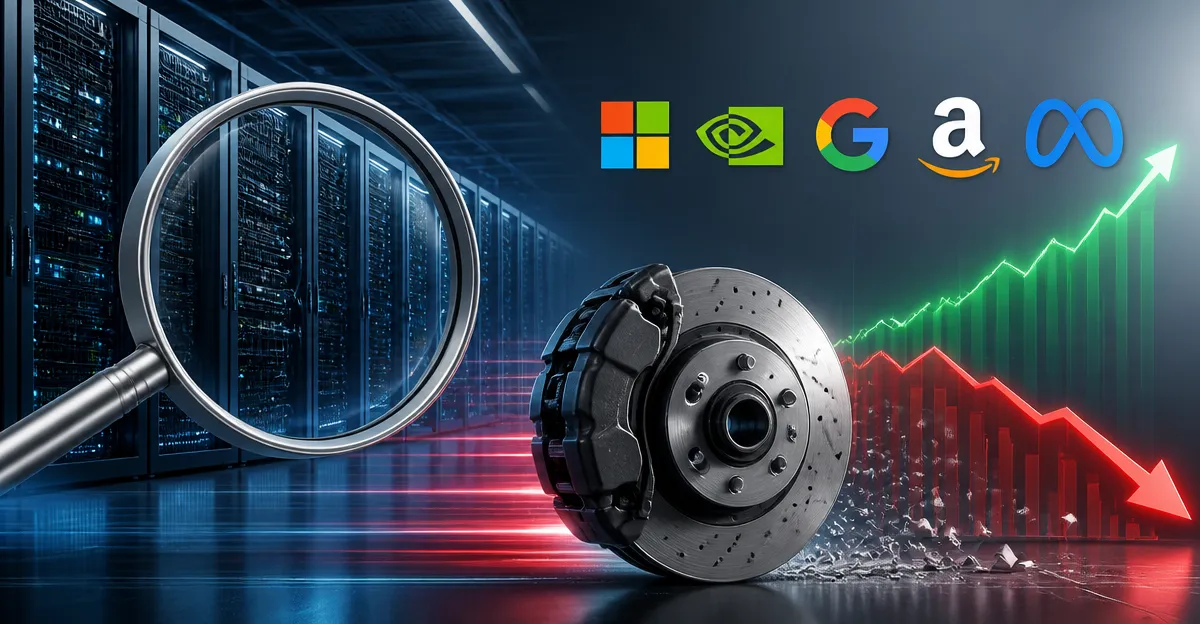
August 5, 2026, (Inside AI) — A stark financial warning is emerging from the heart of the AI infrastructure boom. Investment strategist Joachim Klement of Panmure Liberum argues that the economics of new AI data centers are so unfavorable they could trigger a sharp correction in U.S. corporate earnings, which are currently running nearly 60% above their long-term trend.
Klement’s analysis, published via Reuters, points to a fundamental shift in the business models of the so-called hyperscalers—Alphabet, Microsoft, Meta, and Amazon—which have transformed from capital-light firms with wide competitive moats into capital-intensive enterprises burdened by massive infrastructure spending. This change, he contends, has eroded the very advantages that allowed them to sustain supernormal profits for over a decade.
The core of the problem lies in a pair of jarring numbers. Nvidia CEO Jensen Huang recently estimated that a 1-gigawatt data center could cost $80 billion to $100 billion to build. Meanwhile, market intelligence firm Cleanview and energy infrastructure company Lancium estimate that such a facility would generate only $10 billion to $12 billion in annual revenue running AI models. That implies an amortization period of eight to 10 years, far exceeding the useful life of cutting-edge GPUs or TPUs, making new data centers a deeply unattractive investment.
“If accurate, this means that it would take eight to 10 years for a newly built data centre to amortise its initial costs, let alone pay for operating expenses or make a profit. Clearly, this is longer than the reasonable life of a cutting-edge GPU or TPU,” Klement writes.
This math clashes with the bullish consensus on Wall Street, where analysts expect S&P 500 earnings to grow more than 27% in the next 12 months, propelling earnings per share to over 85% above trend by next year and 100% above trend by mid-2028. Historically, earnings have never exceeded 44% above trend since World War Two, Klement notes, suggesting current projections are historically extreme.
Shrinking Moats and Circular Financing
The hyperscalers’ moats are thinning due to fierce competition across the AI value chain. Users of large language models (LLMs) are showing a willingness to switch providers based on performance and cost. When Anthropic‘s Claude overtook OpenAI‘s ChatGPT in performance in March, spending data from the Ramp AI Index indicated low switching friction. This fluidity puts hyperscalers at the mercy of model preferences, either risking revenue loss if their partner model falls behind or facing margin compression from competing for business.
“This means that hyperscalers are either at the mercy of users’ preference for one specific model provider, or they will have to compete with other data centre providers for the business of each new market leader. In the former case, their revenue growth will slow if their partner model falls behind. In the latter, their margins will shrink from increased competition,” Klement explains.
Adding to the fragility, the Bank for International Settlements (BIS) analyzed revenue flows in its Annual Economic Report 2026 and found that in 2025, over half of hyperscalers’ revenue and almost all of chipmakers’ revenue could be traced to circular financing arrangements—where companies across the AI value chain are effectively funding each other. If hyperscalers cut capital expenditures to preserve margins, a domino effect could slash earnings for semiconductor firms and drag the broader market down.
The Capex Trap and a Potential Tailspin
Klement warns that the hyperscalers face a stark choice: continue spending heavily on infrastructure, risking negative net profits, or cut back on capex, triggering a revenue collapse for chip suppliers like Nvidia. Either path could deflate the AI earnings bubble. While optimists argue that exponential AI growth will eventually justify the spending, the data center cost-revenue gap presents a formidable hurdle.
Research from academic analyses of AI infrastructure costs corroborates the challenge, highlighting that the capital intensity of frontier AI models is rising faster than efficiency gains. If hyperscalers begin to conclude that new data centers cannot generate adequate returns, Klement cautions, “this could send today’s entire investment boom into a tailspin.”
The warning comes as U.S. corporate earnings are already at record highs, buoyed by AI enthusiasm. But with the tail end of the second-quarter earnings season revealing that most companies beat lofty expectations, the sustainability of this growth is now under scrutiny. For investors, the key question is whether the AI revenue miracle will materialize before the bills come due.