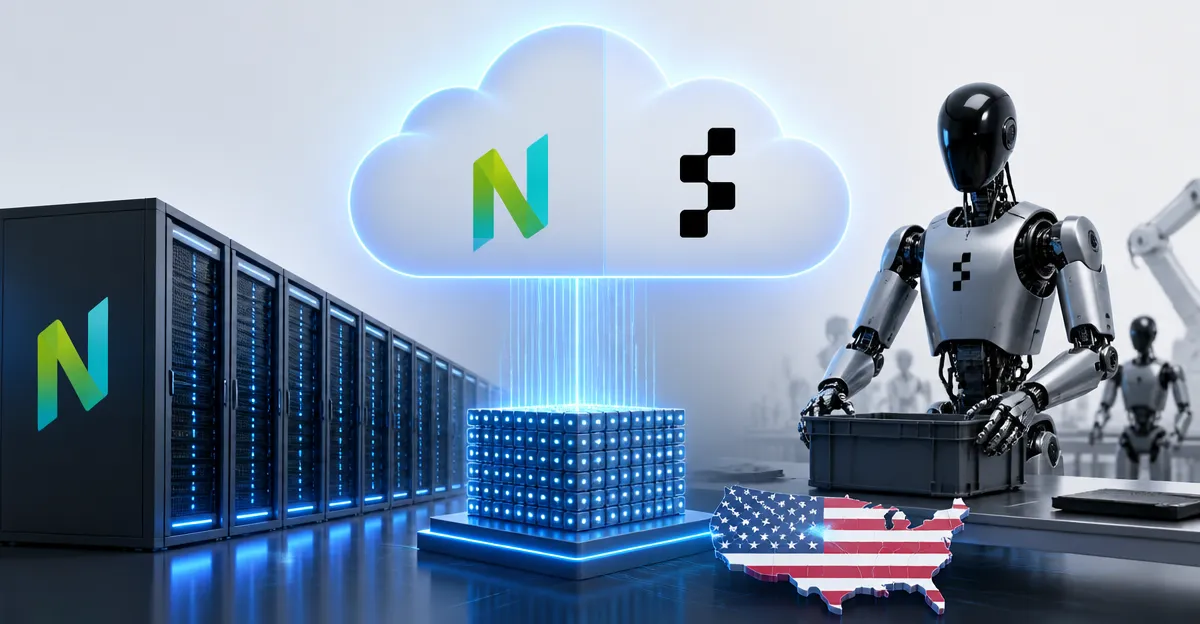
September 3, 2026, (Inside AI) — AI cloud firm Nscale has signed a multi-year agreement to supply compute resources for humanoid robotics company Figure. The deal initially commits $3.5 billion in compute capacity for developing Figure’s AI models and robots.
The partnership addresses one of the most pressing bottlenecks in advanced robotics: the massive computational power required to train embodied AI systems. Figure’s humanoid robots need continuous access to high-performance infrastructure for simulation, reinforcement learning, and real-time inference.
Nscale, a specialized AI cloud provider, has been expanding its footprint in the high-performance computing market. The company operates data centers optimized for large-scale AI workloads, positioning itself as an alternative to hyperscalers for AI-native startups.
Figure, founded in 2022, has raised over $700 million from investors including Jeff Bezos, OpenAI, Nvidia, and Microsoft. The company aims to deploy humanoid robots in manufacturing, logistics, and warehousing, with early pilots at BMW facilities.
The $3.5 billion compute commitment is not a cash payment but a reservation of cloud capacity over multiple years. This structure gives Figure predictable access to GPUs and other accelerators without upfront capital expenditure, a model increasingly common in AI infrastructure deals.
Industry analysts note that humanoid robotics requires orders of magnitude more compute than traditional industrial automation. Training a single robot policy can consume thousands of GPU-hours, and fleet-wide learning multiplies demand exponentially.
Nscale’s announcement comes amid a broader scramble for AI compute. Global data center capacity is projected to double by 2030, driven by generative AI and robotics workloads. Deals like this signal a shift toward long-term infrastructure partnerships rather than spot-market purchases.
The agreement also highlights the growing convergence of cloud computing and physical AI. Unlike software-only AI, robots must process sensor data, plan motions, and adapt to unstructured environments in real time, requiring low-latency edge and cloud integration.
Figure has previously used OpenAI models for language understanding and Nvidia hardware for simulation. The Nscale deal adds dedicated cloud capacity, potentially reducing dependency on any single provider.
Neither company disclosed the exact duration of the agreement or the specific hardware configurations involved. However, sources familiar with the deal say it includes access to next-generation GPU clusters optimized for embodied AI training.
The robotics sector has seen a wave of infrastructure investments this year. Competitors like Tesla Optimus, Agility Robotics, and Apptronik are also scaling compute-intensive development programs, intensifying competition for scarce AI accelerators.
Nscale’s commitment underscores a strategic bet that humanoid robots will become a major compute consumer. If Figure’s deployment targets are met, the partnership could expand beyond the initial $3.5 billion reservation.
For Figure, the deal removes a critical scaling constraint. The company has stated a goal of producing commercial humanoid robots at scale by 2027, a timeline that requires continuous model iteration and fleet data processing.
The agreement also reflects a maturing AI infrastructure market where specialized cloud providers compete on workload-specific performance rather than generic compute. Nscale has tailored its offerings for training large multimodal models and simulation-heavy robotics pipelines.
Financial terms beyond the compute commitment were not disclosed. The deal is structured as a usage-based reservation, with pricing tied to actual compute consumption over the contract period.
This partnership could serve as a template for other robotics companies seeking guaranteed compute access. As embodied AI moves from research to production, infrastructure reliability becomes as critical as model quality.
The announcement comes at a time when AI cloud providers are racing to secure long-term contracts with high-growth startups. Locking in customers like Figure provides revenue visibility and validates specialized infrastructure strategies.
For the broader AI ecosystem, the deal signals that humanoid robotics is transitioning from experimental to industrial-scale compute demand. The $3.5 billion figure, while not cash, represents one of the largest compute reservations in the robotics sector to date.