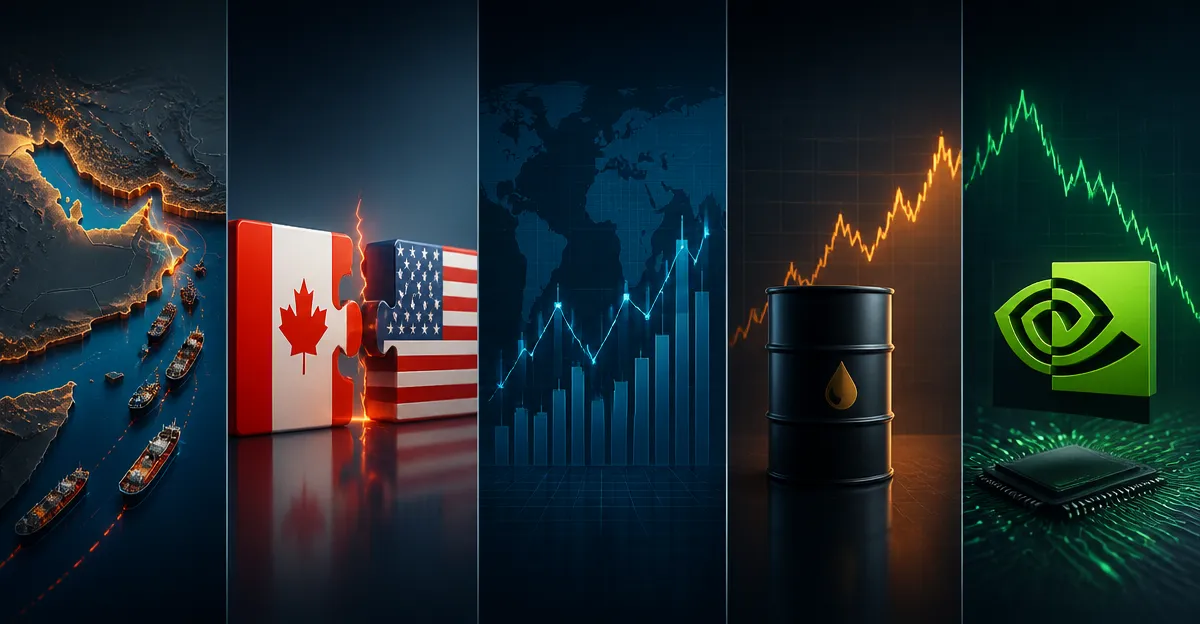
August 28, 2026, (Inside AI) — Nvidia’s latest quarterly report reveals a widening gap between its operational strength and its share price. The chipmaker posted strong second-quarter results and projected a 70% revenue jump for the next fiscal year, yet its annual stock performance remains underwhelming. This divergence underscores how much of the AI boom is already baked into valuations.
Investors now face a critical question: Can Nvidia’s fundamentals outpace the market’s lofty expectations? The company’s guidance suggests the AI infrastructure buildout continues at full throttle, but the stock’s muted reaction points to a deeper problem. The market has priced in perfection, leaving little room for error.
Nvidia’s results arrive amid a broader financial landscape marked by geopolitical strain and policy uncertainty. Oil exports through the Strait of Hormuz remain constrained six months into the Iran war, keeping energy markets on edge. Washington’s latest sanctions proved less disruptive than feared, and Oman-Iran negotiations raised hopes for a temporary shipping arrangement. But the conflict is hardening into a stalemate that could last well into 2027.
This energy gridlock has direct implications for inflation and central bank policy. At the Jackson Hole summit, new Federal Reserve Chair Kevin Warsh faces a delicate balancing act. He has urged the reintroduction of money-supply aggregates into policy analysis, reopening a long-dormant debate over monetarism versus inflation targeting. Yet money-supply growth is running above 5% annually, complicating any dovish pivot.
Meanwhile, the U.S.-Canada trade spat has flared up again. Washington slapped 50% tariffs on a range of Canadian imports and threatened similar action on autos. Ottawa vowed to retaliate dollar for dollar. If the dispute escalates, the ripple effects could extend well beyond North America, disrupting supply chains already strained by war and energy volatility.
Europe’s diesel forward curve tells a similar story of prolonged pressure. Traders expect fuel prices to remain elevated through 2027, reflecting confusion over energy flows from the Middle East and Russia. The market is bracing for a future where geopolitical tensions stay high, supply chains stay vulnerable, and key fuel products stay scarce.
For Nvidia, these macro headwinds are a double-edged sword. On one hand, AI spending remains resilient because enterprises view it as a strategic necessity, not a discretionary cost. On the other hand, persistent inflation and trade friction could eventually force companies to delay or scale back capital expenditures, including AI infrastructure.
The chipmaker’s challenge is not demand but valuation. Its forward price-to-earnings ratio remains elevated by historical standards, even after this week’s gains. Every quarter, Nvidia must prove that its growth trajectory justifies that premium. So far, it has delivered, but the margin for error is razor-thin.
What makes this moment different is the convergence of risks. Energy costs, trade policy, and monetary conditions are all moving in ways that could compress corporate margins. Nvidia’s customers, from cloud providers to automakers, face higher input costs and uncertain demand. If those pressures intensify, the AI boom could face its first real stress test.
Yet the company’s guidance suggests no slowdown in sight. The 70% revenue forecast implies that hyperscalers are still placing massive orders for GPUs and networking gear. The AI arms race shows no signs of cooling, even as the broader economy wobbles.
This resilience has a historical parallel. During the early days of cloud computing, Amazon Web Services grew rapidly even through economic downturns because enterprises saw it as a cost-saving tool. AI infrastructure, by contrast, is a cost-increasing investment. That distinction matters if budgets tighten.
For now, Nvidia remains the undisputed leader in AI silicon. Its CUDA software moat and next-generation architectures keep competitors at bay. But the stock’s underperformance relative to its earnings growth is a warning sign. The market is asking a simple question: What happens when the AI capex cycle peaks?
No one knows the answer, but the stakes are enormous. Nvidia’s market capitalization now rivals the GDP of major economies. A sustained pullback in AI spending would send shockwaves through the entire tech sector and beyond.
Investors will watch the next few quarters closely. If Nvidia continues to beat expectations, the stock could finally break out of its range. If it stumbles, the AI trade could unwind quickly. Either way, the gap between fundamentals and valuation will narrow, one way or another.