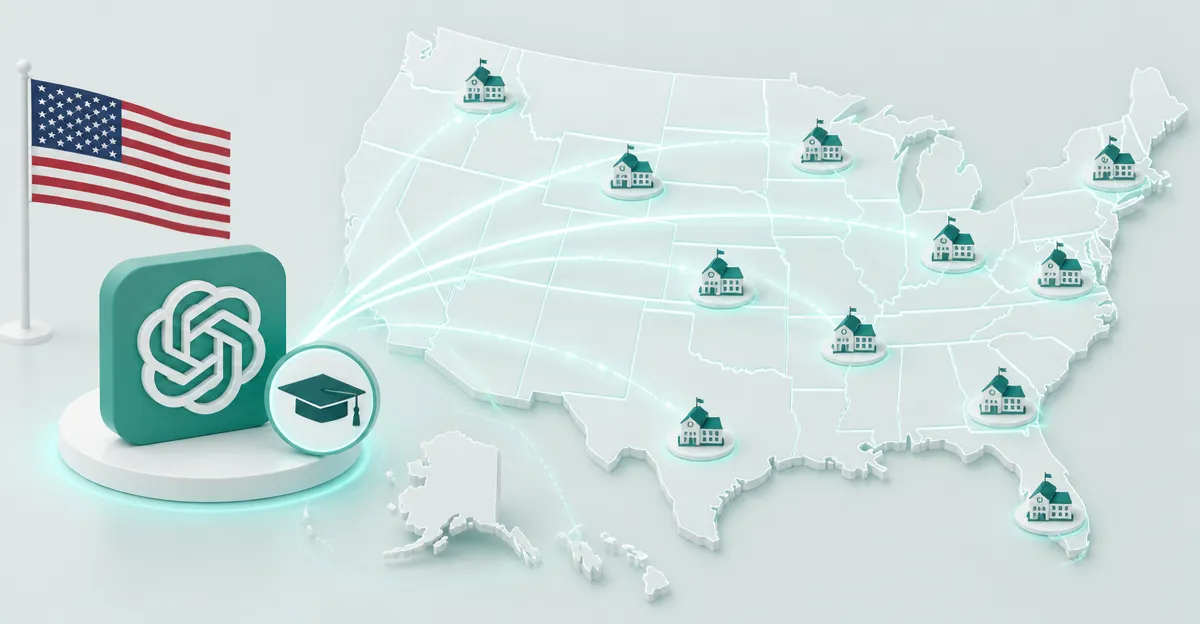
August 27, 2026, (Inside AI) — OpenAI is expanding its ChatGPT for Teachers program to 55 additional school districts across 20 states, adding more than 100,000 educators and staff. The move brings total reach to over 300,000 educators in more than 100 K-12 organizations across 30 states.
The expansion includes one in five of America’s 20 largest public school districts and some of the country’s most diverse school systems. A new 16-state National Data Privacy Agreement, a first for the industry, provides a common framework for districts to evaluate the tool against student data privacy requirements.
ChatGPT for Teachers remains free for verified U.S. K-12 educators through June 2028. It is available only to administrators, faculty, and educators, not students. Data shared in the workspace is not used to train OpenAI models by default, and district leaders can manage role-based controls to support FERPA compliance.
The program’s growth signals a shift in how school systems approach AI adoption. Instead of fragmented district-by-district negotiations, the multi-state privacy agreement offers a standardized path. This could accelerate responsible AI use in classrooms while easing procurement burdens for district leaders.
Read: Anthropic Launches Free Claude Access for US K-12 Teachers
Privacy Framework Aims to Cut Red Tape
The 16-state agreement covers Illinois, Iowa, Maine, Massachusetts, Missouri, Nebraska, New Hampshire, New Jersey, New York, Ohio, Rhode Island, Tennessee, Texas, Vermont, Virginia, and Washington. California is covered by a separate agreement. The framework uses the Student Data Privacy Consortium model, allowing districts to adopt ChatGPT for Teachers without negotiating individual contracts.
This approach addresses a key barrier for school systems: legal and privacy reviews can stall AI adoption for months. By aligning with existing state and local requirements, OpenAI is betting that simpler procurement will lead to broader, more consistent use.
“Education has always helped young people prepare for the world they’re going to inherit. In the age of AI, students need educators and schools that help them build judgment, confidence, and agency with these tools,” said Leah Belsky, Vice President of Education, OpenAI. “By partnering with educators, our goal is to give teachers time, training, and a community to learn from one another, and they help us build alongside the people who know students best.”
OpenAI’s shared implementation model includes hands-on training, peer learning across districts, and ongoing guidance. The company is also working with the American Federation of Teachers on a five-year initiative to equip 400,000 K-12 educators with practical AI skills.
Teachers Report Time Savings, But Questions Linger
An OpenAI analysis from January 1 to July 16 found educators sent more than 1.9 million messages related to time-saving tasks. That includes 900,000 about report cards and progress reports, 800,000 about lesson planning, and over 100,000 each about substitute plans and teacher-evaluation materials.
At summer AI Skills Jams, 93% of participants said they left with something they could use again, and 96% planned to apply what they learned within 30 days. Examples include a Fairfax music teacher creating a year-long planning resource and a Jonesboro fourth-grade teacher condensing lengthy lesson plans into focused 30- to 40-minute sessions.
Despite the momentum, some education researchers caution that AI tools must be evaluated for bias, accuracy, and impact on critical thinking. The privacy agreement does not address pedagogical quality or long-term effects on student learning. District leaders will need to pair adoption with clear guidance on when and how teachers should use AI.
New district partnerships include Baltimore City Public Schools, Fort Worth Independent School District, Frisco Independent School District, Los Angeles County Office of Education, and Virginia Beach City Public Schools, among others.