July 26, 2026, (Inside AI) — While headlines scream about mass layoffs, a quieter AI revolution is unfolding on Main Street. Small business owners aren't buying bots to fire workers—they're buying them to save their teams from drowning in paperwork, errors, and burnout.
The owner of a windows-and-doors company recently invested $10,000 in an AI application that listens to sales conversations and auto-generates quotes. "It allows my salespeople to talk to more customers and spend less time doing paperwork," he said. "And it cuts down on errors."
Another entrepreneur connected Claude to a repository of product specs, manuals, and technical sheets. Her customer-support team now queries the AI for instant answers, with plans to extend the tool directly to clients. These aren't isolated experiments—they signal a shift from last year's simple AI use cases (drafting emails, reviewing contracts) to real-world applications delivering measurable ROI.
The narrative that AI is a job killer ignores a stubborn reality: there simply aren't enough workers. The Department of Labor reports a 9% employment increase since mid-2021. Payroll processors like ADP, Gusto, and Paychex confirm continued hiring, especially among small firms. Gusto projects small businesses will hire 974,000 recent grads in 2026, up from 962,000 in 2025. With nearly 7.6 million job openings—most at small companies—owners view AI as a lifeline, not a layoff tool.
Demographics, Not Dystopia, Drive Adoption
The U.S. workforce is set to shrink dramatically over the next decade due to an aging population and falling birthrates. Immigration curbs further tighten the labor pool. Construction firms are desperate for workers; robots that can install dishwashers or fix HVAC systems remain years away and unaffordable for small shops. AI fills the gap, helping existing employees do more while older workers transition into retirement.
Historical patterns also undermine the unemployment panic. The tax code ballooned from a few dozen pages in 1913 to tens of thousands today, yet accountants thrive. Roles like social media manager, mobile app developer, and SEO specialist didn't exist 20 years ago. A recent surge in entrepreneurship suggests people adapt and seek purpose—not passive income checks.
Trust Deficit Slows Bot Takeover
Small business owners remain deeply skeptical of AI's reliability and privacy promises. They read about data breaches and models trained on proprietary information. They worry their pricing and costs could be exposed. Bugs, errors, and "hallucinations"—a term many dismiss as big tech's cover-up—breed caution. "There's a long way to go before business owners are going to let some bot process invoices, collect receivables, or interact with irate customers without human oversight," one observer noted.
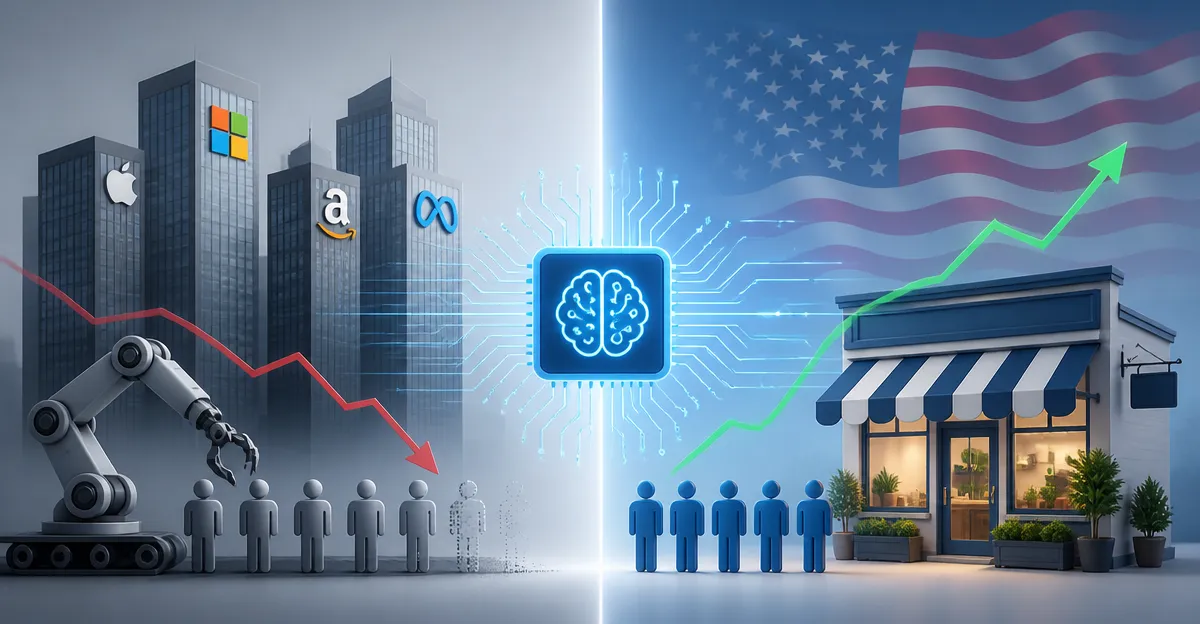
This trust gap explains why AI on Main Street augments rather than replaces. In a 20-person company, there's no corporate bloat—every employee is critical. AI helps staff handle more customers, reduce mistakes, and shift from survival mode to growth. Big corporations may use AI to trim PR, marketing, and IT departments, but small firms lack such slack. Their AI investments target time savings and margin protection, not headcount reduction.
Research supports this divergence. A National Bureau of Economic Research study found that AI adoption in small firms correlates with employment growth, not decline, as technology enables scaling without proportional labor increases.
Technology has always displaced some workers, and the AI boom will too. But the real story—the one worth watching—is how Main Street uses AI to save time, save margins, and save the employees it fought so hard to find.