July 14, 2026, (Inside AI) — Over 200 economists and AI researchers, including 16 Nobel laureates, issued an urgent open letter on Monday demanding immediate institutional action to address artificial intelligence’s potential to disrupt economies and displace workers on a massive scale.
The four-sentence statement, organized by Stanford University’s Digital Economy Lab, warns that AI could trigger an economic transformation surpassing the Industrial Revolution but compressed into a far shorter timeframe. It calls for building “incentives, guardrails, and institutions” to steer development toward human complementarity.
Signatories span academia and industry, with names from Anthropic, Google, and OpenAI joining Yoshua Bengio, a pioneering computer scientist and University of Montreal professor. The letter’s brevity belies its stark message: the window to shape AI’s trajectory is narrowing.
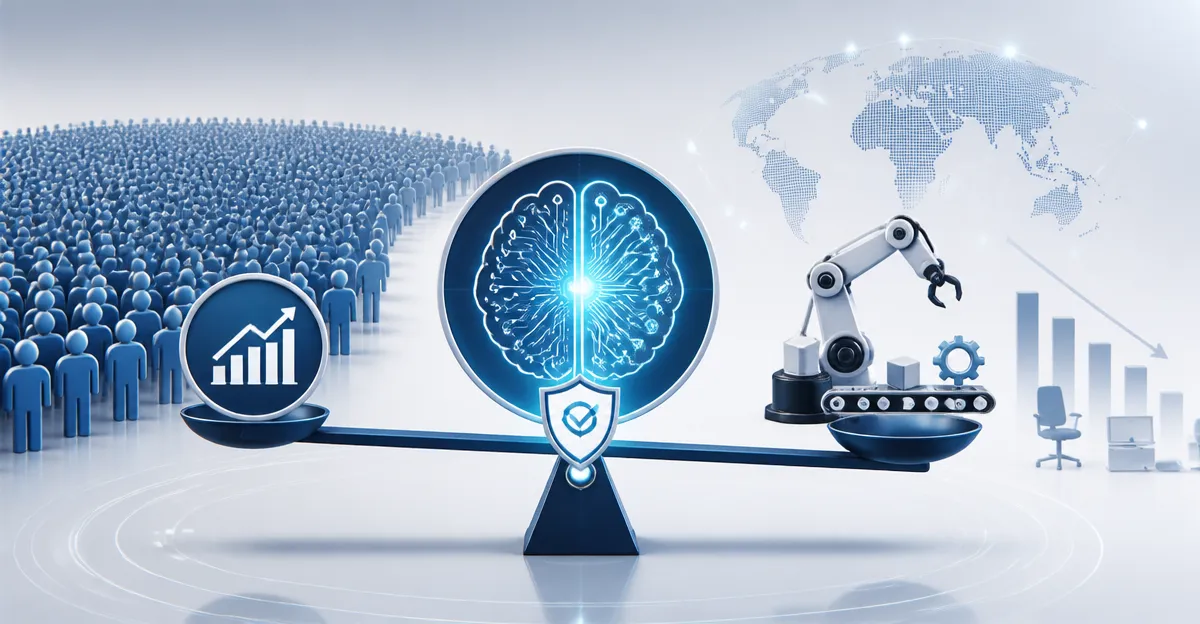
“AI may become radically more powerful over the next 10 years,” the letter states. “This could drive an unprecedented transformation of our economy, larger than the Industrial Revolution, but unfolding over a vastly shorter time frame. It could bring risks, including large-scale job displacement, as well as opportunities such as major gains in living standards.”
Bengio, in a separate statement, stressed the need for deliberate governance. “It is highly plausible that AI will drastically transform our economies,” he said. “We must be intentional and make collective, democratic choices, rather than letting market forces play out and risking leaving most citizens behind.”
The Speed of Disruption Outpaces Policy
The letter lands amid mounting evidence that AI’s labor impacts are already materializing. A 2025 OECD report found that 27% of jobs across member countries are in occupations at high risk of automation. Unlike past technological shifts, which unfolded over decades, AI’s integration is happening in years.
Economists point to generative AI’s ability to perform cognitive tasks once thought immune to automation. Goldman Sachs estimated in 2023 that 300 million full-time jobs globally could be exposed. The letter’s Nobel signatories—including Joseph Stiglitz and Christopher Pissarides—lend gravity to the call for preemptive policy.
Critics, however, note that similar warnings accompanied the rise of computers and the internet, yet employment ultimately grew. David Autor, an MIT economist who did not sign the letter, has argued that AI could augment workers rather than replace them, creating new roles. The letter’s focus on downside risks leaves little room for this nuance.
Still, the signatories’ institutional affiliations signal a shift. When researchers from the very companies building advanced AI join the call for guardrails, it underscores internal unease about the pace of deployment. Anthropic, known for its safety-first ethos, and OpenAI, which has publicly grappled with governance, both have employees on the list.
From Warning to Action: What Institutions Must Do
The letter’s demand for “institutions” echoes proposals from groups like the Partnership on AI, which advocates for a global observatory to monitor labor impacts. Some economists favor universal basic income trials or wage insurance. Others push for overhauling education to emphasize skills AI cannot replicate.
Historical parallels are instructive. The 1930s Great Depression spurred the creation of social safety nets that eased subsequent transitions. Today’s challenge is compressed: the letter implies that waiting for crisis is not an option. “We must act now,” it insists, without specifying who should lead.
Missing from the letter is a clear mechanism for accountability. Governments have been slow to regulate AI, and international coordination remains fragmented. The EU’s AI Act, fully enforceable by 2026, focuses on safety rather than economic disruption. The letter may amplify pressure on bodies like the G7 or ILO to fill the gap.
As AI capabilities advance, the economists’ plea is a race against time. Whether it translates into concrete policy or becomes another footnote in the long history of technological anxiety depends on the collective will they seek to summon.