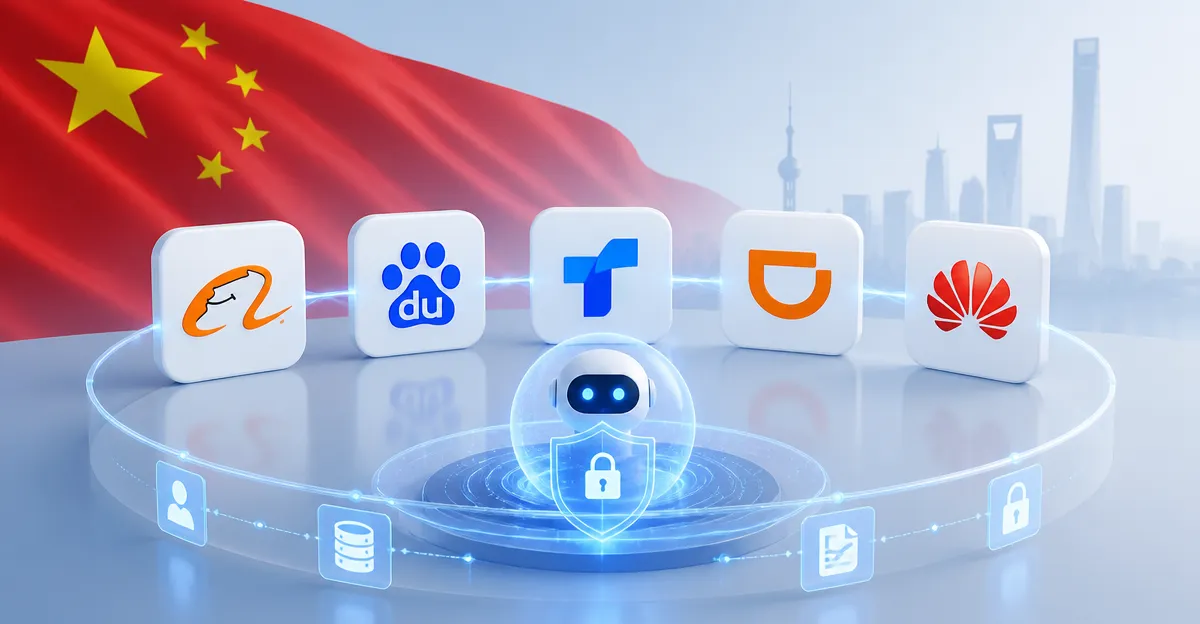
July 13, 2026, (Inside AI) — China’s biggest internet companies have signed a landmark self-regulatory pact to govern how AI agents handle personal data, as the technology rapidly expands across platforms.
The China Internet Association unveiled the agreement at a forum in Beijing, with Baidu, Tencent, Alibaba, Volcengine, and 27 other firms among the first signatories.
The pact sets standards for collecting, processing, and using personal information by AI agents—autonomous systems that act on behalf of users. A separate pact for mini-program ecosystems was also released, signed by Tencent, Ant Group, Baidu, and other platform operators.
The Data Privacy Imperative for Autonomous Agents
AI agents are moving from simple chatbots to proactive systems that book appointments, manage finances, and make purchases. This shift raises the stakes for data protection, as agents access sensitive user information across multiple services.
Read: China Bans AI Chatbots from Cultivating Emotional Dependence
Unlike traditional apps, AI agents often require broad permissions and continuous data access to function. The pact aims to curb misuse by enforcing transparency, user consent, and data minimization—principles already embedded in China’s Personal Information Protection Law (PIPL).
The association’s move reflects a global trend. The European Union’s AI Act and GDPR impose strict rules on automated decision-making, while the U.S. lacks comprehensive federal AI privacy legislation. China’s industry-led approach could serve as a test case for balancing innovation and rights.
Mini-Programs: The Hidden Data Frontier
The parallel pact for mini-programs—lightweight apps within super-apps like WeChat and Alipay—is equally significant. These ecosystems process vast amounts of personal data, often with less oversight than standalone apps.
Tencent’s WeChat alone hosts over 3 million mini-programs, handling transactions, health records, and identity verification. The new pact requires platform operators to audit data practices and ensure third-party developers comply with privacy standards.
Notably, ByteDance’s Volcengine joined the AI agent pact but was absent from the mini-program agreement. This hints at competitive dynamics, as ByteDance’s Douyin (TikTok’s Chinese sister) pushes its own mini-program ecosystem.
The pacts are not legally binding, but they carry weight in China’s regulatory environment. The Cyberspace Administration of China (CAC) often treats such self-regulatory frameworks as precursors to formal rules.
Read: 29 Countries Sign Agreement in Beijing to Form Global AI Cooperation Body
Industry observers note that compliance could become a market differentiator. Companies that fail to adopt the standards may face user distrust or exclusion from major platforms.
The association has not disclosed enforcement mechanisms, but signatories are expected to undergo periodic reviews. This mirrors the approach of the Internet Society of China, which has previously issued guidelines on algorithmic recommendations and deepfakes.
As AI agents become ubiquitous, the pact signals that China’s tech giants are preparing for a future where data stewardship is not just a legal requirement but a competitive necessity.