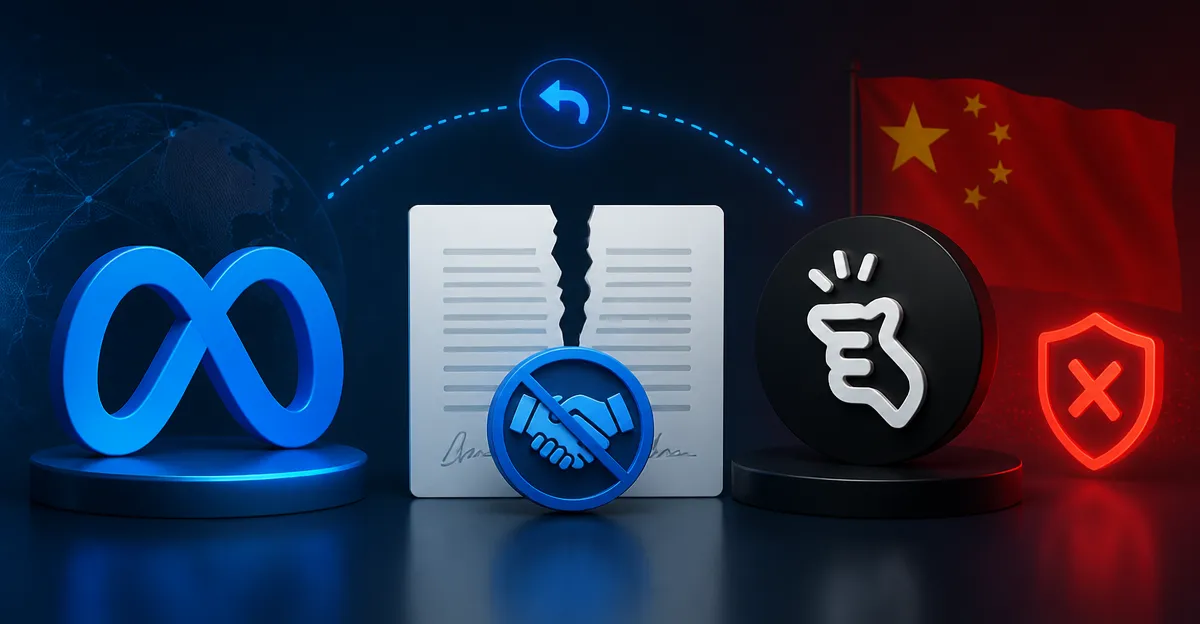
August 12, 2026, (Inside AI) — Meta Platforms is fully unwinding its acquisition of AI agent start-up Manus after Beijing blocked the deal on national security grounds more than three months ago. The reversal marks another high-profile decoupling between the US and China in artificial intelligence.
Manus told users on Tuesday it will delete data generated on or after December 29, the date Meta acquired the company, as part of a transition back to independent operations. Affected users must back up data by August 23; others can continue using the service without disruption.
The deletion is needed “to comply with regulatory requirements in specific parts of the world,” the note said, without naming the requirements. The move underscores the growing weaponization of data sovereignty in cross-border tech deals.
Regulatory Friction Reshapes AI M&A
Meta’s failed US$2 billion acquisition of Manus, founded in March 2025, highlights how national security reviews are increasingly scuttling AI deals. Manus is an AI agent platform that autonomously executes tasks like browsing the internet and writing reports — a technology with dual-use potential that alarms regulators.
Beijing’s block came amid a broader crackdown on foreign control of sensitive data and algorithms. China’s Cyberspace Administration has tightened rules on cross-border data transfers, while the US has used CFIUS to kill Chinese AI investments. The standoff leaves firms like Meta caught between two regulatory regimes.
The unwind forces Manus to purge user data generated under Meta’s ownership, a costly and technically complex process. For Meta, it’s a strategic setback in the race to deploy autonomous AI agents at scale. The company had planned to integrate Manus’s technology across its family of apps.
Data Deletion as a Geopolitical Tool
The forced data deletion reveals how regulators now treat user data as a national asset. Manus’s note did not specify which jurisdictions demanded the purge, but experts point to China’s Personal Information Protection Law and the EU’s GDPR as likely drivers. Both laws give regulators power to order data erasure after a change in control.
This is not the first AI deal undone by geopolitics. In 2023, the UK forced a Chinese investor to sell its stake in a semiconductor firm. The Meta-Manus collapse follows a pattern where AI startups with cross-border roots face existential risks from regulatory vetoes.
For Manus, independence means rebuilding trust and infrastructure without Meta’s resources. The start-up must now convince users its platform is secure despite the data wipe. Industry analysts say the episode will chill future AI acquisitions, as buyers demand clearer regulatory pre-approvals before closing deals.
The unwind also raises questions about the fate of joint AI research between the two nations. Collaborative projects on AI safety and standards may stall as governments erect higher barriers. Meanwhile, both the US and China are racing to develop domestic AI agent platforms, further bifurcating the global AI ecosystem.