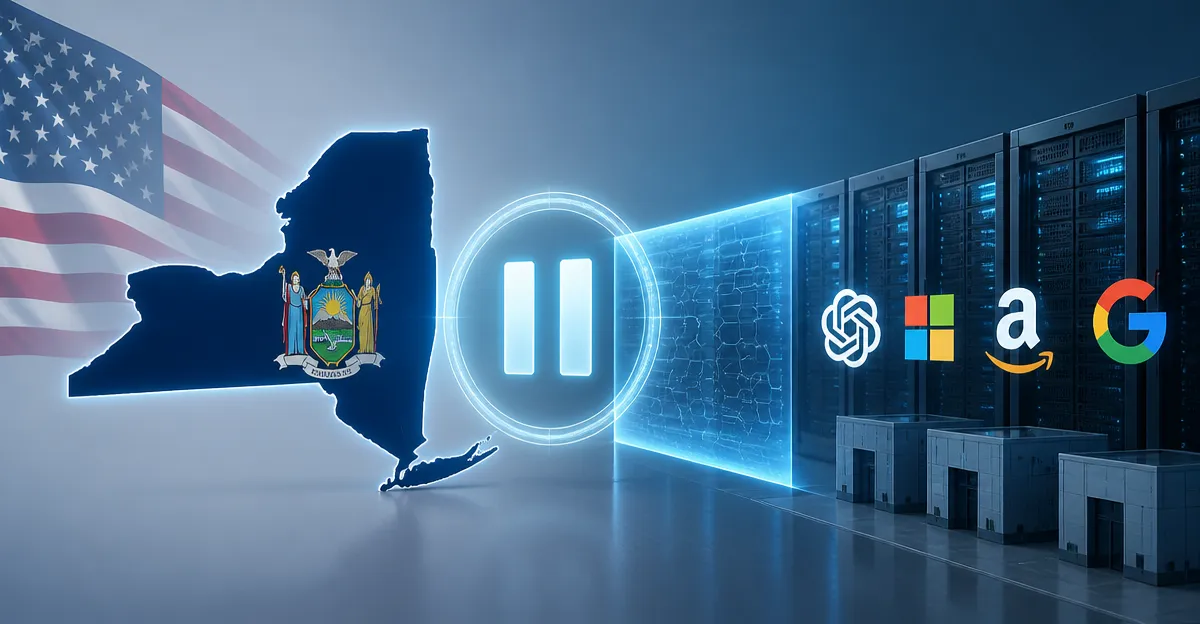
July 14, 2026, (Inside AI) — New York has become the first U.S. state to impose a one-year moratorium on new hyperscale AI datacenters. Governor Kathy Hochul issued an executive order Tuesday halting permits for facilities exceeding 50 megawatts, citing threats to utility bills, natural resources, and community stability.
The pause, effective immediately, freezes state-level approvals while regulators craft standards addressing energy demand, water consumption, and environmental impacts. It marks a watershed moment in the escalating national debate over the hidden costs of the AI boom.
Hochul, a Democrat, framed the move as a protective measure for residents. In a statement, she said:
“As data center development threatens to hike up utility bills, deplete our natural resources, and create uncertainty for New Yorkers, it’s my responsibility to take action and lead.”
The executive order targets “hyperscale” datacenters—massive server farms that underpin modern AI systems. These facilities consume vast amounts of electricity and water, often straining local grids and aquifers. New York’s order directs agencies to study cumulative impacts before any new construction can proceed.
The move comes amid surging public opposition. A recent Heatmap poll found that nearly three-quarters of Americans oppose a datacenter project near their home. In New York, a June Siena Research Institute survey showed 46% of residents supported a moratorium, while only 21% opposed it.
More than a dozen states have considered similar pauses. Maine’s legislature passed a moratorium, but its governor vetoed it in April. At the local level, a small Southern California city enacted a construction ban last month, followed by Seattle—the largest municipality to do so. New York’s statewide order, however, is unprecedented in scope.
The state legislature had already approved a moratorium bill with broader provisions, including labor and transparency standards. Hochul has not yet signed that legislation, but its author, State Senator Kristen Gonzalez, endorsed the executive order. Gonzalez stated:
“With this executive order, Governor Hochul is protecting everyday New Yorkers with a first in the nation moratorium on new large data centers. By giving our state time to plan, we can ensure that development and innovation do not come at the expense of all of us.”
The order reflects a growing tension between economic development and environmental stewardship. Datacenters are critical to AI advancement, but their physical footprint is immense. A single hyperscale facility can use as much power as a small city and millions of gallons of water daily for cooling. In drought-prone regions, this has sparked fierce resistance.
Industry groups warn that moratoriums could slow innovation and cede competitive advantage. Yet environmental advocates argue that unchecked growth risks permanent damage. New York’s pause buys time to craft guardrails—potentially a model for other states grappling with the same dilemma.
While the order halts new permits, existing datacenters and those under construction are unaffected. The state’s regulatory review will likely examine grid capacity, renewable energy commitments, and water recycling mandates. Any future standards could reshape how tech giants like Google, Microsoft, and Amazon expand their AI infrastructure in the Empire State.
The national appetite for datacenter regulation shows no sign of abating. As AI adoption accelerates, the physical costs of digital progress are becoming impossible to ignore. New York’s executive order may be the first of many such interventions.