September 23, 2026, (Inside AI) — Pune will deploy more than 10,000 police personnel and a layered AI surveillance network for the Ganesh idol immersion procession on September 25, the final day of the festival that began on September 14. Police Commissioner Amitesh Kumar outlined the plan on Wednesday, calling crowd safety the department's central priority rather than the speed of the procession itself.
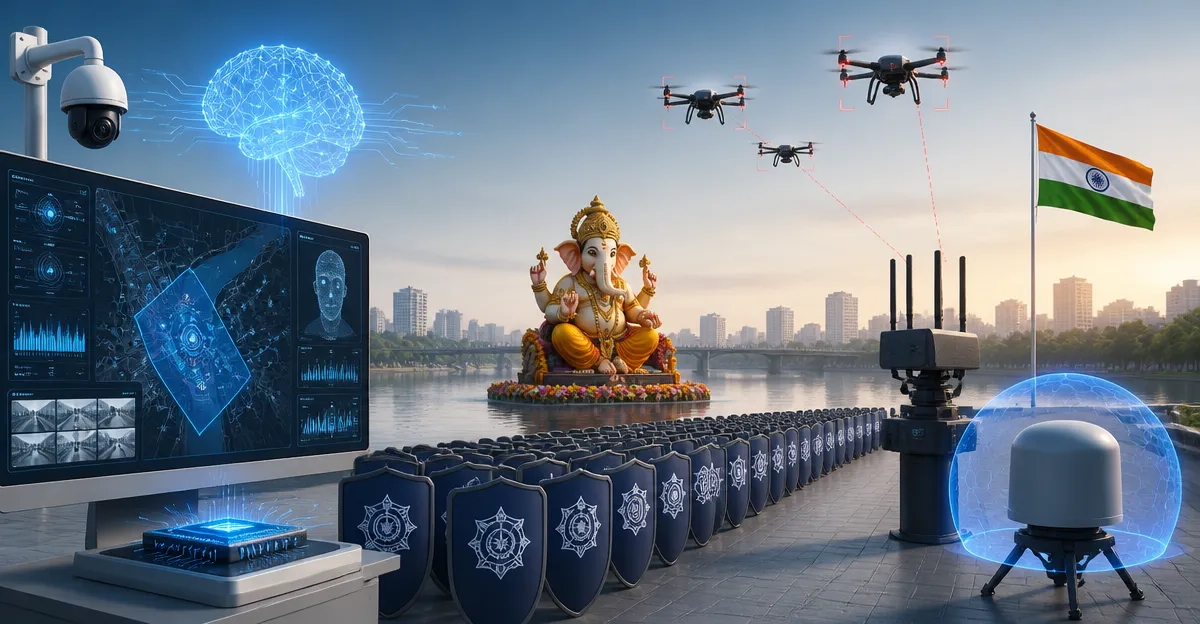
The operation combines facial recognition, AI video analytics, drone monitoring, anti-drone countermeasures and GPS tracking of participating mandals. A dedicated war room at Faraskhana police station will coordinate with the Integrated Command and Control Centre at Police Headquarters in Shivajinagar, giving commanders a live view of processions as they move through central Pune's crowded corridors.
More than 3,500 cameras will feed the centralised monitoring system, including coverage of immersion points. The fixed-camera grid will be supplemented by five Mobile Surveillance Vehicles and 19 Mini Surveillance Vehicles equipped with high-definition cameras, AI analytics and public-address systems. Live feeds from Metro stations, PMC Smart City systems and Ganapati mandal CCTV networks will widen the monitored area beyond the main procession routes.
AI Analytics Meets Traditional Policing
The AI layer is designed for detection rather than mere recording. Video analytics will flag unusual activity, including possible weapons, abandoned objects, violence, fire or smoke. Facial recognition will help identify persons matching criminal records held by police. The system also supports intelligent video searches and automated incident detection, functions that shift surveillance from passive monitoring to active alerting.
Read: California AI Safety Executive Order
Kumar framed the technology as an extension of manpower, not a replacement for it. "The extensive manpower deployment, backed by centralised monitoring, AI analytics, facial recognition, CCTV, drones, mobile surveillance, GPS tracking and multiple communication systems, is aimed at giving the police real-time situational awareness during one of the city's largest annual public gatherings," he said.
Drone surveillance adds an aerial layer. Micro and small-category drones with HD cameras and public-address speakers will monitor crowd movement, rooftops and emergencies. At strategic locations, police will deploy anti-drone systems to detect and counter unauthorised drones over crowded and sensitive areas.
"Drone surveillance will provide an aerial layer to the security arrangements. Micro and small-category drones equipped with HD cameras and public-address speakers will be used to monitor crowd movement, rooftops and emergencies. At strategic locations, police will also deploy anti-drone systems to detect and counter unauthorised drones over crowded and sensitive areas," Kumar said.
Ground coordination relies on 100 wireless communication sets and 400 walkie-talkies, with Wi-Fi networks established at critical locations. An IP-based public-address system at more than 250 locations will let police issue real-time announcements, directions and emergency instructions to crowds.
Traffic enforcement will use Automatic Number Plate Recognition to detect wrong-way driving, triple riding, illegal parking, footpath encroachment and overspeeding, with alerts routed to designated personnel. Anti-sabotage measures include 30 door-frame metal detectors and 100 hand-held metal detectors at important installations, entry points, mandals and procession routes. Around 120 calibrated noise-level meters and one fixed monitoring station at Alka Chowk will track noise violations.
GPS tracking of Ganapati mandals will provide real-time information on their location, movement and halts. "Another technology-based measure is GPS tracking of Ganapati mandals, providing real-time information on their location, movement and halts. This will help the police track the progress of processions and coordinate deployment," Kumar said.
Read: Senate AI Safety Legislation
The scale of participation explains the caution. Kumar said meetings were held with five Manache Ganpati mandals and other prominent groups. "We have held meetings with five Manache Ganpati and other prominent mandals in Pune. 267 Mandals on Laxmi Road, 231 on Tilak Road, 50 mandals on Kumthekar Road, and 79 on Kelkar Road -- over 600 Mandals will participate in the main immersion procession in Central Pune. Like I said last year, how long the procession takes to conclude or how fast it concludes is not the key priority for Pune Police. For us, the priority is crowd management, safety of Ganesh devotees and Ganesh mandals, and peaceful conduct of the processions," he said.
A 24x7 Dial-112 helpline desk staffed by trained personnel will handle emergency calls, while social media monitoring will track suspicious activity, threats and misinformation.
Pune's approach mirrors a broader pattern in Indian cities, where festival security has become a proving ground for AI-assisted public safety. Similar systems have been tested during the Kumbh Mela and at large railway stations, though independent audits of accuracy and false-positive rates remain rare. Privacy advocates have repeatedly raised concerns about facial recognition in public gatherings, noting that legal safeguards lag behind deployment. Pune police have not published data on how many identifications the system produced during previous festivals or how many were verified as correct.
For now, the department is betting that real-time situational awareness will prevent the kind of crowd incidents that can turn a religious procession into a tragedy. Whether the technology delivers on that promise will be measured on September 25, when more than 600 mandals and thousands of devotees converge on central Pune's streets.