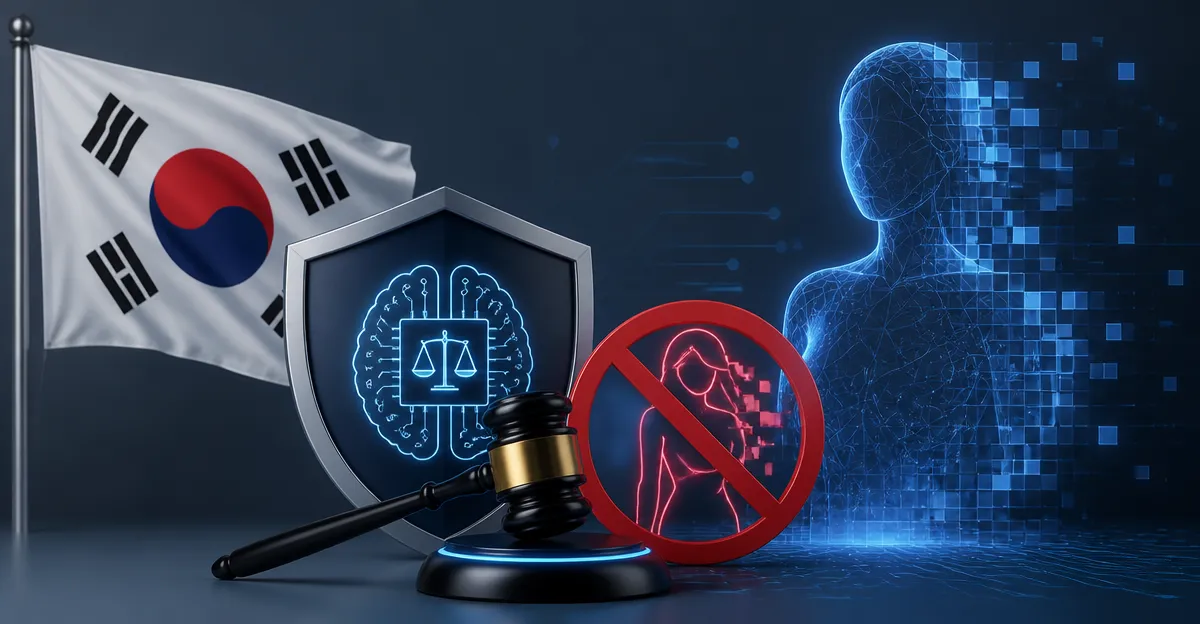
August 11, 2026, (Inside AI) — South Korean lawmakers are racing to criminalize AI-generated sexual content featuring entirely fictional personas, after a court ruling exposed a startling gap in the country’s legal framework. The push follows the acquittal of a man who distributed deepfake nude images in a Telegram chat room, because prosecutors could not prove the images depicted real people.
The case, decided last August by the Uijeongbu District Court, hinged on a simple yet profound question: can a virtual victim be a victim under the law? Judge Lee Jung-hoon said no, citing a lack of evidence that the images were of actual individuals.
“There is no material confirming the origin or synthesis method of the image, making it difficult to conclude that a real person was depicted,” Lee Jung-hoon, Uijeongbu District Court.
The ruling meant the defendant walked free, despite prosecutors seeking up to seven years in prison or a fine of 50 million won (roughly US$35,341). The verdict sent shockwaves through advocacy groups and political circles, who warned that existing laws are impotent against the rising tide of AI-generated sexual exploitation.
Read: San Francisco Demands Apple and Google Remove AI Nudify Apps
In response, Representative Huh Young and nine other members of the ruling Democratic Party of Korea introduced a bill that would explicitly ban the creation, distribution, and possession of sexually explicit AI material, even when no real person is depicted. The proposal has been referred to a subcommittee of the National Assembly’s Legislation and Judiciary Committee for detailed review.
“Rapid advances in AI have made it easy for anyone to create images of virtual people that are difficult to distinguish from real individuals,” the legislators said in the proposal.
“However, the technology has also been misused to produce and distribute manipulated sexual content that causes sexual humiliation or disgust, which is emerging as a serious social problem.”
The bill marks a significant shift in legal thinking. Traditionally, laws against image-based sexual abuse require a real, identifiable victim. South Korea’s existing statutes, including the Act on Special Cases Concerning the Punishment of Sexual Crimes, focus on the harm to actual people. The new proposal would recognize that entirely synthetic imagery can still inflict societal harm and fuel a culture of exploitation.
Global patchwork of laws struggles with synthetic abuse
South Korea’s legislative scramble mirrors a global struggle. The United Kingdom’s Online Safety Act, passed in 2023, criminalizes the sharing of deepfake intimate images without consent, but its scope around purely fictional characters remains untested. In the United States, a federal deepfake revenge porn law has been proposed but not enacted, leaving a patchwork of state laws. Virginia and California have criminalized non-consensual deepfake pornography, yet most states do not address entirely fictional depictions.
Legal scholars argue that South Korea’s proposed law could set a precedent by decoupling the crime from a specific victim. “This is about moving from a harm-to-person model to a harm-to-society model,” said Dr. Min-ji Kim, a cyberlaw professor at Seoul National University, in a recent interview. “It acknowledges that AI-generated abuse material can normalize sexual violence and create a hostile environment, even without a real person in the image.”
Read: Minnesota Defends AI Nudification Ban Against xAI Lawsuit
Critics, however, warn of overreach. Some digital rights groups caution that banning fictional AI porn could chill artistic expression or lead to censorship of legitimate adult content. The bill’s language will need to carefully define what constitutes “sexually humiliating or disgusting” material, a term that could be subject to broad interpretation.
Tech platforms face mounting pressure
The case also puts pressure on platforms like Telegram, which has been a hotbed for deepfake distribution in South Korea. In 2024, the Korea Communications Standards Commission reported a 300% increase in requests to remove AI-generated sexual content compared to the previous year. Telegram’s encrypted nature makes enforcement difficult, and the company has historically been slow to cooperate with local authorities.
Meanwhile, AI detection tools are struggling to keep pace. Researchers at the Korea Advanced Institute of Science and Technology (KAIST) recently developed a forensic tool that can identify synthetic images with 92% accuracy, but the technology is not yet widely deployed by law enforcement. The bill may include provisions mandating platforms to use such detection systems or face penalties.
As the National Assembly deliberates, the acquittal stands as a stark reminder of how technology outpaces the law. For now, the creation of AI-generated sexual imagery of fictional characters remains legal in South Korea—a loophole that lawmakers are determined to close before the next case emerges.